
The Skill of an Unknown Photographer: More on the ALB Group Portrait
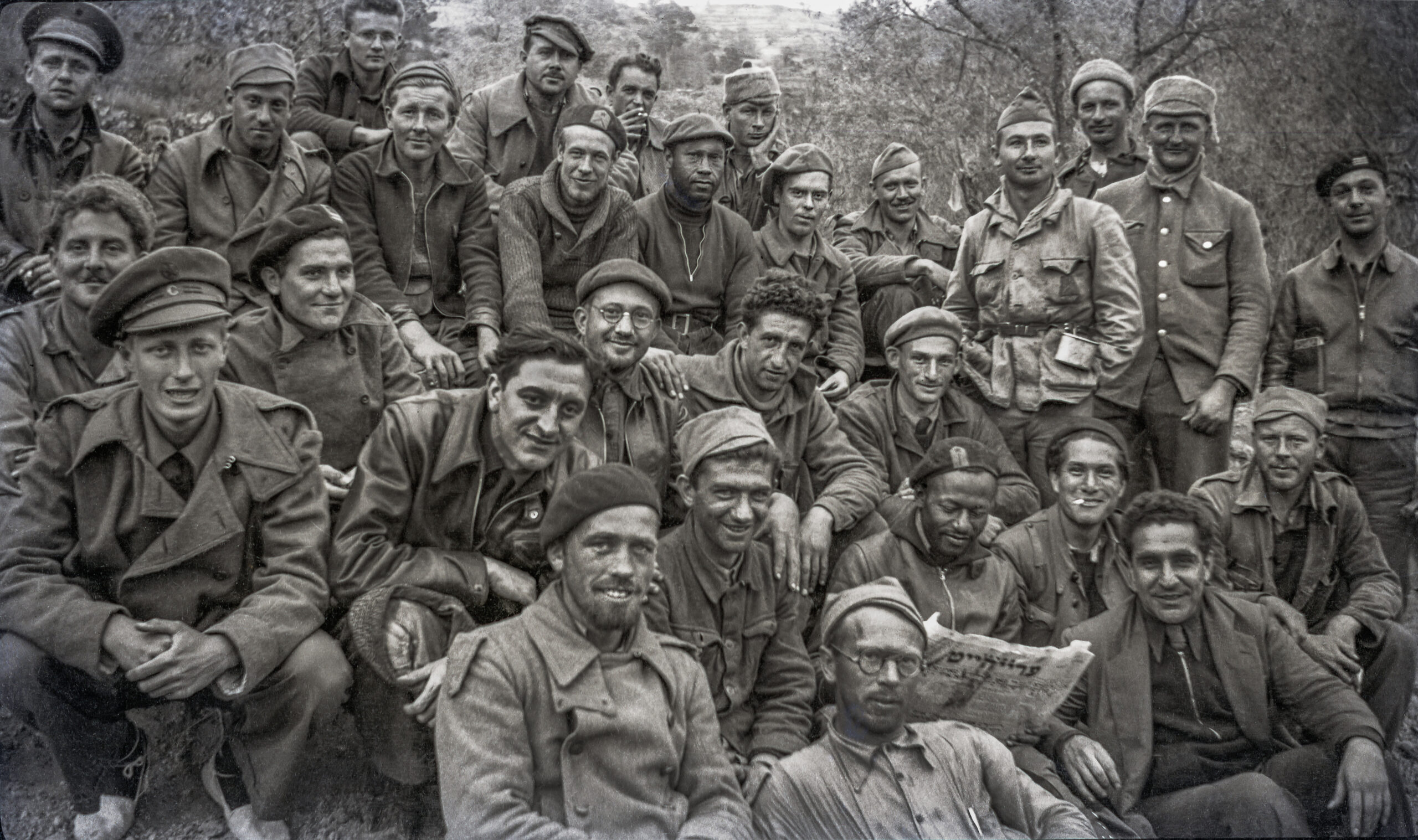
Tamiment Library, ALBA.PHOTOS.010 Box 3, Folder 8. Enhanced by David Bacon.
David Bacon has been drawn to the iconic group photograph of Lincoln Brigade volunteers from the moment he first saw it. So when The Volunteer ran a piece on the discovery of the negative and the circumstances under which it was shot, he got inspired to do further research—and to enhance the picture.
I grew up with the history of the International Brigades; I could sing the words to “Los Cuatro Generales” before I knew Spanish—and “Freiheit” without knowing German. I was very moved, therefore, when I first saw the group photograph of IB volunteers taken after the battle of the Ebro, enough so that I made a rough copy that I taped on the wall where I work. As a photographer, I saw and admired the skill with which it was taken. The more I looked at it, the more I felt drawn to this image.
It could have been just a picture of uniformed men in stiff poses, taken for official purposes. What makes it remarkable is that it’s anything but that. From the commentary by Sebastiaan Faber we know that it was taken during a visit by Joe North, the Daily Worker reporter, and John Little, executive secretary of the Young Communist League. Their presence, at the center of the image, makes it likely that its purpose was to memorialize the visit—probably to accompany an article in the Volunteer or in the Daily Worker back in New York.
But it is a photograph of relationships, as much as a picture of an occasion. This is evident first in the relaxed way the men hold themselves, whether they’re sitting or standing. They are physically bunched together, many touching and some leaning on each other. Even the ones standing are close. They’ve been through a terrible, traumatizing battle and have confidence in each other. They had each other’s backs. North and Little want to be part of this. They hunker down to share in this relationship that already exists.
The soldiers’ uniforms are not all alike. Most wear overcoats, no doubt because it must have been very cold. Some are neater than others. But there’s no obvious indication of rank. Instead, we get a feeling that these men see each other as equals. It doesn’t undermine the discipline they must have had to survive, but there’s an atmosphere of confidence in each other. This is especially important because the photograph includes two Black soldiers and was taken in an era of intense racism back home. Joe Taylor abstracts himself by holding a newspaper [the Frayheyt (פֿרײַהײט), as Joe Butwin notes], looking at it rather than at the camera. Marcus Ransom looks directly at the lens, as do the two men on either side of him. There is a difference between the two, but also between them and their comrades. But those differences don’t separate them.
The photographer framed the photograph carefully. A bit of the countryside is evident, enough to establish that the image is taken outside and not in a specifically military environment. The frame of the photograph adheres tightly to the group on either side. The men in front are cut off so that their legs don’t appear. The use of a wide-angle lens allows the inclusion of everyone. But this comes at a cost: the faces of those at the back appear smaller. Yet thanks to the skillful use of light and a small enough aperture, each face is rendered sharply, regardless of its distance from the photographer.
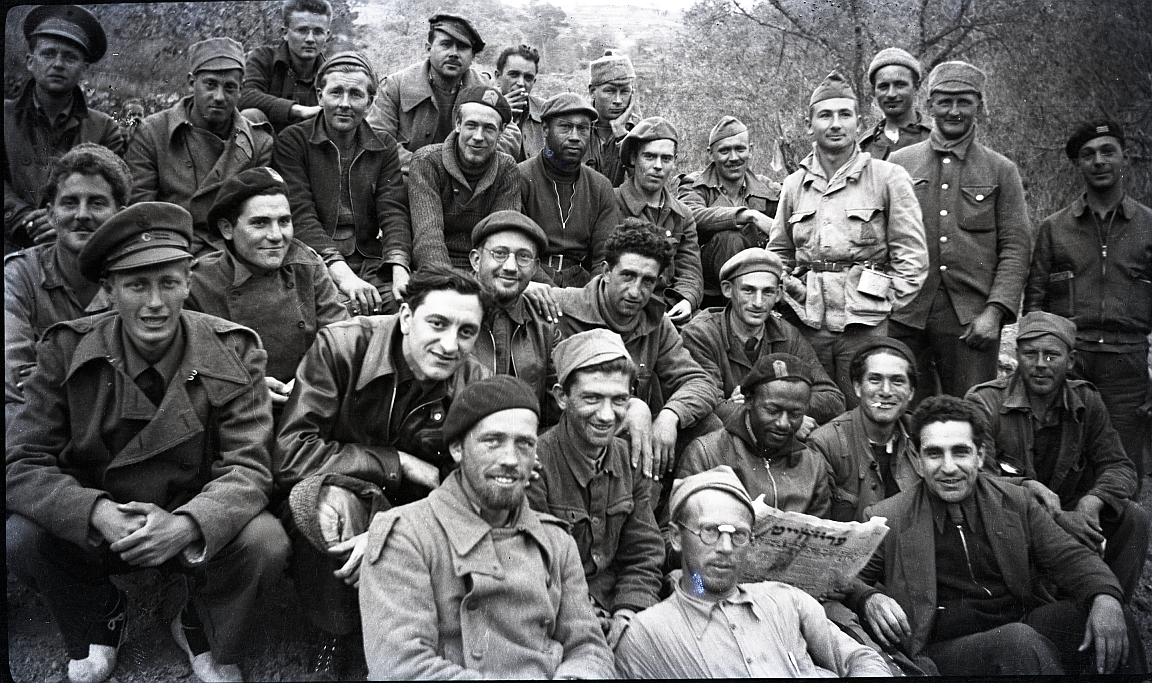
Tamiment Library, ALBA.PHOTOS.010 Box 3, Folder 8.
Still, the lens and camera impose other limitations that create problems in reproducing the image. The biggest issue is that the light is strong on the figures in the middle and then tapers off quickly at the edges. This means that it’s hard to see the details in the faces and clothes of Lenny Lamb on the right and Howard Goddard on the left. Without notes from the photographer, we can only guess at the light source used. Since the photograph was taken outside, the natural light would clearly be one source. But possibly the photographer used a reflector, or even some kind of flash, that concentrated light into the figures in the middle.
What camera and what film the photographer used, we do not know. Edwin Rolfe was undoubtedly the person who would have had the most immediate use for the photograph, in The Volunteer. Faber tells us he edited the paper and joined the group at the front in mid-April. Possibly he arranged to be present with Little and North to document their visit. But he certainly didn’t take the photograph, given that he’s in it. Perhaps there’s a record somewhere of the photographer’s identity. It would be good to know.
Trying to understand the image as best I could, I decided to make a small contribution to solving some of its technical problems. I asked Sebastiaan to send me the original scan of the film, made by the librarians at Tamiment. It is a high-quality scan made at a high resolution, 7201×4271 pixels. My two goals were to overcome the scratches and defects in the negative and to control the contrast enough so that detail could be seen in the figures at the edge of the image without compromising those at the center.
Photoshop, fortunately, has very powerful tools for fixing defects. There were many hairline scratches, some apparent holes in the negative, and other artifacts of unknown origin. Looking at the negative at 300% and 400% magnification, I used the spot healing tool to eliminate the scratches and holes. It was laborious and time-consuming, but the image came out much cleaner. To control the contrast, I opened the scan in Camera Raw, a subsidiary program of Photoshop, and reduced the intensity of both highlights and shadows. Then I increased the exposure level to compensate. That equalized to a great extent the difference between the dark figures at the edges and the bright ones in the middle. I did have to mask some of the faces to keep them from losing their detail. Finally, I applied a general sharpening tool very lightly to compensate for the impact of the scanner itself.
I hope that the result is what might have been possible in the hands of a skilled photographer in the darkroom of The Volunteer. It is amazing to think that the photograph was exposed and then developed under the very difficult conditions that existed during the war. It is a tribute to the skills of the worker, or workers, who produced such a fine image. It is also a tribute to the courage of the volunteers—and the commitment of North and Little. They inspired this work and gave it its political content.
David Bacon is a California-based writer and photographer. He was a factory worker and union organizer for two decades with the United Farm Workers, the United Electrical Workers, and other unions, and has been documenting the lives of farm workers through photographs and journalism since 1988.






