
Lene Schneider-Kainer Sheltered German Refugees in Republican Spain—Until She Had to Flee Herself
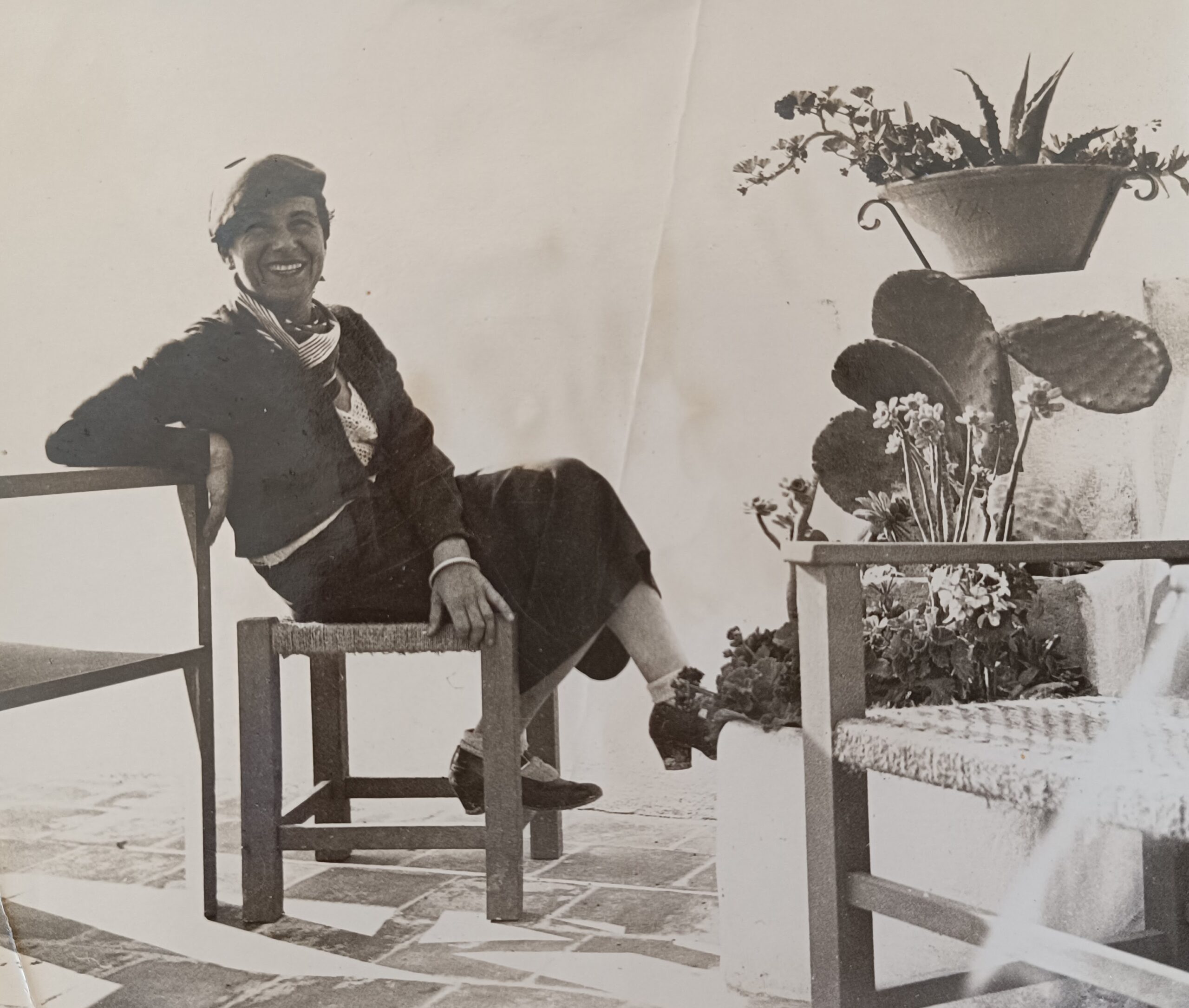
Lene Schneider-Kainer on Ibiza, ca. 1934. Photographer unknown. Courtesy of Anne Berthelot and Gesche Kainer.
Ca-Vostra, a bar-hotel in the historic center of Ibiza Town that the Austrian painter Lene Schneider-Kainer opened in 1933, served for years as a refuge for artists and intellectuals fleeing Nazism—until she herself was forced into exile. Sol Izquierdo reconstructs a remarkable life.
Born into a Jewish bourgeois family in Vienna in 1885, the painter Lene Schneider-Kainer was educated in Munich and Paris. Around 1910 she settled in Berlin, where she frequented the radical Expressionist circles associated with the magazine Der Sturm; her portrait of the famous Jewish poet Else Lasker-Schüler, now on display at the Jewish Museum in Berlin, dates from that period. In 1926 she divorced and embarked on a two-year expedition through Asia to travel the legendary Marco Polo route alongside the journalist Bernhard Kellermann. She returned with paintings, drawings, photographs, and even a film shot in Persia. She also acquired a vast collection of sculptures and handicrafts. Back in Germany, she published her paintings from the trip in newspapers and magazines and held numerous exhibitions. But when Hitler’s rise to power led to a decline in her commissions and a growing threat to her life, she decided to move to the Balearic Islands and buy a house in Dalt Vila, in the walled upper part of the city of Ibiza, which she turned into the Ca-Vostra hotel.
In the spring of 2023, I traveled to Mallorca to meet the sculptor Anne Berthelot, Schneider-Kainer’s grandniece, to learn more about the period the artist spent in the Balearic Islands. Anne is the daughter of Robert Berthelot, a Frenchman, and Vera Schenk, a Viennese woman and niece of Lene Schneider-Kainer—both of whom were also artists. She welcomed me into her home in Cala d’Or (Mallorca) on a sunny March morning. Sitting in her garden, over ginger and honey tea, she began to tell me about her great-aunt’s life. The garden, which borders the Mediterranean, is filled with her stone sculptures; inside the house, her mother’s ceramic pieces and her father’s murals decorate the rooms. The house was originally built as part of the historic Cala d’Or development, founded in the early 1930s by the Ibizan gallery owner and caricaturist Josep Costa Ferrer and a group of European artists, among whom was Schneider-Kainer. The house was designed “in the Ibiza style,” with simple, white geometric shapes, reflecting the taste for modern architecture with utopian overtones, and was named Casa Lene. In addition to her memories, Anne shared some letters, old photographs, and a document essential for reconstructing Schneider-Kainer’s activities in Ibiza: the guestbook of the Ca-Vostra hotel.
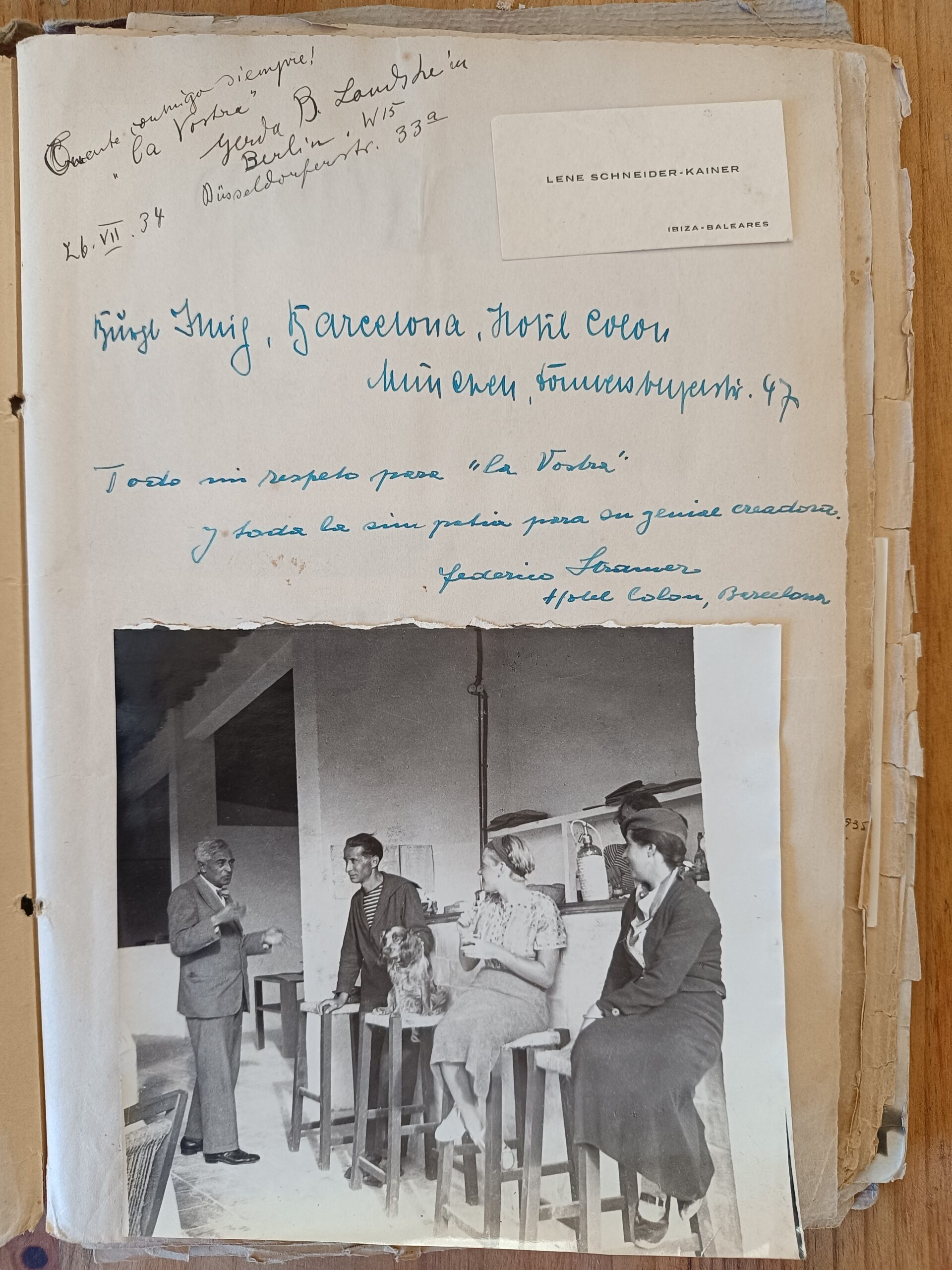
First page of the Ca Vostra visitors’ book, 1935. Courtesy of Anne Berthelot and Gesche Kainer.
This book contains entries, signatures, and photographs that document the identities of the people who stayed at the hotel and their experiences on the island. The messages, written in at least five different languages, reveal the cosmopolitan atmosphere of the time, as well as the pleasant experience of the visitors, who, in their notes, praised the hostess’s work and her various roles as “friend, hostess, artist, advisor, and collector.” Along with numerous anonymous guests, the book’s pages have allowed me to identify several figures who had fled Germany, including the writer and journalist Bernhard Kellermann, the photographers Sibylle von Kaskel and Florence Henri, the dancer Eva Tay, and the ski champion Hans Teichner, who later defended the Spanish Republic. Their presence at the hotel is intertwined with that of the first international tourists, such as the French surrealist poet and ethnographer Michel Leiris; the French photographer, editor, and art historian Emmanuel Boudot-Lamotte; and the Dutch illustrator Debora G. Duyvis. But it is also linked to distinguished local visitors, such as the Mallorcan psychiatrist and writer Lorenzo Villalonga, whose chronicles—published in the Mallorcan cultural magazine Brisas—describe the hedonistic atmosphere reflected in the guestbook. They are part of a little-known history of German exiles on the island of Ibiza during the Second Spanish Republic.
On Saturday, June 16, 1934, a “traditional Ibizan party” took place on the terrace of Ca-Vostra, accompanied by “local music, dancing, and songs,” with a “prize for the best costume.” The admission ticket to the party is preserved, pasted onto one of the pages of the guestbook. In the accompanying photographs, we see the guests in a cheerful atmosphere, dressed as payeses (Balearic peasants), wearing traditional clothing, hats, and scarves, and playing local instruments. Villalonga, for his part, mentions in his chronicle “140 guests, most of whom belonged to the foreign community.” And, regarding their presence, he writes that “The unique character of the city of Ibiza, combined with its landscape and the highly hospitable spirit of its inhabitants, has captured the attention of tourists interested in beauty and the exotic.”
In the early 20th century, Ibiza—with a single poor, dirty, and underdeveloped urban center, and the rest of its territory consisting of rural areas—was, unlike Mallorca, still unknown to international tourists. But this began to change in the 1930s. In 1935, the Catalan journalist Irene Polo observed: “Foreigners, shrewd as they are, have discovered Ibiza before we have and are moving there at full speed.” Indeed, Ibiza attracted a select group of foreigners, consisting mainly of European and North American artists and intellectuals. Some came to the island drawn by the low prices and the Mediterranean light; others, seeking a remote place to take refuge from the persecution of Jews and the rise of Nazism and fascism. The island became a space where exile and tourism—two experiences of mobility that were, in principle, opposed—coexisted and overlapped. Among the most famous German Jewish visitors were the philosopher Walter Benjamin, the painter Manfred Henninger, and the photographer Raoul Hausmann. The latter settled there in 1933, fleeing Nazism, only to find himself trapped in an Arcadian dream until 1936. Through the stories of these visitors, the writer Vicente Valero has recently reconstructed the creation of the enduring myth of freedom and hedonism that took shape around the island of Ibiza during those years.
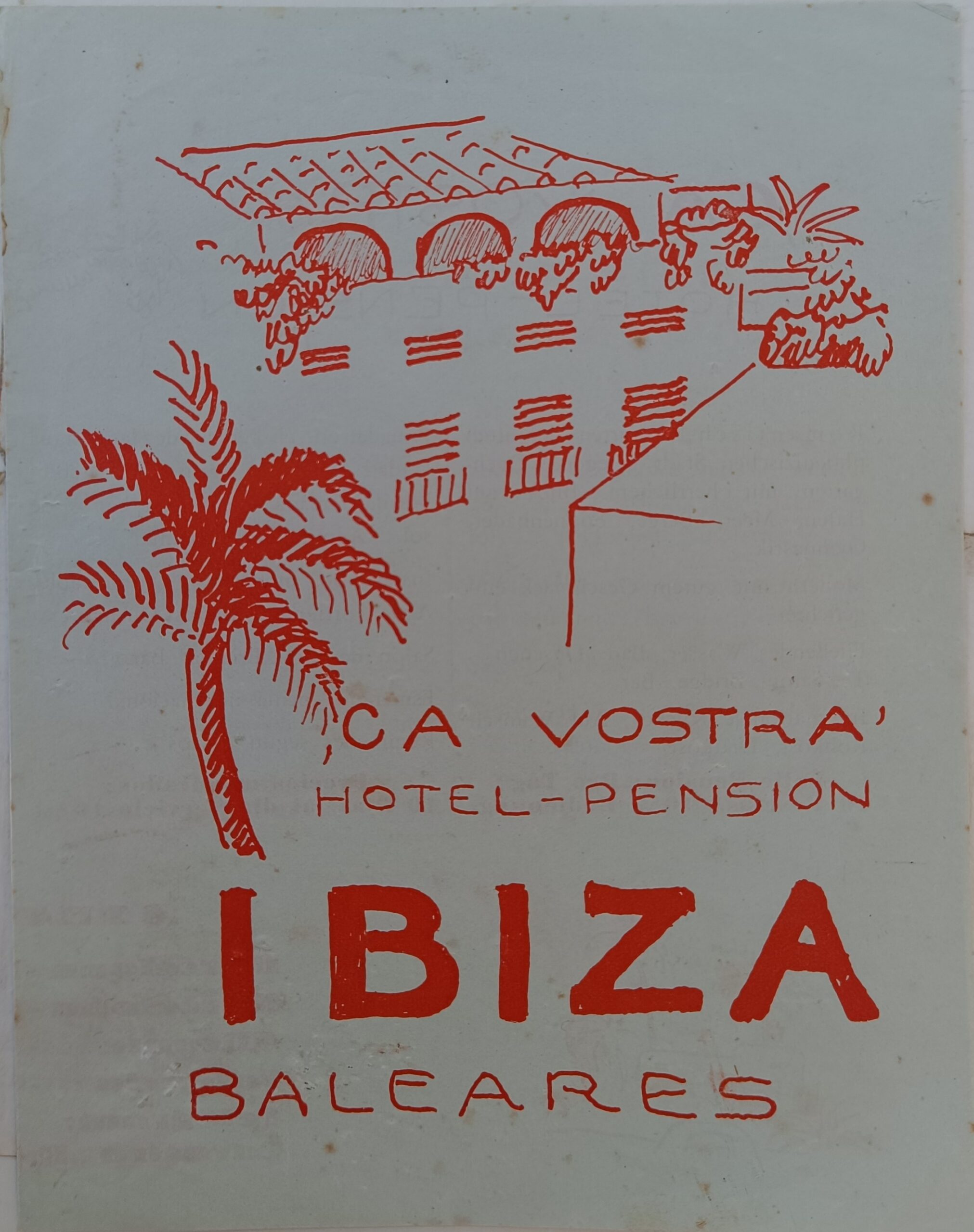
Hotel Ca-Vostra leaflet, designed by Lene Schneider-Kainer. Courtesy of Anne Berthelot and Gesche Kainer.
The young German-Jewish painter Hans Rot also stayed at the Ca-Vostra Hotel. In March 1936, in a letter sent to his parents, Otto and Hanna Rothschild, he described his experience on the island: “How different and confusingly blissful life seems to me! […] Imagine that the day passes with parties and car rides, picnics and afternoon strolls through the harbor, landscapes and paths filled with the most beautiful experiences. […] For a moment, life seems beautiful to me again—and more beautiful than I had ever dreamed. I don’t think about the approaching end; I’m enjoying the moment, and I’ll be rich for a long time thanks to this captivating dream.” His friendship with Schneider-Kainer and his son, Peter Kainer, had bound them together since their days in Berlin. At that time, already in exile in Paris, he moved to the island to enjoy a restorative retreat. In another letter, he described the hotel’s features and the personalities of its guests: “The house, spacious and with a very intricate layout, features tiled-floor, whitewashed rooms adorned with treasures from Kellermann-Kainer’s trip to Asia: Chinese Buddha heads, glazed Tang-dynasty horses in the niches, Indian textiles, and Chinese rugs arranged like rare tapestries. The dining room features upholstered seating around the English fireplace heated with fragrant olive wood, a reading room, a tearoom, and a bar. The living rooms are spacious, with plush sofas and running water. A strange blend of Eastern lifestyles, Asian culture, and European comfort. It seems as cinematic and surreal as the landscape and the people. The residents are no less so. Travelers, the homeless, those jaded with Europe—a jumble of English, French, Spanish, and German. A heavy consumption of whiskey…” The escape the guests sought was complemented by the exotic atmosphere created by Schneider-Kainer, who decorated the hotel with her collection of Asian artworks.
At the same time, Schneider-Kainer was also involved in solidarity networks among exiles. A letter she sent on behalf of “some 50 German intellectuals” who had settled on the island over the past two years was addressed to the writer and journalist Rudolf Olden and to the German writers’ section of the PEN Club, whose new headquarters in exile was located in London. The letter urged them to visit Ibiza, taking advantage of the fact that the PEN Club was holding its annual congress in Barcelona. The letter echoed the book Voyage and Discovery by Irish author Conor O’Brien, in which he stated: “There may be in the world better places than Iviza [sic], but unless they make living as safe and cheap and easy, Art and Literature would not have a chance in them.” The island’s privileged position as a haven for displaced writers is clear.
Yet the military uprising and the ensuing outbreak of war in Spain accelerated the dissolution of that utopian, exotic-feeling international colony established by Schneider-Kainer in the old citadel of Ibiza. In July 1936, one of the last messages written in the guestbook enigmatically reflects the brief but meaningful experience lived in that place, to which all the guests longed to return. The message read: “I don’t know how to write poetry, I don’t know how to paint—I only know how to play. It’s not much, but it’s been lovely—so lovely that I’ll be back soon. So, goodbye.” This is how an idyllic chapter came to a close, a chapter in which, fostered by the island’s isolation and the vibrant cultural context of Spain’s Second Republic, vacations were a pastime for exiled artists and art was a source of enjoyment for summer visitors. For Lene Schneider-Kainer, Ca-Vostra had served as a means of subsistence during her exile and, at the same time, as a platform for cultural exchange through which the artist opened herself up to the public sphere via the emerging tourism industry.
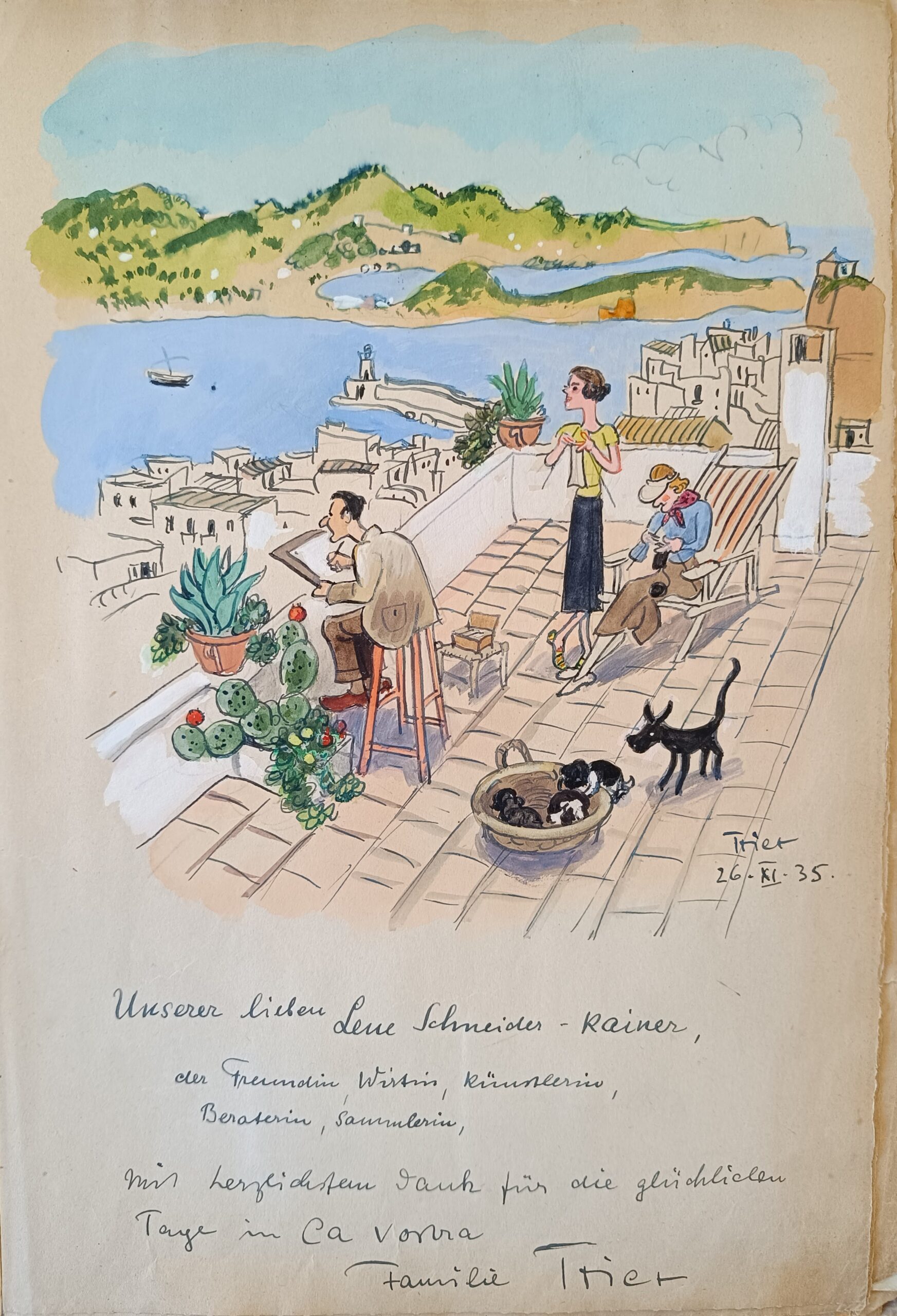
Page from the Ca Vostra Visitors’ Book, 1935. Courtesy of Anne Berthelot and Gesche Kainer.
Last February, I had the opportunity to meet her granddaughter, Gesche Kainer, in Florida. I was impressed by her intelligence, her appreciation of my research project, and her reflections on her grandmother’s story. We had been corresponding since 2022. During a video call, she clarified the details of the difficult fate of her father, Peter Kainer, and her grandmother, which had been misrepresented in the only monograph published to date on the artist.
Schneider-Kainer left Ibiza on an Italian ship in April 1937. In Berlin, she obtained a passport with which she traveled to the United States and arrived in New York in the summer of 1938. Her son was less lucky. Peter Kainer spent the war in Spain, where in 1940 he was interned in Franco’s concentration camp at Miranda de Ebro. In a prisoner exchange, he was sent to Berlin, where he managed to escape a deportation that would have been fatal. He remained in hiding until the end of the war, when he emigrated with his partner and daughter to Bolivia, where his mother soon joined them. In Bolivia, Schneider-Kainer embarked on a new venture: a company called Andea, dedicated to producing textiles using traditional Andean techniques and materials, which employed disadvantaged indigenous women. She bought a colonial-style house in downtown Cochabamba and restored it to serve as Andea’s headquarters, complete with a workshop where the rugs and tapestries she sold were woven. Until the end of her life in 1971, Schneider-Kainer also hosted concerts and celebrations in that house, which once again—just as Ca-Vostra had—became a hub for cultural exchange.
Sol Izquierdo is a Marie Skłodowska-Curie Global Postdoctoral Fellow in the Spanish National Research Council (CSIC) and a Visiting Scholar at New York University. Her current research project, “Transcultural Weaving,” recovers the histories of exiled Jewish women artists in the 20th-century Americas. A longer version of this article appeared in the journal Espacio, Tiempo y Forma (UNED). Translation by Sebastiaan Faber.






