
Stuyvesant High School’s Ongoing Project
The Abraham Lincoln Brigade, New York’s Volunteers
In the spring semester of 2020, the first thirty-three students completed biographical sketches that were published to a student-built website.
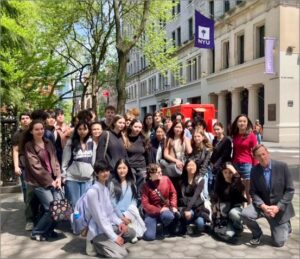
Stuyvesant High School teacher David Hanna declared his goal for students to compile biographical entries for each of the approximately 800 volunteers who went to Spain from New York City. He met with the editors of The Volunteer who ran an article about the project in the August 2020 issue. At that time, Hanna estimated that it would take 24 years to complete the project.
I recently followed up with Hanna to check in on the project. He graciously agreed to answer a few questions. He also suggested I contact Theadora Williams who also graciously accepted my request. Thea was a student in Hanna’s first seminar in the Spring of 2020. She along with the help of fellow student Angel Ortmann-Lee (credited as the designer) constructed the website.[i] Thea continues to support the project by maintaining and updating the site.
David Montgomery Hanna- History Teacher
Tell us a little about yourself? I teach history at Stuyvesant High School in Lower Manhattan. I grew up Maine, and first moved to New York to attend graduate school at NYU. I’m also a writer.
What prompted you to start the project? I’ve been interested in the Spanish Civil War since I was a kid, after seeing Pablo Picasso’s painting “Guernica”, in a book. Back in 2019 I proposed an elective course to the school’s cabinet, and my main pitch was that the Abraham Lincoln Brigade Archives were housed at the nearby Tamiment Library at NYU, and that students would be able to conduct original research due to this proximity.
What type of lesson do you do to introduce the students to the period and the project? It’s the entire semester-long course, really. We start with socialism, communism, anarchism, and fascism; then examine these ideologies in the political context of the 1920’s and 1930’s. Those were radical times, and New Yorkers, and Americans more broadly, were affected by them. Knowing what we know now about Stalin and the purges, and Hitler and the Holocaust, it’s hard for us to see the appeal, but back then these things either were concealed or had yet to occur. Those that volunteered to go to Spain to help defend the Republic were both very far-sighted (about the threat posed by Hitler) and very naive (about what Stalin really was). For the record, I am not a communist, and I do not support communism. I am an American, who believes in democracy.
How do the students select the volunteer they research and write about? They don’t. I assign them one randomly.
What are some of the challenges the students run into researching the volunteers? Many of these volunteers have very little on them. They “fly beneath the radar screen” of history. These, in fact, are the most important, because (as I emphasize to my students) if “you don’t do a bang up job”, then their stories might fade permanently into historical obscurity. The students have a big responsibility to dig, and then dig more, to structure a narrative, even if a lot of it winds up being contextual.
What type of feedback have you received from the students on the project? For many, they have found it to be one of the most rewarding things they’ve done in their entire time in high school. It becomes personal for many students, that’s the only way I can explain it.
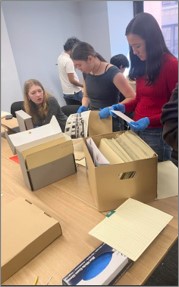
Theadora Williams- Website creator
Tell me how you initially got involved with the project? I was in the class the first year David taught it. I’d previously taken AP European history with him, where he announced the new course, and knew I had to take it. His vision was to have a website that displayed student research and helped other historians. At the time, I was focusing on tech academically – I was graduating early and had my schedule filled out with college-level CS classes (as in beyond the APCS exam). I’d already been working as a software developer outside of school for a while. So, I volunteered to make the site. Having no budget, I built the site from scratch and hosted it using github pages so that it runs completely free of hosting charge and without a proper backend server. Some nifty coding work if I do say so myself.
What especially “captured” your interest to the extent that you have continued to support the project? Most simply, I was a red diaper baby! My father, a British expat, was a teenage Maoist turned “Militant Menshevik”; he’d met Premier Zhou Enlai, Fidel Castro, and other such figures as a youth. I grew up singing the workers’ flag, the Internationale, and John Brown’s body – all the old union songs. My British paternal grandfather had tried to fight in Spain and was repeatedly caught and sent back – after a few times, he decided to support the war effort from home. My honorary uncle, an old NYC DSA founder, would sometimes tell stories of the old NYC brigade volunteers who stayed in the city and kept fighting the good fight after the war. The war was culturally foregrounded for me growing up in ways it wasn’t for most. But that only explains my initial interest in the course.
The ongoing support was still influenced by that, but more important than my upbringing was the project itself. The Spanish Civil War is essentially completely obfuscated by the public school history curricula, a paragraph in a history book at most. In years of history classes up til then, it hadn’t come up. In an explicitly woke elementary-through-middle school that told us we were the “Talented tenth” and used Howard Zinn’s A People’s History of the US. In the other history classes in the high school, the same. Only David did a whole lecture/day on it for AP Euro. To my cynical mind, it isn’t particularly shocking that American education would want to hide that
1) WWII had a trial run. 2) the U.S./West turned a blind eye and did more to prevent aid than to just give it while the Soviet Union provided material support, and 3) ordinary everyday people volunteered in the tens of thousands globally to militantly resist fascism. Or that the Abraham Lincoln Brigade was the first desegregated American unit. Various embarrassing details like that.
Overall, I do it because of two strong beliefs/goals. The first, is that these volunteers should and must be remembered – they deserve more than obscurity for their heroism. Some volunteers’ family members have written to us that they didn’t know about any of this until they came across the project. The second is that we must remember. The fight against fascism continues and we mustn’t let the fight be untethered from history, but understand how long it’s continued. In my lifetime, I’d like to see the war become a standard part of the history curriculum and for the youth to know who they inherited the fight from. To quote Mother Jones, we must pray for the dead and fight like hell for the living.
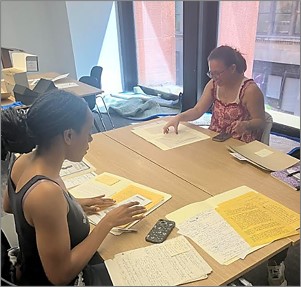 With about a quarter of the NYC volunteers now accounted for do you have any favorites among the biographical sketches? I just uploaded this year’s batch of student entries so I think we’re officially over a quarter! My favorite would likely be my own on George Watt. After I graduated and was in undergrad, I took another elective on the Spanish Civil War and researched him even more thoroughly, writing a deeper biography of him for that project, which included getting to interview his surviving family. I feel like I got to know him really well, and yet still wish I got to meet him. I sometimes catch me asking myself what George would do. Two that similarly stuck with me that were researched by others were Salaria Lillie Kea and William Aalto.
On the other hand, there’s something to be said for the weight of all of them; I think only David and I have read every single one of those entries. So, in addition to the individual figures like Watt, Kea, and Aalto that my brain singles out, the mass of them have a place indexing disjoint snippets and fragments. Tales of gunners, drivers, commissars, and nurses. Stories of labor activists, communists, tenant organizers, and civil rights campaigners. Short snippets of someone we only know volunteered and died in action far too young, lengthy tales of decades of fighting good fights before and after the war. A heroic zeitgeist that I keep in my mind at all times so I can ask myself, as I often do, what would an IB volunteer do?
NYC’s Spanish Civil War Volunteers
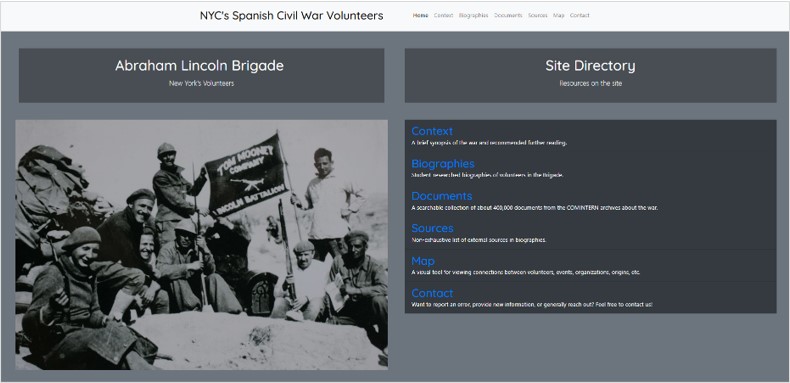
Linked below are four of the 242 biographical sketches on the site –
William Aalto by Lian Kai Lin Stuyvesant ‘20
Ena Ferwerda by Adele Healy, Stuyvesant ‘26
Abe Osheroff by Ari Gurovich, Stuyvesant ‘21
George Watt by Theadora Williams, Stuyvesant ‘20
—–
[i] Theadora Williams, “Student Researcher Expands ALB, Website,” The Volunteer, August 14, 2021.






