
“Many Saw Their Parents’ World Fall Apart”: Elke Weesjes on Growing Up Communist.
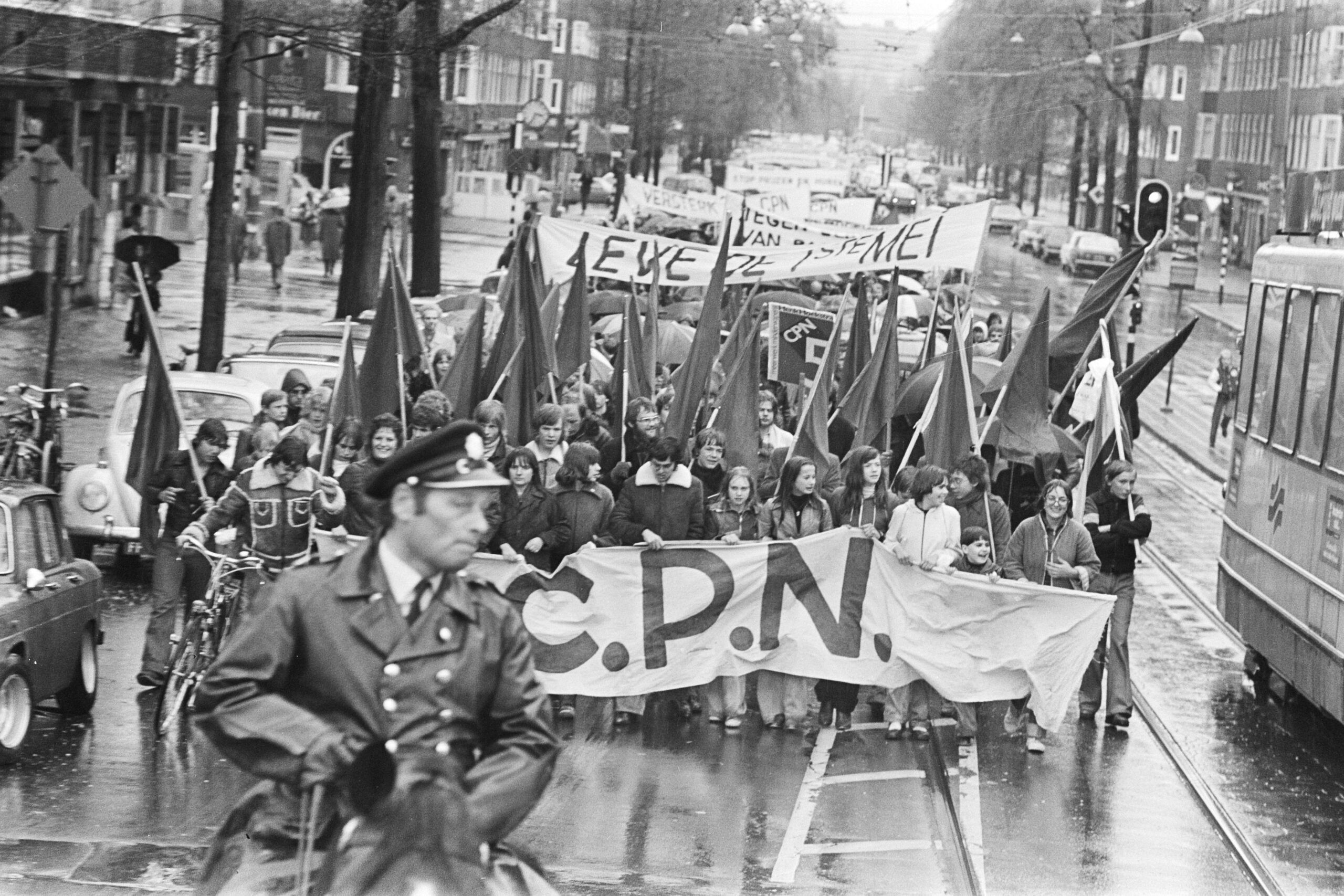
Members of the Communist Party of the Netherlands (CPN) at the May Day Demonstration in Amsterdam, 1977. Photo Rob Bogaerts /Anefo, Nationaal Archief. Public Domain.
What was it like to be born into a Communist family during the Cold War? How do red-diaper babies look back on their childhood? How did geopolitics and their parents’ political work shape their worldview? What legacies do they cherish, and which ones do they reject?
Over two decades’ time, Elke Weesjes spoke at length with more than forty American, British, and Dutch men and women whose parents were active in the Communist Party. In a forthcoming essay for The Oxford Handbook of Global Socialist Culture, she summarizes her—sometimes surprising—findings.
Weesjes (b. 1979) grew up in the Netherlands, where she studied at VU University Amsterdam before earning a PhD in Contemporary History at the University of Sussex. In 2021, she published Growing Up Communist in the Netherlands and Britain: Childhood, Political Activism, and Identity Formation, followed by the Dutch-language nonfiction book Mama Las Marx (Mama Read Marx) in 2023. Her current research project explores the experiences of Americans who grew up in white supremacist families. Weesjes teaches at the City University of New York.
I’m curious what drew you to the topic. Are you a red-diaper baby?
Far from it! I grew up in a Dutch Reformed family in the east of the country. But that doesn’t mean we didn’t have political values. My grandparents, for example, were active in the Resistance during the Nazi occupation of the Netherlands. My mother’s father helped hide people on his farm before they were moved to other hiding places, and my father’s mother distributed an illegal newspaper. I often think that, had they not been religious, they might well have been socialists. They believed in solidarity, albeit from a Christian moral framework.
What got you interested in the radical left?
As a teenager in the 1990s, I joined the punk scene. Then, while studying history in Amsterdam, I got an internship at the International Institute of Social History (IISH), where I helped with an interview project on Communist families. The institute houses the archive of the Communist Party of the Netherlands (CPN), alongside the archives of many other left-wing movements. I became fascinated by the Communist movement, partly because I recognized certain parallels with my own upbringing. We shared some core values, I felt—the idea, for example, that you never put yourself first.
Elke Weesjes
What was it like to work with adults who’d grown up in Communist families?
I learned so much from them. As an interviewer, I always like to give my participants—a term that I prefer to “respondent”—a lot of agency in the conversation. Asking questions from a position of naivete tends to help with that. But of course, at the time I was only 21 and actually pretty naïve! (Laughs.) It was hard for them to see me as an equal. When I went back to interview them years later, after I’d become a parent myself, the nature of our conversation was very different. One of the fascinating aspects of longitudinal studies is that the perspective of both the researcher and her subjects change over time. In the beginning, I’d focused on the children’s experiences. Later, I became more interested in the dilemmas that the parents faced. Similarly, in those early interviews we mostly spoke about my participants’ fathers, often forgetting about the mothers, whose role had also been quite important, especially in the years of the anti-Nazi resistance. Even as a woman, it took me a while to become aware of that imbalance.
Tell me about the interviews.
Although I don’t consider myself an oral historian in the traditional sense—I find the conventions and protocols of oral history way too rigid—my work as a social historian centers on gathering life histories. I usually take my time when interviewing participants. The better we know each other, the richer my material. The conversations, which typically last between two and three hours, can be quite intense, at times resembling a therapy session. This was especially true for my Dutch participants, many of whom had never been interviewed about their experiences and were not accustomed to sharing such intimate aspects of their lives with one another either. Their experiences have also received far less attention than those of, for example, children of American Communists. In the US, after all, the first memoirs and interviews with red-diaper babies already came out in the 1980s. By contrast, the IISH interview project I worked on in the early 2000s was the first of its kind in the Netherlands.
Among your more surprising findings, at least to me, is that the degree of social isolation experienced by children growing up in Communist families varied considerably between the three countries. American children, for example, often grew up within a broader radical milieu, despite the much more severe state repression their families faced. British Communist families, meanwhile, remained embedded in trade unions and working-class communities. In the Netherlands, the situation was different. The vertical division of a society into separate ideological, religious, or socio-economic groups—known as “pillarization”—and longstanding divisions within the socialist movement meant that Communists were largely excluded from other political and social networks, including those of the Social Democrats.
Exactly. In the United States, a large part of the Communist movement overlapped with secular Jewish urban communities, where it often didn’t make much difference whether you were, or had been, an actual Party member. Within the broader radical left, there was plenty of room for fellow travelers of different stripes. Friendships crossed those lines, and people could distance themselves from the Party without necessarily losing their social networks. There was simply more fluidity.
That said, I’m aware that this was particularly true of places like New York and Los Angeles, especially among middle-class secular Jewish families. It’s much harder to find children of Communists from other milieus—say, Finnish American factory workers in Detroit. So, we have to be careful about generalizing from the experiences of those whose stories have been preserved.
In the Netherlands and Britain, participants’ parents were more often working-class and less socially mobile than their American counterparts, sometimes deliberately so, out of principle. But the Dutch case was particularly distinctive. Because of pillarization and the longstanding divisions within the socialist movement, Dutch Communists were largely excluded from other political and social networks, including those of the Social Democrats. They developed their own close-knit community, which provided a strong sense of belonging but was also relatively isolated from the wider society. On top of that, in the immediate postwar years, Dutch Communists faced a fierce backlash. Having been celebrated as heroes for their role in the Resistance, they were suddenly portrayed as traitors and enemies of the state. This sudden shift had a profound psychological impact on parents and children alike.
What do you mean by that?
The Dutch Communist Party played a central role in the Resistance, often at enormous personal cost. Many Dutch Communists were captured, imprisoned, or deported to concentration camps, and many lost their lives. Immediately after the war, those who survived were celebrated as heroes, which was uncomfortable for many of them because of survivors’ guilt. Yet mental health issues like survivors’ guilt, depression, and what we now know as post-traumatic stress didn’t really align with the official party stance. But that doesn’t mean people weren’t struggling with these issues at home.
And then, adding insult to injury, within just a few years, as the Cold War began, there was this enormous backlash. The very people who had been celebrated as heroes were suddenly branded as a fifth column. Talking with their children, I began to realize just how profound the psychological impact of all this must have been on these families. In fact, I suspect that if I’d been able to interview the parents themselves, some of this might not have come out nearly as clearly. Children often pick up on things that their parents may not have been willing or able to articulate themselves.
The presence and impact of surveillance, discrimination, and redbaiting have been studied extensively in the U.S. But I have the impression that Cold War culture, and particularly the experiences of Communist families, have been studied much less in the Netherlands. Is that reflected in how these families have been portrayed?
In some ways. Some recent memoirs by red-diaper babies have actually reinforced Cold War stereotypes. They paint a picture of families in which the Party always came first, at the expense of everything else, including the children. That is definitely not the picture that emerges from my research. Sure, the parents were busy during the week—but so were most other parents. Other than that, Communist families had normal lives, with fun on the weekends, birthday parties, and holiday celebrations.
Did many of your participants follow their parents into party politics?
Some did, at least initially, but certainly not all of them. Although the majority still identifies as leftist, most are no longer members of political parties. Their parents’ experiences often turned them off to party politics, but not to political activism more broadly. Many are active in single-issue organizations, such as Greenpeace or Amnesty International. And if you look at the way they engage with their neighbors and communities, they’re clearly committed and involved, often fighting for the underdog. And, of course, they vote. I also noticed that most of them ended up in socially oriented professional careers: they are teachers, social workers, dedicated to helping others. Let’s say I did not run into anyone who’d become a corporate CEO. (Laughs.) You see the same thing when it comes to what they tried to transmit to their own children. They’re not particularly concerned with passing on their own political affiliations, but they do instill in their children the importance of voting, of knowing how the world works: understanding who the oppressors are and who the oppressed—and standing in solidarity with the latter. It’s the kind of intergenerational transmission of moral and social values that we also see in religious communities, in which people may leave a congregation but hold on to its moral core.
Did they draw any negative lessons from their parents’ experience?
Many saw their parents’ world fall apart when the Soviet Union collapsed. And they had to come to terms with their parents’ support for the Soviet regime. Looking back, they often understand the choices their parents made, but they also see how much the Party asked of them. So, while most children have not renounced their parents’ values, they are generally more skeptical and critical. Less likely to follow anything or anyone blindly.
Sebastiaan Faber teaches at Oberlin College.






