
Book Review: The Spanish Civil War in 100 Objects
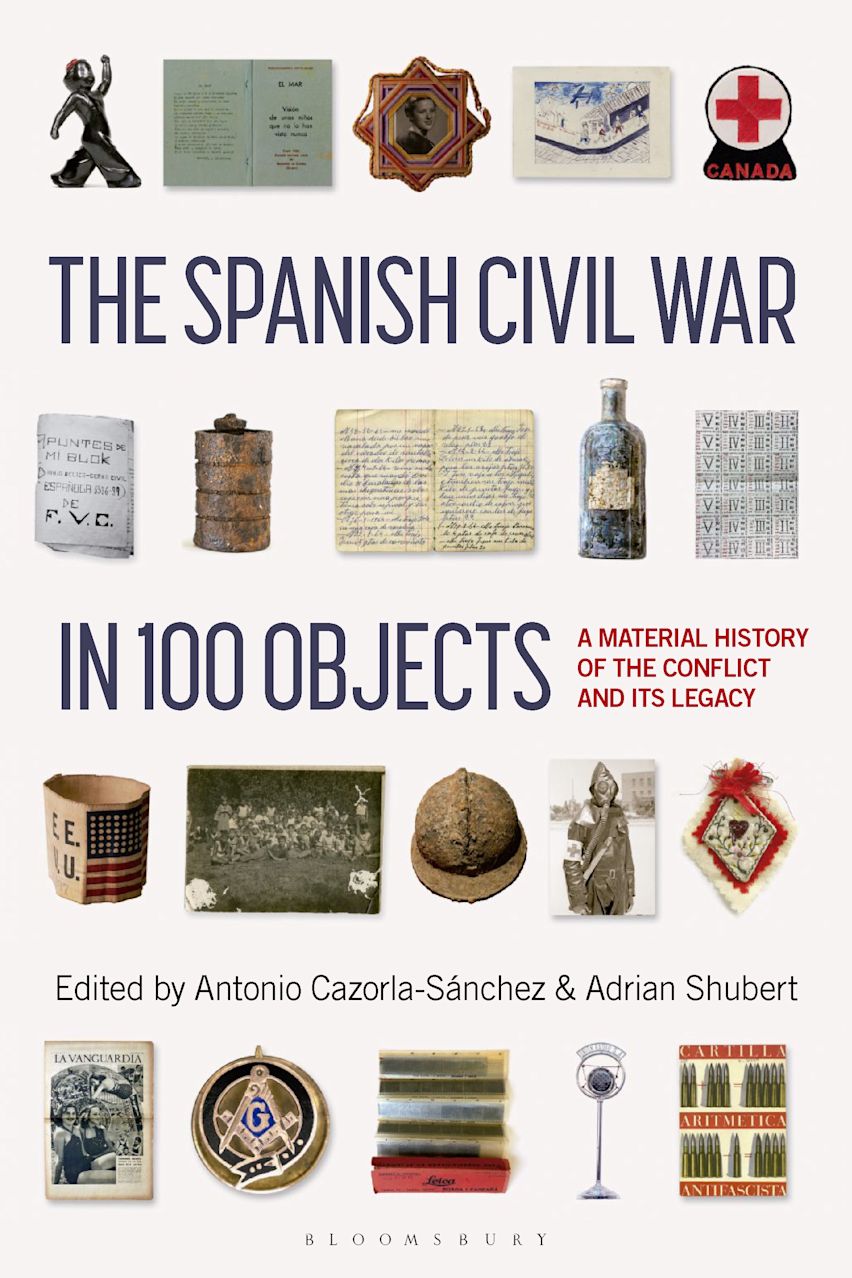 The Spanish Civil War in 100 Objects: A Material History of the Conflict and Its Legacy, edited by Antonio Cazorla-Sánchez and Adrian Shubert, translated by Esther Shubert-Palacios. Bloomsbury Academic, 2025. 299 + xii pp., 100 photographs. $34.95 (paperback).
Reviewed by Robert Shaffer
Inspired especially by the influential British Museum’s radio series and 2010 book A History of the World in 100 Objects, Antonio Cazorla-Sánchez and Adrian Shubert, who co-direct the Canada-based Virtual Museum of the Spanish Civil War, have compiled a similarly impressive volume focused on the conflict in Spain. The editors and their nine additional contributors, all prominent Spanish scholars or journalists, have chosen a hundred objects—defined to include documents, films, and physical sites—to present a wide range of perspectives and experiences. Photographs of each object, presented in roughly chronological order, are accompanied by a two- or three-page explanation. The result is both scholarly and emotionally wrenching, conveyed with a decided sympathy for the Republic and a pervasively critical approach to the Nationalist uprising and dictatorship. But the contributors also forthrightly examine Loyalists’ faults and excesses.
The “objects” range from a 4-inch-tall grenade produced from scrap materials by resourceful Republican troops to filing cabinets in which Francoists kept the names of hundreds of thousands targeted for imprisonment and execution. A diary of a pro-Republican Galician conscripted into the rebel army and subsequently executed appears alongside the 1937 Joint Letter of the Bishops of Spain to the Bishops of the Whole World, which portrayed the war as a struggle between “spiritual” and “materialistic” values.
Objects from daily life, such as tobacco pouches, take on greater significance. As each side sought to show that it could best provide this “necessity” for its soldiers, “the tables turned in 1937” in the Nationalists’ favor when they came to control Spain’s tobacco-growing regions. Other objects show the increasingly desperate circumstances of the Republic, such as the “bread bombs” that Nationalist planes dropped over Madrid in 1938 to propagandistically dramatize the severe food shortages in Loyalist zones.
Numerous objects were unearthed in the archaeological digs spurred by the movement to recover this historical memory of the war years. These include the binding that tied the hands of a Basque man who was executed for expressing sympathy for the Republic and whose body was exhumed in 2019.
Readers of The Volunteer will likely be most interested in the several objects in the book that relate to the International Brigades and other expressions of solidarity for the Republic. Interestingly, the only IB identification card reproduced is of a Spanish soldier who served with the Rakosi (Czech and Hungarian) battalion—reminding us that national distinctions among Loyalist forces were not always clear-cut. We also see the shoulder patch of Norman Bethune, the Canadian physician who helped set up a blood transfusion system for Republican armies. The accompanying description notes that the “prickly” Bethune sparred with government leaders and left Spain after only six months.
A .303 caliber bullet clip excavated from a Madrid trench in 2016 illuminates a fascinating episode of international history: thousands of these US-made cartridges made their way to Britain in World War I, were captured by the Red Army from British forces intervening in Russia’s Civil War and then comprised a portion of Soviet aid to the Republic. A photo of Gerda Taro with her Leica camera serves as a backdrop for a perceptive discussion of how new technology helped launch 1930s-era photo-filled newsmagazines—and thus ushered in “modern war coverage” (even if the commentary misdates the publication of this war’s iconic photograph, Robert Capa’s “Falling Soldier”).
The contributors also cover the international support for Franco. The description accompanying a “Certificate of Service in Eoin O’Duffy’s Irish Brigade” reveals that more Irish volunteers served with the rebels—to defend Catholicism—than in the IBs. A drawing of “Betty Boop” (more demure than in her original American version) appeared in a publication of Women at the Service of Spain, one of numerous right-wing organizations that sewed clothing for Nationalist soldiers. Nevertheless, one of this book’s recurring themes, hammered home in numerous objects and descriptions, is the stark contrast between Republican moves towards gender equality and the Francoist commitment—often backed by sexual violence—to women’s subordination.
Brutal and wanton violence, while routinely practiced by the Nationalist insurgency and dictatorship, was not limited to the rebel side. Supporters of the Republic will be pained to read of the August 1936 murders of dozens of young Catholics in one community in northeastern Spain—illustrated by their final words etched onto a piano stool—and to view a rosary unearthed from a mass grave in Toledo that testified to the “savage anticlericalism that characterized the revolutionary violence” of the war’s early months. The book’s contributors attribute these atrocities primarily to Anarchist forces, noting that the central government soon tried to rein them in. Nevertheless, the toll in lives and property, and the publicity value for the Nationalists of such destruction, are sobering, indeed.
While many contributions refer informally to new studies of the conflict, some readers will lament the omission of footnotes and a bibliography. Moreover, the translation is marred by far-too-frequent typographical errors and several factual mistakes. Some photographs are too hazy to make a true visual impact. (A map of the country’s provinces and major cities, mentioned throughout, would have helped non-Spanish readers.)
Still, the composite portrait that emerges in The Spanish Civil War in 100 Objects will be of great value both to those well-versed in the subject and others beginning to learn about it. The book’s structure—linking intriguing images with brief, readable vignettes—encourages browsing and will make it especially valuable for high school and college classrooms, whether instructors assign the whole book or pick-and-choose notable examples.
Robert Shaffer, professor emeritus of history at Shippensburg University, is the author of “The Spanish Civil War in ‘World History’ Textbooks,” published in World History Connected (2022).






