
Book Review: Poetry of the Spanish Civil War
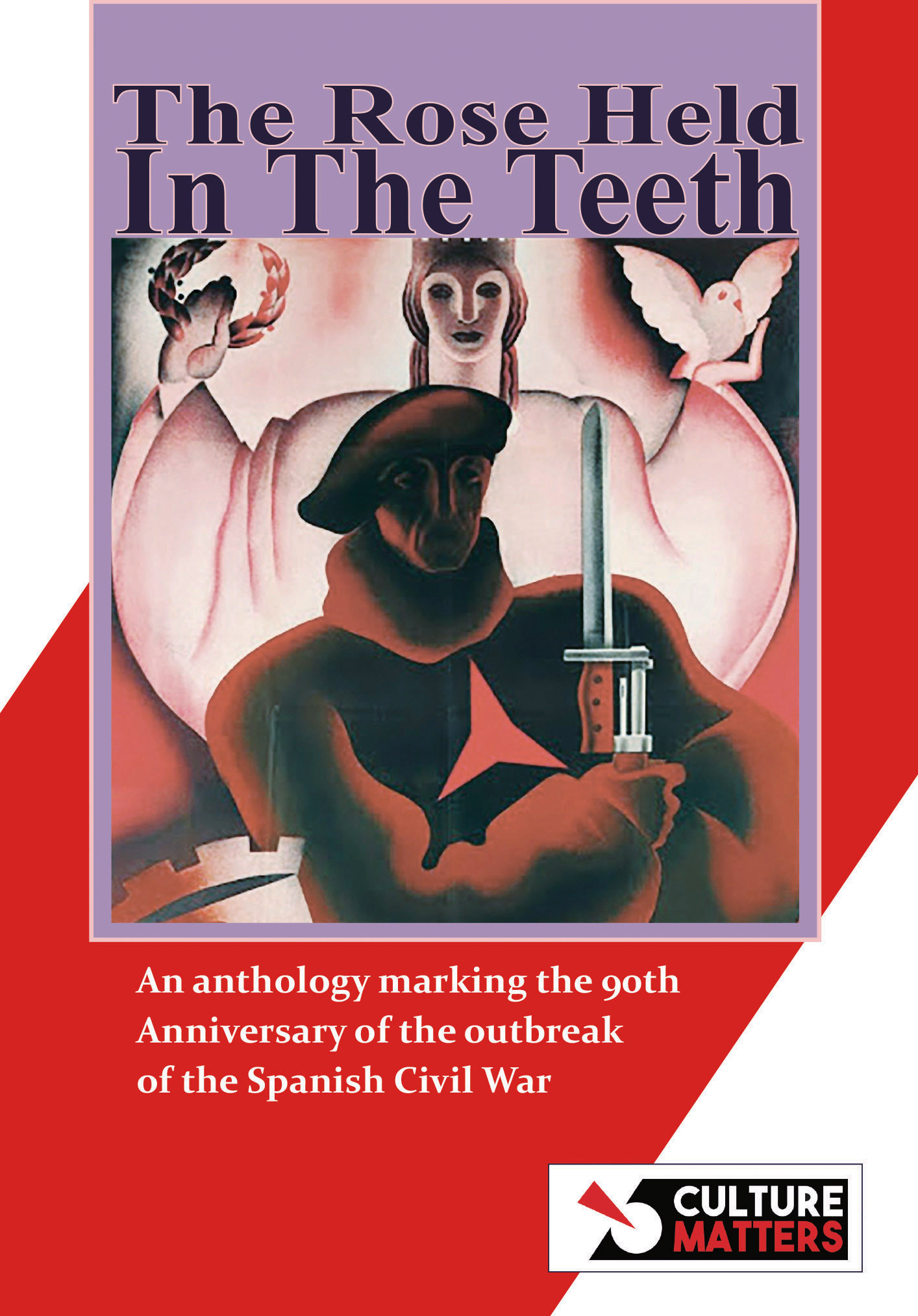 The Rose Held in the Teeth: An Anthology Marking the 90th Anniversary of the Outbreak of the Spanish Civil War, edited by Alan McGuire, Culture Matters, 2026, 84 pp.
Reviewed by Anthony Geist
The Rose Held in the Teeth brings together the work of 15 British poets: eight who were in Spain during the Civil War (three of whom died in combat), and seven contemporary writers who reflect on the war from the present. This book makes an important contribution to our knowledge of the importance of art and literature during the conflict in Spain, filling the gap left by The Penguin Book of Spanish Civil War Verse (1980, 1996), now long out of print.
Both in history books and literary studies in the English-speaking world, the Spanish Civil War is often overshadowed by the two world wars that bookended it. Yet at the time, and throughout the world, it was understood as the first armed resistance to the rise of fascism. In response to the attempted coup led by Franco and a considerable part of the Spanish armed forces, the Spanish people took up arms to defend the recently established democracy in their country. As the Republic was vastly outgunned by Franco’s forces—supported by arms and soldiers from Nazi Germany and fascist Italy—some 40,000 volunteers from over 50 countries came to its aid, forming the International Brigades. Many of the volunteers were working class; among them were a number of artists and poets. The vast majority of Spanish writers and artists took the side of the Republic, using their art as a weapon. Notable among them were Rafael Alberti, Miguel Hernández, and Manuel Altolaguirre.
In his insightful foreword, Alan McGuire begins by reviewing the history of Spain after the death of Franco, parsing the different narratives of the Transition. The newly established democracy promoted the Pact of Forgetting (el Pacto del Olvido) or the Pact of Silence (el Pacto del Silencio), yet the civil war remains an open wound. As McGuire states, it still “shapes the language of politics, the memory of the streets, and the uneven visibility of state violence.”
The poems included by McGuire by the poets who fought in Spain describe an array of actions and emotions, ranging from the commitment that led them to volunteer to the experience of battle, prisons, hospitals, and comradeship. John Cornford, killed in action at Lopera one day after his twenty-first birthday, wrote:
Freedom is an easily spoken word
But facts are stubborn things. Here, too, in Spain
Our fight’s not won until the workers of all the world
Stand by our guard on Huesca’s plain
Swear that our dead fought not in vain,
Raise the red flag triumphantly
For Communism and liberty.
Alex McDade, who died in the battle of Brunete, wrote what has become the iconic song of the Spanish Civil War, “Jarama Valley”:
There’s a valley in Spain called Jarama,
That’s a place that we all know so well,
for ‘tis there that we wasted our manhood,
And most of our old age as well.
While the poets who participated in the civil war largely wrote about their experience in the first person and present tense, the poems of the seven contemporary writers most often are cast in the third person and past tense, often naming brigadistas who lost their lives in the conflict. They look back with sorrow and admiration. Rob Hindle reconstructs the execution of Lorca. Alan McGuire devotes a poem to Miguel Hernández. In another, he grieves: “No open graves / ghosts still haunt / the present / from the past.” Others pay homage, with names and dates, to the fallen poets. To the best of my knowledge, relatively few contemporary Spanish poets write as explicitly about the war and its effects still felt in Spain today.
Tony Geist, a longtime ALBA board member, teaches at the University of Washington in Seattle.






