
ARKIVO: Pablo de la Torriente Brau from New York, July 1936
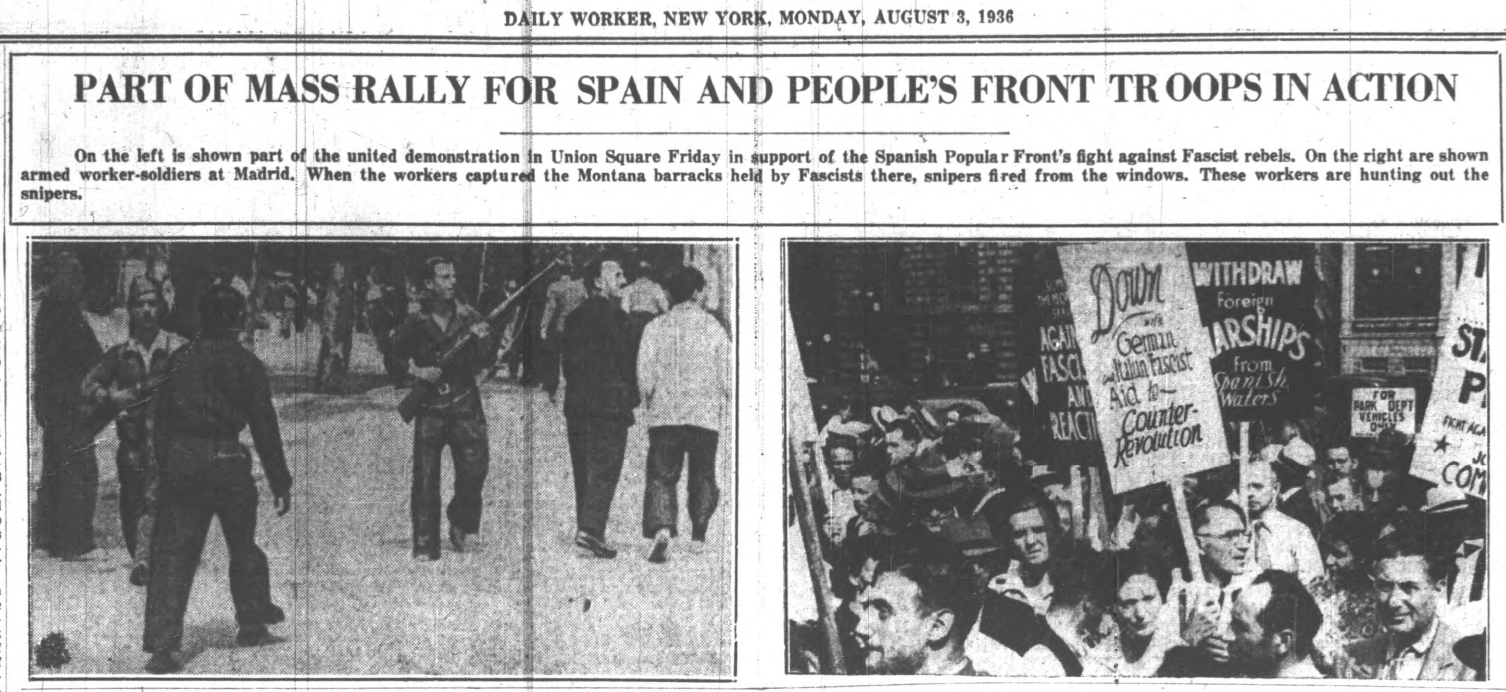
Clipping from the Daily Worker, Aug. 6, 1936.
The Cuban journalist, intellectual, and activist Pablo de la Torriente Brau (1901-1936) was living in exile in New York when the Spanish Civil War erupted in July 1936. Here he chronicled two of the earliest solidarity gatherings held in New York in support of the Spanish Republic: a parade and meeting at the Spanish Workers’ Club in Harlem and, a week later, a mass rally in Union Square. His account captures the political fervor that gripped the city that summer and fall. Just five months later, on December 26, 1936, 96 volunteers would sail from New York aboard the Normandie bound for Spain by way of France.
Moved by the mobilization he witnessed in New York, particularly the Union Square rally, de la Torriente Brau himself traveled to Spain in September 1936 as a correspondent. He subsequently joined the Republican forces. On December 19, he was killed in combat at Majadahonda, northwest of Madrid, while helping defend the capital.
July 24, 25, 1936, Spanish Harlem, Ablaze
…On July 24, in Harlem, a torchlight parade made its way along the avenues. Beneath the blazing lights, the delirious enthusiasm of the red flags waved, and perched on their characteristic stepladder platforms, the speakers hailed the inevitable triumph of the militias over an army without popular support.
And the following day, at the Spanish Workers’ Center on Madison Avenue, the workers’ hall was packed to the rafters, and the staircase creaked under the weight of all the people so eager to get in. The reason was that the first sailors had arrived from Havana aboard the Cristóbal Colón, and since the fleet had shown such formidable unity in favor of the government, people wanted to encourage these men who were now bound for Spain. Anarchists, socialists, and communists laid out their views. For all of them there is only one possible outcome: victory. The audience, as electrified by enthusiasm as the speakers, grows restless. Impassioned. Everyone who has a peso gives it. And if not, a peseta, a real. Everyone gives. People shout that all Spaniards and all sympathizers with the revolution throughout the world must make sacrifices. And whoever cannot offer his body and his life must offer part of his labor, a little of his food, for the tireless heroes. Someone shouts that the women are fighting; that the children are fighting; that there is no alternative but victory or death; that sacrifices must be made. Someone says that the sailors of the Colón, during their stay in Havana, have obtained $27,000.00, and that many thousands more pesos will be sent from Cuba to the Popular Front government. And one sailor declares that “they would seize the ship if the officers did not come out in favor of the government.” Never had there been more uproar and clamor there. And several hundred pesos were collected.
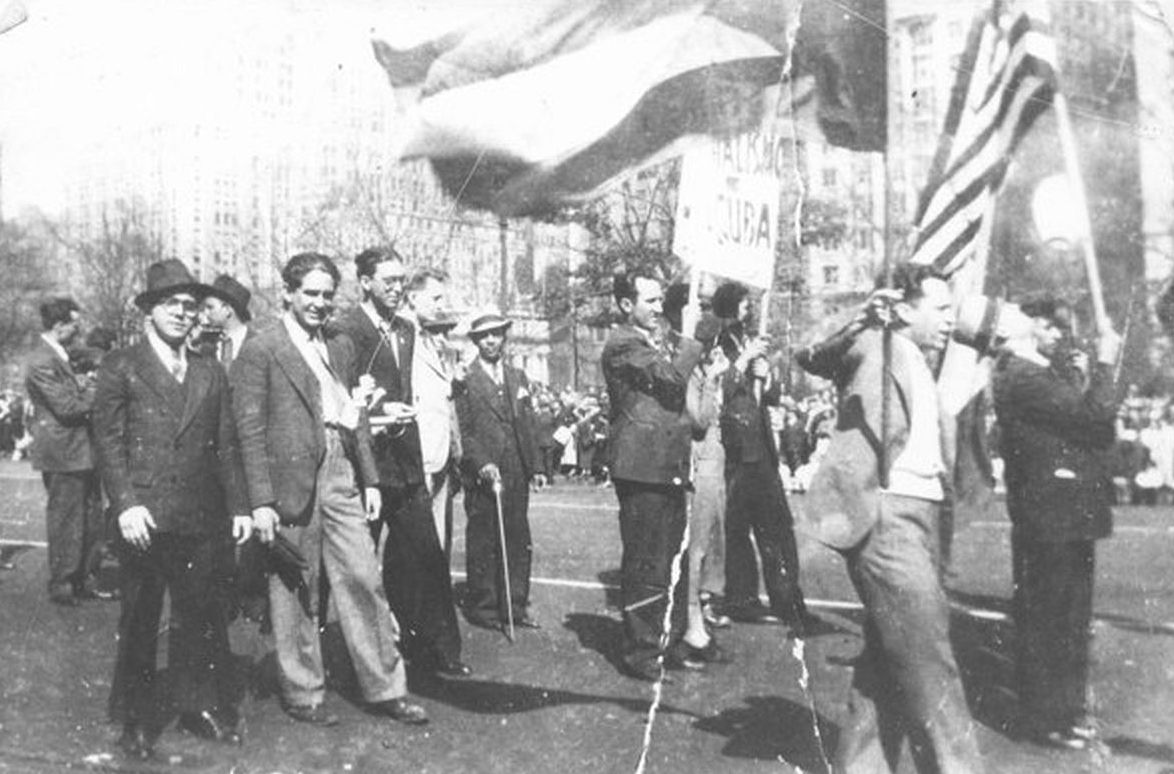
De la Torriente Brau (second from the left, without hat) on the streets of NYC. Ca. 1936. Public domain.
July 31, 1936, Union Square
Union Square, as everyone knows, is New York’s Red Square. The May Day parades end there. All the demonstrations against war and fascism take place there, and it is there that American workers put forward their demands. Every day of the year, there are always groups of men and women talking about the revolution. They are invariably from different parts of the world. But they understand one another in New Yorkese, which is a kind of English. The police hate that square. The revolution loves it because it has been the scene of its first difficult struggles. It is not small, but nor is it one of those typical American parks with lakes, woods, and walking paths. An uneven wall of buildings surrounds it, recalling the pretentious old New York of just a few years ago, when neither the Chrysler nor the Empire State Building had yet been built. On one corner, from a lofty tower, a great clock measures time, the city’s absolute master. And Fourteenth Street, the street of noisy sales and sidewalk vendors, is a river of people bordering the square.
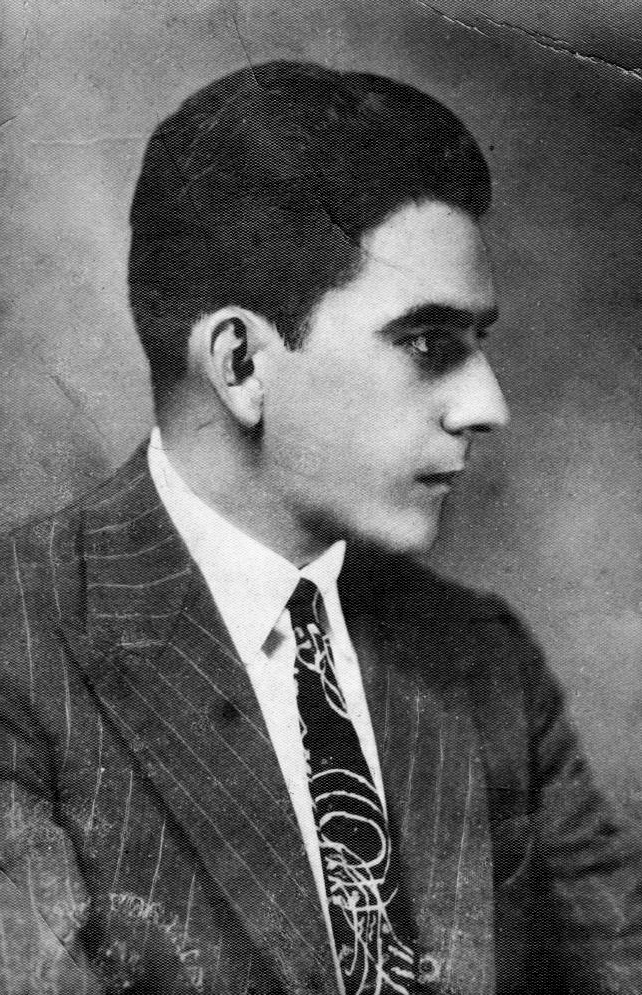
Pablo de la Torriente Brau, ca. 1936. Public domain.
This was where the great demonstration of international workers’ solidarity took place in favor of the Spanish Popular Front government and against the fascist and monarchist insurgents. At four in the afternoon, the large open space set aside for rallies was filled with a heterogeneous crowd. […] As the hour advanced, workers leaving the nearby factories streamed into the demonstration. On a truck decorated with red symbols, loudspeakers spread out like the trumpets of the Last Judgment. Mounted police surrounded the audience. And a closely packed line of reporters and photographers took up “strategic positions” on the wall of the pergola that marks the square’s end at Seventeenth Street. On the roofs of their vehicles, the newsreel cameramen cranked away at “the event,” always on the lookout for something exceptional or some commotion.
[,,,]
And the red banners of all the clubs waved. Not only those of the Spaniards. Not only those of the Spanish Americans. Also, those of the German, Italian, Chinese, American, and French clubs. And the speakers spoke in the same fashion. No one understood their words, but everyone understood them. One spoke in German. Another in Yiddish. Another in Russian. When one began to speak in Italian, many people exclaimed sympathetically: “That one’s Spanish!…” And when the Spanish speakers Garriga, García, and Alonso spoke, the great ovations came. There were delegations from the “Mella Club,” the “Tampa,” and the “Martí Club.” Pamphlets and manifestos were distributed. Newspapers were sold. La Estampa Libera, in Italian, El Socialista, Daily Worker, The Fight, Socialist Call, New Masses, China Today, Frente Hispano.
[…]
Before the rally closed, money was collected from the audience in red flags, while, after an appeal from the chairman, everyone who had a dollar raised it overhead, and the bills passed from hand to hand up to the platform, to swell the funds, to raise half a million dollars for the Spanish workers. Then, the Internationale, the Red Flag, and fists held high, like a single, solid cheer.
And the rally closed with the slogan: whoever cannot go must send help. For here the half-million dollars will be collected, and even more, undoubtedly, because people are determined not to be outdone, and it is known that Cuba will make a great effort, as will Mexico, and Chile, and Argentina, and every people of Latin America. But many here are not content with sending money; they want to go, and the Consulate is now looking for a solution to the problem facing the Spanish volunteers. There are even those who want to go to form a counter-Foreign Legion. Everyone who yearns to witness and be part of these momentous events wants to ship out to Spain. For in Spain, extraordinary and scarcely believable things are happening every day. And it is a spectacle not to be missed.
De la Torriente Brau wrote the chronicles “La Revolución española se refleja en Nueva York” for the Cuban magazine Bohemia, but for some reason they were not published until many years later in Cartas y crónicas de España, edited by Víctor Casaus, Ediciones La Memoria, Centro Cultural Pablo de la Torriente Brau, 1999, pp. 269-277.
In this occasional feature of The Volunteer, whose title is the Esperanto word for “archive,” we will present, translate, and contextualize iconic foreign language documents related to the anti-fascist struggle in Spain. If you have a favorite document in a language other than English, let us know!






