
A Newsreel Christmas: New York, 1936
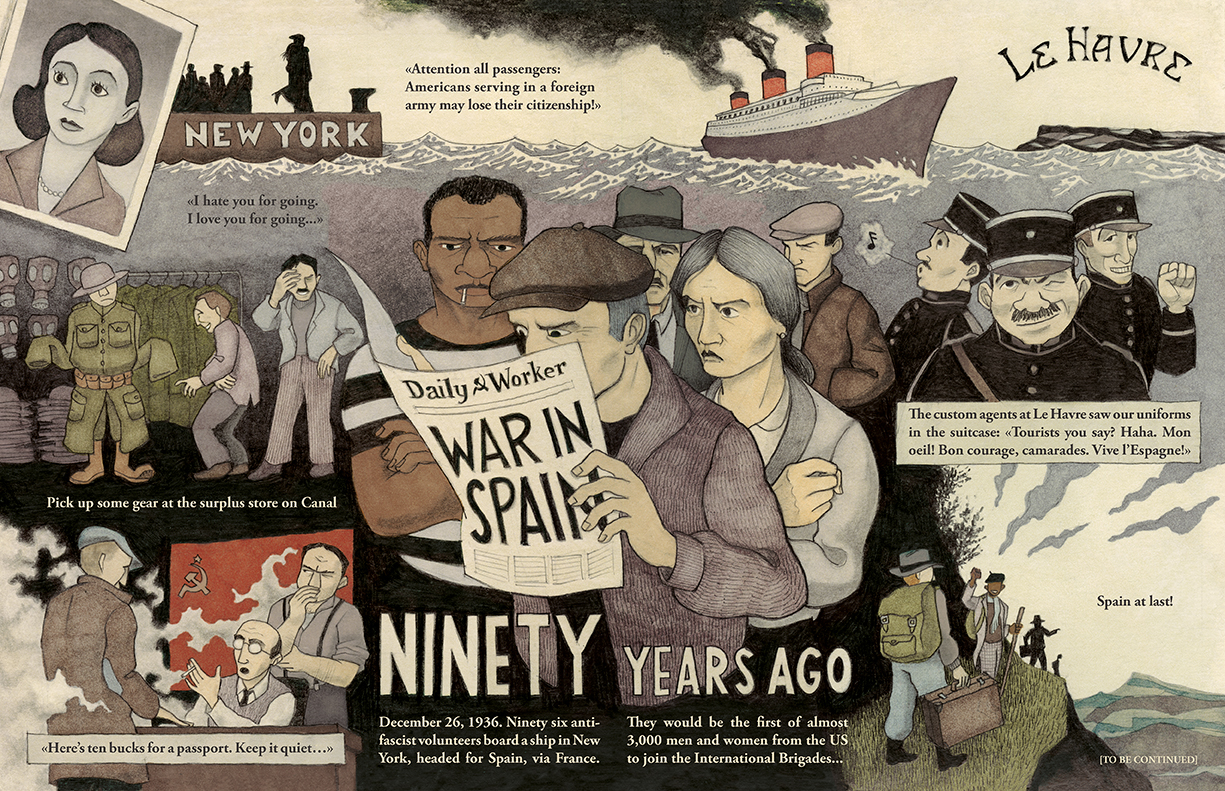
Illustration by Seisdedos exclusive to ALBA.
To be read out loud, with the booming voice and breathless cadence of a newsreel narrator.
Christmas in New York. Unseasonably warm temperatures—fifteen degrees above normal, mildest day of the month. Train stations packed. Mailbags overflowing. Airplanes filled with passengers and packages—and travelers turned away. “Happiest Yuletide in Years,” declares the Times. Biggest Christmas trade since 1930. Gifts bought. Journeys made. Money moving again. Even the weather seems to offer a reprieve.
Got three cents? You can buy a different Christmas at the same newsstand.
Across the Daily Worker’s front page, photographs of workers, children, demonstrators. “Peace on earth—good will toward men.” Beneath them, a headline in enormous capitals with Franco’s Christmas wish list:
“FRANCO ASKS HITLER FOR 60,000 TROOPS.”
Holiday feel-good stories alongside accounts of bombing, industrial struggle, and threatened evictions. Peace is the dream. War is the news.
O Tannenbaum, o Tannenbaum, wie treu sind deine Blätter!
In Harlem, eight hundred children gather around Bill “Bojangles” Robinson, dressed as Santa for the occasion. Police and fire officials help distribute toys. At City Hall Park, carols sung by children beside the Christmas tree compete with the chants of the nearby WPA picketers. “Children’s Voices Win”—according to the Times, at least.
The Worker trims a different tree. More than a thousand children gather around another Christmas tree at 135th Street and Seventh Avenue. Music. Loudspeakers. Officials. But few gifts. A child says the celebration has made him hungry. Another asks whether Santa Claus has a relief budget. “Long on Spirit, Short on Gifts,” is the headline’s verdict.
For hate is strong, and mocks the song of peace on earth, good will to men.
“Murdered Babes in Fascist Planes’ Christmas Raids,” shrieks the Daily Worker. Women and children killed in attacks on Spanish towns. The Times chimes in: “Shells Kill 5 in Heart of Madrid; Explode Among Holiday Strollers.” Refugees crowd the Telephone Building’s basement. For an hour and a half, the city’s holiday streets become “a place of tragedy and terror.” Ralph Bates insists that Franco will not take Madrid. The city of Rochester, NY, sends eight hundred dollars to help the Spanish wounded.
Now the Christmas count! More than five thousand worshippers at St. Patrick’s. Six thousand needy people fed by the Salvation Army. At the Advertising Club, two hundred elderly guests dine, dance, unwrap presents. Warm food. A song. A place at the table.
O tidings of comfort and joy
But in Hell’s Kitchen, reporter Beth McHenry finds a hand-me-down Christmas. A mother shows her a doll retrieved from the garbage, its head crooked, one arm gone. Another family has a broken scooter. A child brings out a picture book with pages torn away. The mothers worry about rent. Christmas has come; the landlord will come, too.
At the waterfront, two thousand striking seamen eat Christmas dinner at their decked-out headquarters. Entertainers perform. The picketing continues. The Worker describes “the yule and strike spirit” at the docks. Nationwide, between fifty and seventy thousand workers are spending this Christmas on strike.
Let nothing you dismay
A Japanese envoy presses for harsher action in China. In Cuba, Batista’s puppet Federico Laredo Bru is installed as president. From Berlin comes news of an antifascist worker sentenced to death. From Houston, a report of fifteen seamen injured in a police assault involving gunfire and tear gas. And the Times surveys the world: “WORLD CELEBRATES JOYOUS CHRISTMAS.” Beneath it, like a footnote: “Only Discord Is Spain’s War.”
Night at the Winter Garden! Beatrice Lillie! Bert Lahr! The Show Is On opens on Christmas night. The Daily Worker carries their photograph on its stage-and-screen page. In both papers, holiday listings advertise dances, concerts, gatherings. In New York, there is always somewhere to go, someone to meet, music to hear.
“Santa Claus Visits the Wrong People,” writes McHenry in the Worker. Remember political prisoners, their families, and the people of Spain. Send clothing to the Spanish consulate or the Committee to Aid Spanish Democracy. Even a small gift can make a big difference.
Turn to the sports page to escape from the politics…
“Fifty steeled athletes march out today to Commercial Field to do their bit for their embattled brothers in Spain.” A Christmas soccer double-header. Another benefit. Spain is even in the box scores.
All is calm, all is bright…
December 26. The morning papers arrive at New York’s newsstands.
“Madrid Searches for Bodies While Xmas Bells Peal.”
Women dressed in black sift through debris. Artillery continues. People scramble for shelter. Nearby, the Canadian surgeon Norman Bethune works to keep his blood bank ready for the wounded—making new advances in blood preservation and storage, reports the Times.
John Dewey will preside at a coming Madison Square Garden rally for Fernando de los Ríos, the Republic’s ambassador. United Spanish Societies sponsor the gathering.
Back on the waterfront: The Normandie arrived yesterday after a frightful crossing, battered by eighty-five-mile-an-hour winds and fifty-foot waves. Inbound passengers barely reached New York in time for Christmas. Outbound passengers make last-minute preparations for the journey.
Among them: Fritz Reiner, operatic conductor; Miss Jeannine Garanga, French fancy skating champion; Buddy Rogers, actor; Miss Lillian Hellman, playwright.
And 96 antifascist volunteers bound for Spain.
O come, all ye faithful
They have attended meetings. Followed instructions. Drilled at the Ukrainian Hall on East Third Street. Bought military-surplus clothing and gear on Canal Street. Obtained passports. Invented alibis. Packed black cardboard suitcases and secured them with yellow straps. They will travel third class and try to keep a low profile. They will probably stick out like sore thumbs.
At the Second Avenue Yiddish Theater, a farewell gathering. Gifts for the journey: cigarettes, a razor, two cakes of soap, a tin of coffee.
Pier 88 on the Hudson. Final farewells. Some have told their families where they are going. Others have not. All aboard. Bon voyage.
The newspapers and newsreels have brought the war into New York.
Now these are the first New Yorkers to head into the war.
James D. Fernández teaches at NYU, where he also directs the Espacio de Culturas.
About the illustration: The art commemorating the first group of US International Brigade volunteers was designed and executed exclusively for ALBA by Seisdedos, a well-known Spanish illustrator and comic artist. See more of his work at seisdedos-ilustracion.com.






