
Wry Smiles in Retreat: The Story Behind an Iconic Lincoln Brigade Photograph
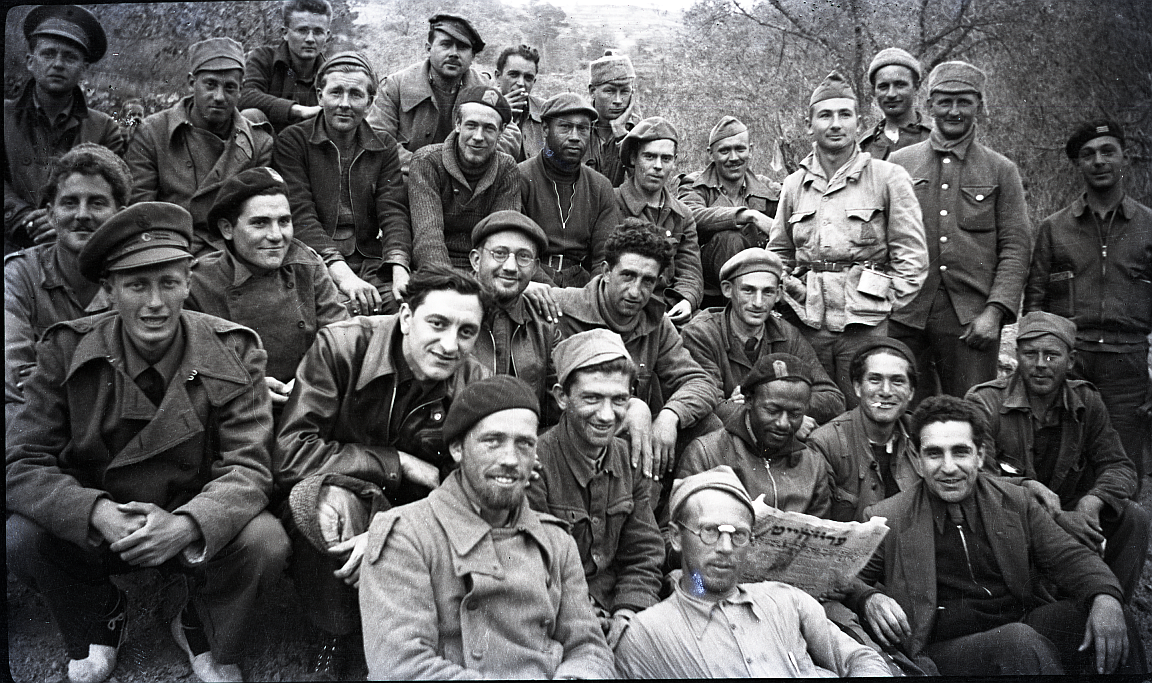
Tamiment Library, ALBA.PHOTOS.010 Box 3, Folder 8.
The iconic group portrait of raggedy Lincoln Brigade volunteers that’s become ALBA’s calling card over the years is now finally available in an uncropped, high-res print. When and where was it taken? And who exactly are these 29 men?
Sometimes the images we see most often are the ones we know least about. Iconic photographs appear to say so much that it seems unnecessary to ask questions. Still, I’m a bit embarrassed to confess that I never seriously researched the precise circumstances that led to the powerful image that ALBA has used most frequently over the past couple of decades: the iconic group portrait of 29 Lincoln Brigade volunteers in Spain that we feature as the “hero image” on ALBA’s website. I’m sure you’ve seen it: All men but four are wearing hats; almost all of them are smiling—though some, arguably, wryly. And all are looking into the camera, except for the Black soldier near the bottom row who seems engrossed in reading a copy of The Forverts, New York’s leading progressive paper in Yiddish.
Although I have been strangely incurious about this picture, I did try several times to locate its original—if only to produce a better copy than the version we’ve been using, which I made some years ago by scanning it directly from Edwin Rolfe: A Biographical Essay and Guide to the Rolfe Archive at the University of Illinois at Urbana-Champaign, a small book published by Cary Nelson and Jefferson Hendricks in 1990. As the title indicates, most of Eddie Rolfe’s archive, which includes manuscripts, letters, and photographs, is at UIUC. I promised myself I’d drive down there sometime to see if I could locate an original of the group portrait. But I never got around to it.
Last fall, it occurred to me I could also ask the librarians to check for me. To my surprise, they said they could not find it. Only then did I remember that the ALBA Collection at NYU’s Tamiment Library also holds a set of Rolfe Photographs. When I finally managed to make a research appointment, it didn’t take me more than 15 minutes to find not just a small, contact-sized print of the image but the original negative.
Thanks to the Tamiment staff, we’re now pleased to present a new, uncropped, high-res scan from that negative as this issue’s centerfold. The print in the 1990 book on Rolfe includes a legend in which 20 of the 29 men are identified, an updated version of which we include here. Some ten years ago, the indefatigable Ray Hoff worked, with help from Chris Brooks, Alan Warren, and others, on ID-ing several others. Can you help us identify the handful of volunteers who are left?
Tamiment Library, ALBA.PHOTOS.010 Box 3, Folder 8.
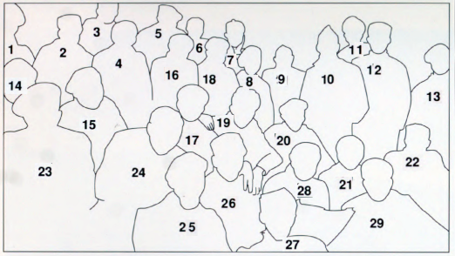
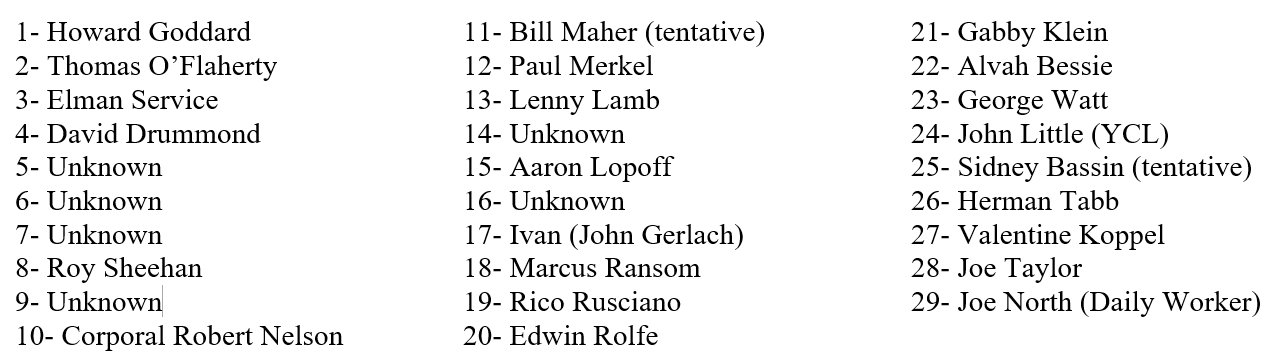 In addition to the names of the people portrayed, there are other questions. When and where, for example, was this photograph taken? We can begin narrowing down the dates thanks to the three people in it who weren’t part of the battalion: Edwin Rolfe, Joe North, and John Little. Rolfe belonged to the International Brigade staff—he edited The Volunteer—but wasn’t normally at the front. In mid-April, however, he wrote to his wife Mary that he’d be “spending some time with the Lincoln Battalion.” Nelson and Hendrickson explain he was responding to a “call for all able-bodied men behind the lines to join the Lincolns for front-line duty.” Joe North was the correspondent in Spain for the Daily Worker and the Canadian Daily Clarion. John Little, finally, was the executive secretary of the Young Communist League, who visited Spain around that same time. The June 1938 issue of the Young Communist Review included a story on Little’s “six weeks’ tour of the Spanish battle front,” stating Little entered Spain on April 2. And indeed, the April 13, 1938, issue of The Volunteer for Liberty reports on Little’s arrival, noting that he carried “1,000,000 American cigarettes and ten large crates of personal packages for the Americans in the Brigade.” “You will probably have already seen and spoken with Comrade Little by the time this number of The Volunteer reaches the brigade,” the article adds.
In a dispatch datelined in Barcelona on May 7 and published on May 8, Joe North reported in the Sunday Worker, the DW’s weekend edition, that when Little “came with news from home, they flocked around him almost within earshot of the enemy, across the river. They were the large contingent of Y.C.L.’ers among the volunteers here. Others not in the Y.C.L. crowded about to talk with the American youth leader.” North added that he “accompanied Little on most of his trips to the brigade out in the lines” and describes a conversation with him “in the lines held by the Fifteenth Brigade—deep entrenchments, a complicated network with numerous machine-gun emplacements.” (The same piece came out in the Clarion on May 10.)
Combined with North’s report and Rolfe’s letters, this information allows us to date the photograph between roughly April 10 and May 8. To narrow down the date further, we consulted the notebooks that Alvah Bessie—clearly recognizable in the picture, crouching to the far right—kept during these days. And, yes, his entry for April 11 reads: “John Litel, secretary Y.C.L. here, spoke to men, change in American sentiment.” (Bessie’s misspelling of the Y.C.L. secretary’s name makes sense; having worked in Hollywood, he must have thought of the well-known Warner Brothers actor John Litel.)
Could the photograph have been taken that same day? It doesn’t seem likely, because Rolfe hadn’t joined the group yet. After a hospital stay to take care of an infected tooth, Bessie returns to the battalion on April 21. On April 22, he notes that “Edwin Rolfe … turned up.” On April 28, as the group moved to the small town of Darmós, Bessie reports a visit by Joe North, “Daily Worker correspondent.” On May 4, he once again notes that the day before, there were visits from “Bob Minor, Joe North, Hans (division commander) and other notables.” Although it seems possible the photograph was taken on May 3, 1938, it could have just as easily been April 28. Ray Hoff tells me he leans toward April. “Some of the officers whom we know were on the May 1-10 paylist are not in the photo,” he points out. “George Watt and Howard Goddard, who were assigned to the 35th Estado Mayor at the time, appear; but Jim Bourne isn’t in the picture, and neither are Milt Wolff and Fred Keller. I would have thought Milt would have posed with a New York Y.C.L.’er if he had the chance.”
In any case, it was a difficult time for the Spanish Republic and for the US volunteers. In a chaotic retreat in which Robert Merriman and Dave Doran, among others, were lost, the Lincolns had been forced to cross the Ebro River. On April 15, the rebel army broke through the Republican lines and reached the Mediterranean coast, isolating Catalonia from the bulk of the remaining territory held by the Republic. Here are more of Bessie’s notes from early April:
Reached Mora de Ebro about 4:30 p.m. after 25 hours flight—sore feet, exhaustion. Fascists arrived in Mora soon; we blew bridge, retreated to other shore. Hundreds of men from all IB units, complete disorganization, men wandering around looking for their units. No command; demoralization. [April 2]
No question that IB is now badly broken up; most of Lincoln-Washington Battalion still missing, also Mac-Paps, Franco-Belge, Thaelmann, etc. … Obvious that the fascists will reach sea and cut Spain in half. … Unless France comes in here Spain is sunk. [April 3]
Innumerable stories of narrow squeaks—some men had to swim the Ebro and wander around naked till found and clothed again. (George Watt, Joe Hecht, etc.) [April 4]
Behind the lines at Mora la Nueva (on the Ebro). A week now since we were surrounded above Batea (March 31-April 1) and the battalion was split up. 70 men (about 35 Spanish) only have been rounded up—none of the Estado Mayor (Merriman, Doran, Wolff, Ofsink—captured or killed). Apparent now that almost 70% of the [Lincoln-Washington] is missing—either dead, captured or still wandering in the hills, trying to get across the Ebro. … Situation extremely difficult, demoralization great. [April 6]
Behind Mora la Nueva. Resting in gullies in the hills. About 120 of the [Lincoln-Washington] have turned up. Some swam the Ebro. Capt. Wolff, [Battalion Commander] has got back—only one of Estado Mayor. Doran and Merriman, Ofsink, etc still missing. A good 3/4 of the battalion killed, captured, missing or fucked off. Men’s nerves on end with uncertainty and inactivity. [April 8]
At the end of April, the remaining US volunteers dug in on the east side of the Ebro, between García and Darmós, as their battalion and the rest of the XV Brigade were reconstituted with mostly Spanish recruits. The volunteers smiling in the photograph, in other words, were survivors who had lost their commander, Merriman, only days earlier, along with other friends and comrades. The picture represents a short period of relative quiet. Less than two months later, the 27 volunteers—not counting Little and North—returned to action to fight the Battle of the Ebro, in which at least two of them, Aaron Lopoff and Thomas O’Flaherty, would die.
Sebastiaan Faber teaches at Oberlin College.






