
The Cost of Fighting Franco: Two Spaniards Before HUAC
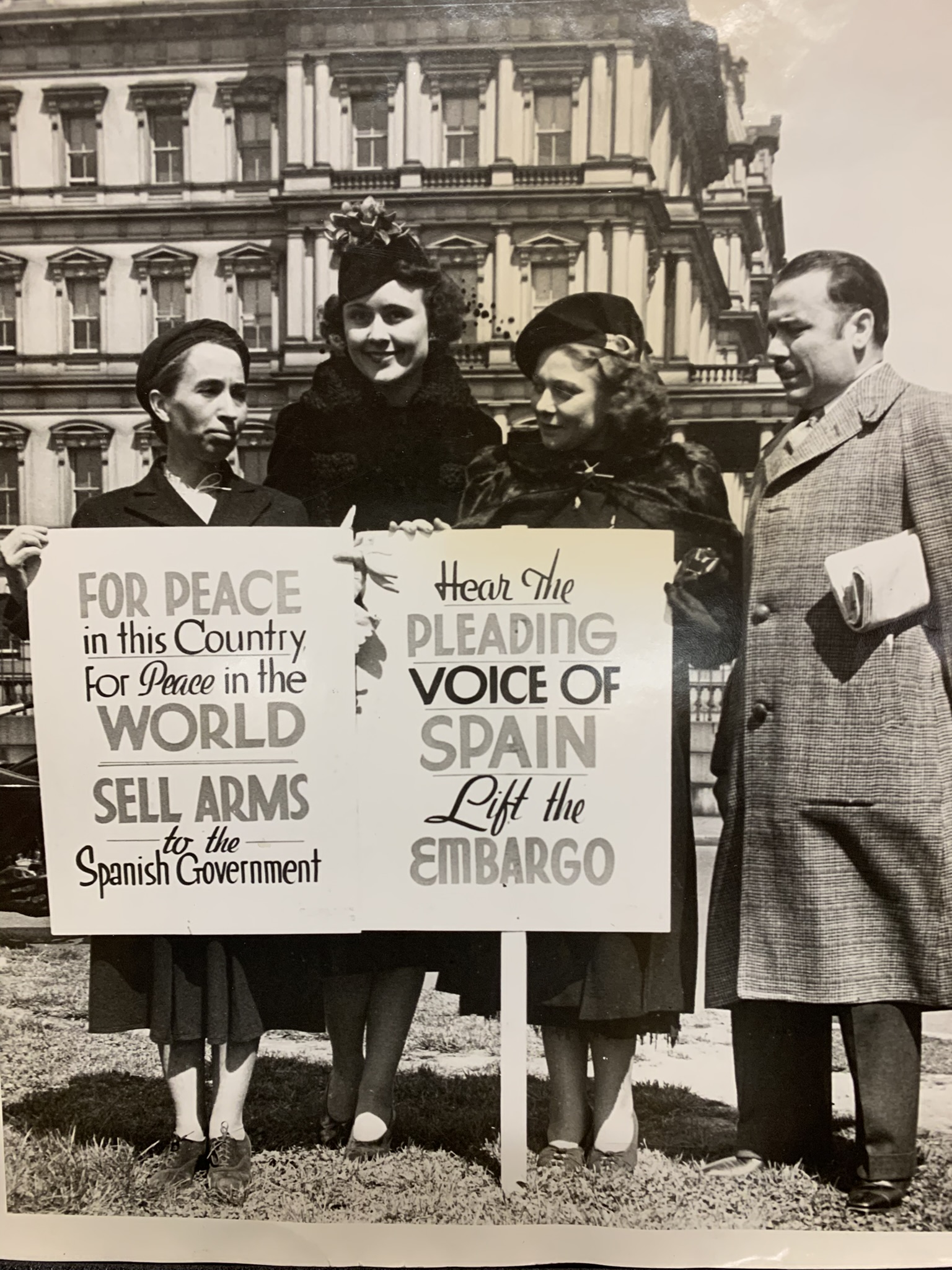
Ernestina González (left) at a protest in DC, 1937. (Spanish Refugee Relief Records, Rare Books and Manuscripts, Columbia Univ.)
In 1946, the leadership of Edward Barsky’s Joint Anti-Fascist Refugee Committee stood up to the House Un-American Activities Committee. For Ernestina González and Manuel Magaña, the brave gesture of defiance was only one chapter in their activist lives.
Eighty years ago, the executive board of the Joint Anti-Fascist Refugee Committee (JAFRC), founded in 1942 in New York to aid Republican refugees, was summoned to Washington by the House Un-American Activities Committee (HUAC). Among the seven women and ten men who testified along with the JAFRC’s chair, the surgeon Edward Barsky, were two Spaniards: Manuel Magaña, a merchant from Aragon, and Ernestina González, a librarian from Burgos.
After founding the American Medical Bureau to Aid Spanish Democracy in 1936, Barsky had traveled to Spain during the Civil War with a group of American nurses, medical supplies, and ambulances donated by New York organizations that supported the Spanish Republic. In 1942, Barsky and a group of collaborators—including Ernestina—founded the JAFRC with two clear objectives: “As long as there remains a single Spanish refugee or member of the International Brigades in a concentration camp who is in danger or in need of aid, wherever they may be, we will provide it”; and “we will continue to expose to the people of the United States of America the dangers of the policy of appeasement toward Franco.” [For more on Barsky and the JAFRC, see the December 2024 issue of The Volunteer—eds.]
Accompanied by numerous friends and supporters, the group, known as “the Eighteen,” traveled by train from New York to the capital on April 4, 1946. HUAC claimed that the “Joint,” as it was known, was not engaged in humanitarian aid but subversive propaganda. Facing the congressional committee, all eighteen witnesses stood their ground, reading an identical statement in which they refused to hand over the organization’s books because they believed that doing so would endanger their donors, the refugees, and their families. “Individually,” they declared, “I do not have possession, custody, or control over any of the material requested in the subpoena that was served upon me … Thus, I am unable to comply with your order to produce them.” As a matter of principle, they asserted that they would submit their records to the government or any civic organization—but not to HUAC.

Ernestina González, 1946. (Spanish Refugee Relief Records, Rare Books and Manuscripts, Columbia Univ.)
Eighty years later, it is clear that the Eighteen were among the first victims of a witch hunt that had only just begun. During McCarthyism, which screenwriter Dalton Trumbo dubbed “the era of the toad,” thousands of Americans found themselves accused of being “subversives” and “anti-Americans.” Some leftists would cover the spines of their books so no one would know what they were reading, cross out their friends’ names from their address books to protect them, or move with their families to Mexico.
The JAFRC’s executive board included doctors, professors, film directors, and lawyers. Barsky, González, and Magaña, worked side by side with novelist Howard Fast, labor organizer Charlotte Todes Stern, NYU professor Lyman Bradley, and attorney Ruth Leider, among others. When they stood up to HUAC, they were well aware of what awaited them. In addition to being tried for contempt of Congress, many lost their licenses and their jobs.
The two Spaniards among them, Manuel Magaña and Ernestina González, are interesting in their own right. Born in Aranda del Moncayo, in Aragon, in 1892, Magaña ran a hardware store in Harlem with his brother-in-law. His story illustrates the vicissitudes of emigration: After traveling to Argentina at the age of sixteen, he made it to the United States as a steward on a ship; he then worked for two years in Havana before finally settling in New York. By 1939, in his mid-forties, he had obtained U.S. citizenship, chaired the Spanish Workers’ Club, and was a member of the Committee for Spanish Democracy. In 1943, he traveled to Mexico with Ernestina and Barsky to participate in the Convention of Solidarity with the Spanish People. In the face of a grueling interrogation from HUAC, his anti-Franco commitment was unwavering. From his statements it is clear that his command of English was not excellent. When he tried to read his statement, the interrogators suggested sarcastically that he check his pockets for the documents they were asking for. “You’re rubbing your nose right up against the gates of the penitentiary here,” one committee member threatened.
Ernestina González Fleischman, who was born in 1896 in Medina de Pomar, near Burgos, became a U.S. citizen after marrying Leo Fleischman, a mining engineer from New York. In 1926, she arrived in Nebraska to work as a Spanish lecturer at the University of Nebraska–Lincoln. After marrying in Queens, she and Fleischman moved to Madrid. Her husband’s tragic death while volunteering at an arms factory in the beginning of the 1936 war [a story covered in our March 2025 issue—eds.] changed the course of her life. After settling in New York with her mother-in-law, Ernestina would spend the next two decades fighting for the Republican cause. In addition to creating the United Women’s Committees in 1937, she was a founding member of the JAFRC, contributed to the press, and hosted a radio program titled “The Voice of Fighting Spain.” During that long day of interrogations in DC, her impeccable English allowed her to respond with irony to HUAC’s questions, which at times appeared surreal. “I think the question is not pertinent,” she said at one point, “but if you say it is pertinent, then I should like to consult my lawyer.” Her unflappable demeanor drove some committee members to exasperation.

Manuel Magaña (middle) visiting Aranda de Moncayo, 1967. Archivo de la familia Vicente Val.
Eventually, all eighteen witnesses were convicted of contempt. The eight men and five women who stood firm until the end included Magaña and González, who were both sentenced to three months in prison. Barsky, as chair, received a sentence double that length. On the day of Magaña’s incarceration, in June 1950, some veterans of the Lincoln Brigade demonstrated in front of the White House with signs reading, “Franco was Hitler’s pal, no U.S. deals with Franco.”
Coinciding with the group’s imprisonment, Howard Fast published a statement explaining the principles behind their refusal to hand over their books: “We held that American citizens could not be forced to become hangmen and informers.” Ernestina and the association’s secretary, Helen Bryan, were the last to be admitted to Alderson Prison in Virginia. The press published the archivist’s statements after the verdict was announced: “If it is a crime to help and defend the victims of the fascist Franco, who, with the aid of Hitler and Mussolini, wiped out half of Spain and destroyed its democratic institutions, then I am guilty. My associates and I are victims of Franco’s friends in the United States.”
In 1955, the JAFRC was dissolved. Ernestina González went into exile in Mexico. She eventually returned to Spain, where, after a legal battle, she managed to be reinstated as a librarian. She died in Madrid in 1976, a few months after Franco. Manuel Magaña continued to run his business, living in the Bronx, and died in Illinois in 1970. Some documents in his family archive show that in the 1960s he continued to send aid and boxes of clothing to political prisoners and relatives in Spain. His Aragonese family recalls that he would send his sister anti-Franco newspapers published in New York. Both remained steadfast in their beliefs and their commitment to democracy. The House Un-American Activities Committee was abolished in 1975.
Ana María Díaz Marcos is a professor of Spanish at the University of Connecticut. Her biography Ernestina González, un pulso antifranquista has just come out with Renacimiento (Seville). Translated by Sebastiaan Faber.






