
Catalan Government Recovers Lincoln Brigade Remains
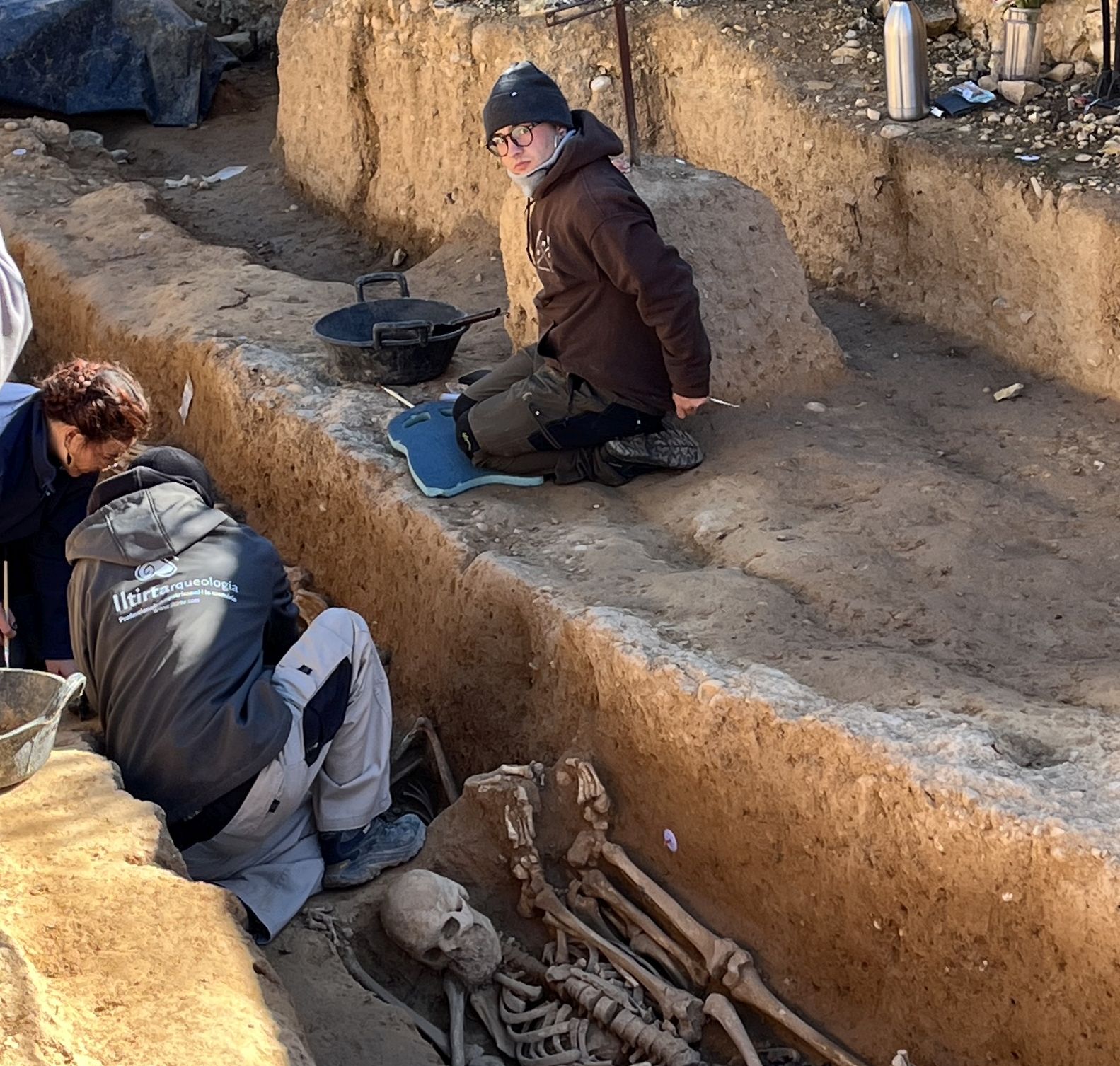
Exhumation near La Bisbal de Montsant. Photo Steve Dinnen.
The Catalan government has recently disinterred the remains of 45 international combatants from a mass grave, hoping to match them with descendants. They include two Americans.
No war goes gently. For the 2,700 Americans who went to Spain from 1936 onward, it was especially brutal. Nearly 800 men, close to one out of three, died on the battlefield or in field hospitals. Moreover, their burial spots are largely unknown. Soldiers killed in battle typically were buried where they fell, with no marking or headstone so as to not tip off fascists who might later prowl through the area. Even the graves of the volunteers who died from wounds or ailments away from the battlefield are often not documented. Recently, however, the government of Catalunya has disinterred 45 combatants from a mass grave near the Battle of the Ebro, hoping to match them with descendants who might accept them for individualized reburials. We know that two Lincoln Brigade fighters are among them.
Until well after the war, we only knew the burial site of three members of the Lincoln Brigade. Abraham Schwartz, who died of Typhoid in 1937 in a hospital, was buried in the village cemetery in Saelices. Bernard Singer, who was killed in action during the Ebro offensive in September 1938, lies in a mass grave near the railway tunnel at Argentera. John Cookson, finally, who was killed in action on September 12, 1938, was buried alongside a stream just outside of Marca, Catalunya. Cookson’s is the only known tombstone of a Lincoln: It was hidden under weeds off the road and authorities during the Franco regime and never discovered.
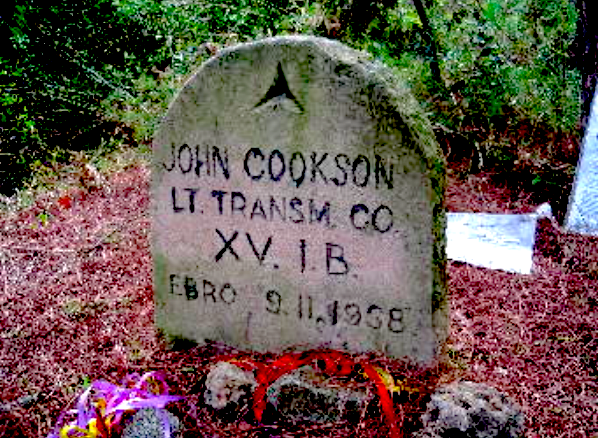
Cookson’s grave.
Since then, two more graves have been discovered, though they lack tombstones. They can be found just a few kilometers from Marca, in the small Catalan town of La Bisbal de Montsant, which was known in 1938 as Bisbal de Falset. On the western edge of the town there is a large cave—rather, a gaping hole in the side of a mountain—that during the Battle of the Ebro, beginning in July 1938, was used as a field hospital. Known as Cova de Santa Lucia, it was staffed mostly by medical personnel from England. Aside from sheltering patients and medical personnel, the cave also had a small fresh-water spring. (The British historian Angela Jackson wrote about the cave and the people who worked there in her 2005 book Beyond the Battlefield).
The cave hospital is just west of the village. The town cemetery, just to the south, received bodies of soldiers who perished. Someone—a graveyard attendant, perhaps—kept a list of bodies that shows the date the bodies arrived, the name of the deceased, and a military unit. In 1954, the Justice of the Peace of La Bisbal de Falset used this information to compile a list that identified 70 soldiers who were buried in the town cemetery.
All were members of the XV International Brigade. The government of Catalunya later determined that 14 were international volunteers from Poland, Romania, Germany, and other countries. Two are Americans: number 35 on the list is Milton Gale, identified as comisario (commissar); no. 40 is identified as “Graunille Payme,” soldado. This is Granville Paine; the list contains spelling errors.
Milton Meyer Gale was born Milton Galitzka in 1914. According to his biography in the ALBA online database, he spent two years at the College of Miami (more probably Miami University in Oxford, Ohio). He was single and a writer and joined the Communist Party in 1934. He also belonged to the YCL and Spanish CP. Gale sailed to France on February 20, 1937, aboard the Ile de France, and arrived in Spain on March 15, 1937. Gale served with the XV BDE and as commissar attained the rank of teniente (lieutenant). There is no mention in the database about the wound he sustained at the Battle of Ebro. It is not known exactly when he was wounded or died, but the cemetery list indicated that his body was brought there on July 29.
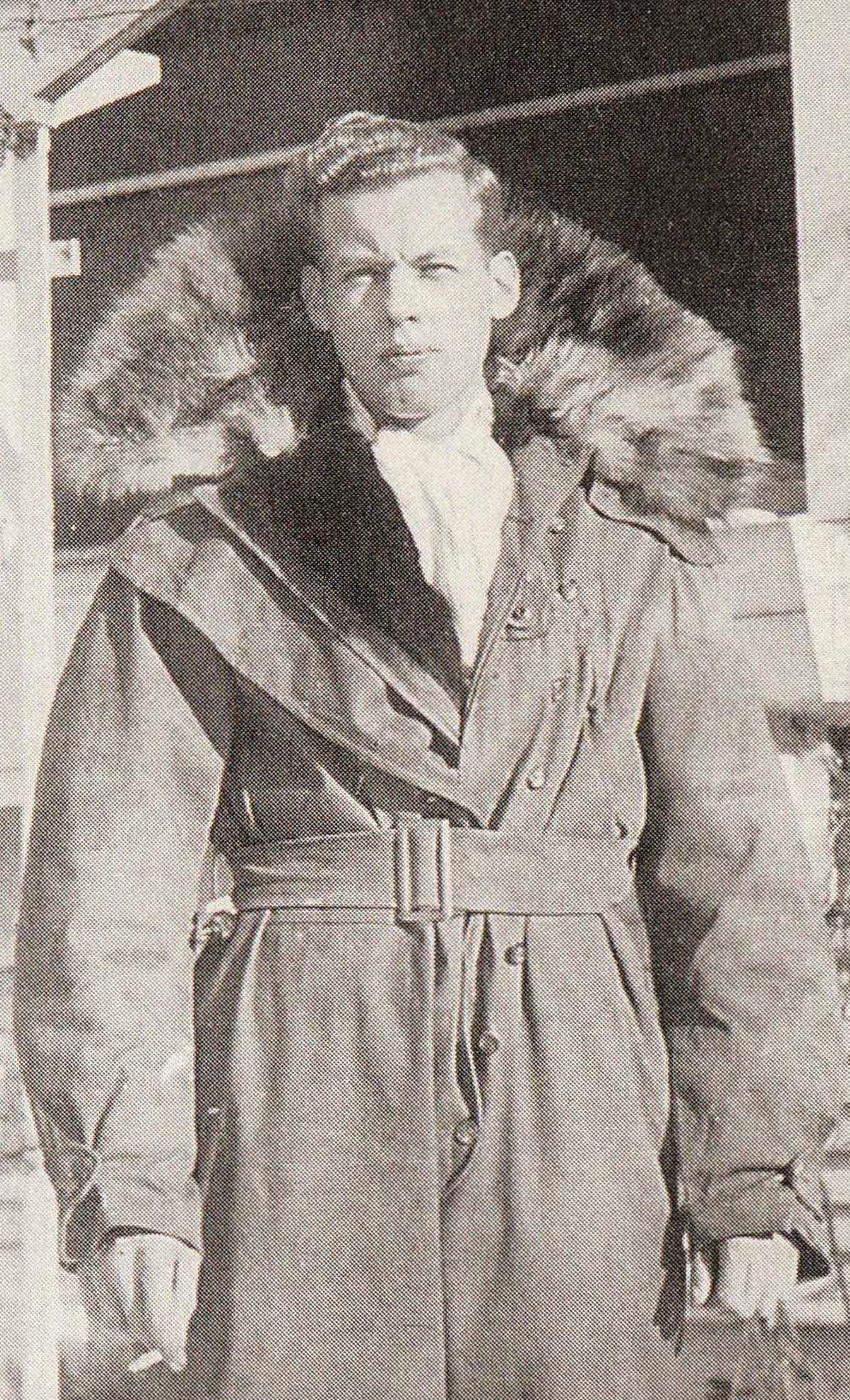
Walker Paine in 1937. From Hank Rubin’s memoir.
The body of Granville Walker Paine arrived the next day. The nature of his injuries and death date also are unknown. But his service record account as compiled by ALBA show he had an active and troubled time in Spain. Born in 1915 in Everett, Washington, Paine had a high school education, was single, and worked as an assistant manager at an air transport company. (Could that have been Boeing Co.? It was founded in Seattle in 1916 and assembles its aircraft today in Everett at Paine Field, coincidentally named in honor of Paine’s uncle, aviator Lt. Topliff Paine). Paine, who belonged to the YCL, received a passport on July 16, 1937, and quickly set sail for Europe, arriving in Spain on Aug. 6. He served with the Mackenzie-Papineau Battalion, from whom he and three companions stole an ambulance and headed for the French border. They were arrested there. After contracting jaundice, Paine was hospitalized in Figueras. Afterwards he was jailed for 30 days; then he was sent back to Brigade. He was reported in a hospital in Híjar on April 5, with an unrecorded ailment, but rejoined the battalion in time for the Ebro offensive—and his death.
The list compiled by the local Justice of the Peace was not a secret. Indeed, Jackson included a copy of it in her book. She also wrote extensively about post-war visits to the cave hospital and cemetery by medical aid workers and families. The Catalan government took the list into account as exhumations began across the autonomous community and nationwide.
Exhumations of mass graves from the war have been frequent in Spain over the past 25 years. More than 100,000 mostly civilian victims of right-wing violence remain unaccounted for. After Franco’s death in 1975, family members undertook efforts to recover their remains, but those efforts were cut short in the early 1980s, following the failed military coup of 1981. That coup failed in the sense that it did not bring about a regime change, but some would argue that the coup succeeded in that it revived the fear that had allowed Franco to reign for almost forty years; spontaneous exhumations were abandoned. It was not until the year 2000 that a new wave of volunteer-led exhumations began, now with professional assistance from forensic anthropologists. A first Historical Memory Law, passed by the Spanish parliament in 2007, established limited government support for searches for the disappeared, which increased somewhat with the Democratic Memory Law of 2022. At the regional level, however, memory policies vary widely.
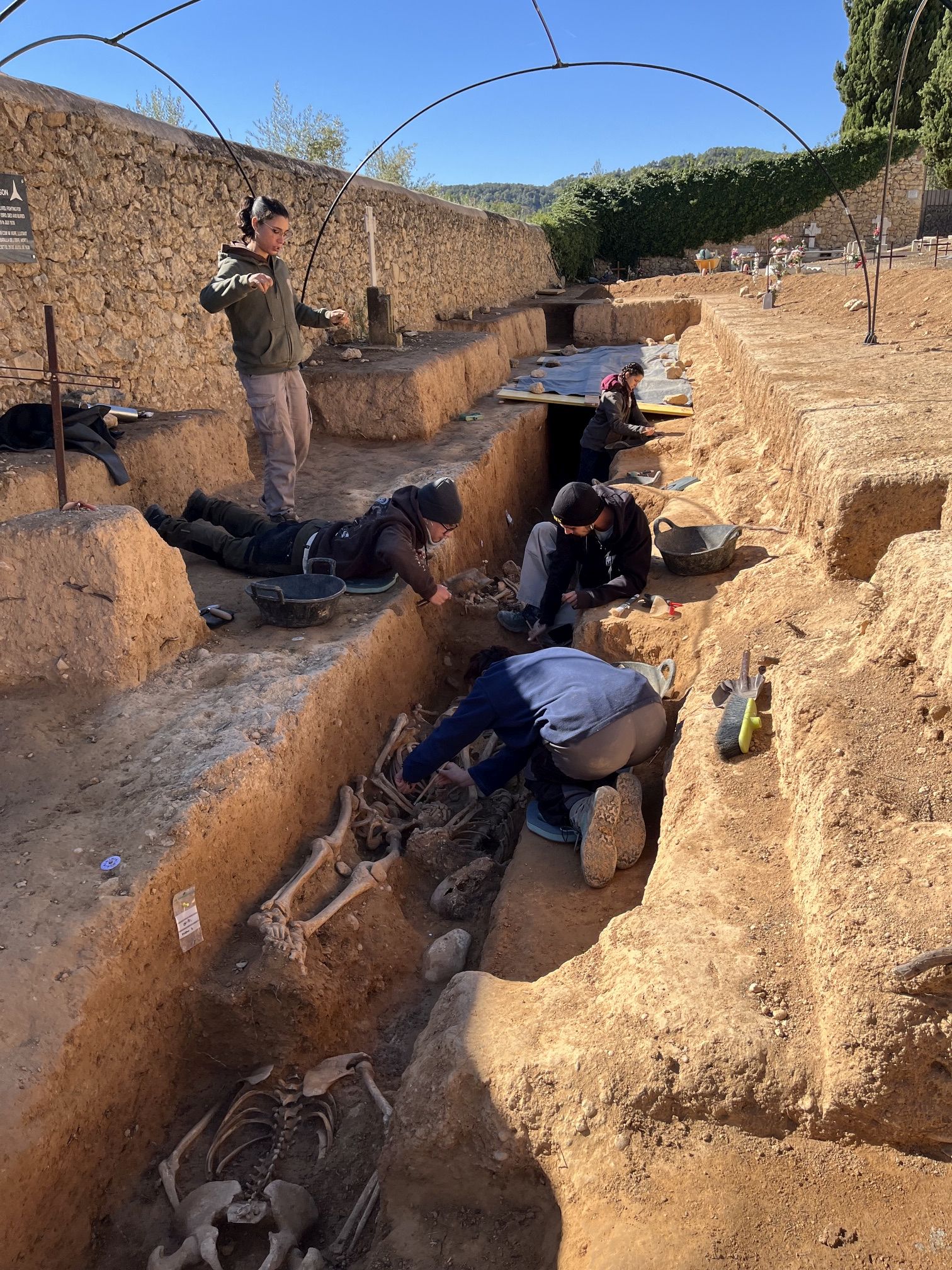
Exhumation near La Bisbal de Montsant. Photo Steve Dinnen.
In Catalonia, the regional Department of Justice and Democratic Quality, through the General Directorate of Democratic Memory, has been especially active in identifying gravesites. It has identified hundreds of places where dead are buried and has carried out dozens of excavations (also called interventions or exhumations). The intervention at La Bisbal de Monsant was included in its 2023-2025 Graves Plan, and on June 25, 2025, work began.
A 20-person-strong team of archaeologists, anthropologists, and geneticists set about with shovels and picks, then hand tools. “It was a complex and meticulous eight-month excavation,” said Anna Santamaría López, who works at the General Directorate of Democratic Memory.
The fieldwork took so long due to rainy weather in Catalonia. It was extraordinarily wet and cold, so work periodically stopped. “On the other hand,” she said, “considering that the mass grave was located in a regular cemetery, we needed to be extra careful with the area and do the major part of the work manually.”
Most of the buried, skeletons by now, were in a supine position and well aligned with space between bodies. That suggested they were buried with care and respect. The remains show clear evidence of their connection to the battle and activity at the cave hospital. Traumatic injuries compatible with projectile impacts from firearms and other wounds typical of a war context were detected in several skeletons.
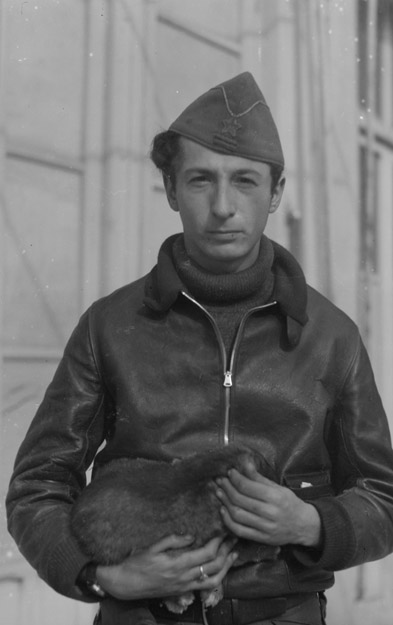
Milton Meyer Gale in Spain. RGASPI.
In all, 50 bodies were recovered. They are currently in the laboratory of Iltirta Arqueologia, a private company of archaeological experts that was contracted for this project. At the time of the exhumation a specialized anthropologist selected the most relevant bones of each individual to later extract the DNA sample in the laboratory. Usually, the sample is extracted from the jaw. Further details on their findings and technical reports can be accessed via the Generalitat de Catalunya Justice Department repository.
The end goal of the project is to identify the victims and return them to their families through the Missing Persons Census and the Genetic Identification Program. The fate of the bodies of Gale and Paine is unknown at this time. There are no records of descendants of Gale. A niece of Paine’s visited La Bisbal de Montsant in 2008 and saw both the cave hospital and cemetery. She also met with town officials. Another niece, reached in July by The Volunteer, said the family was not interested in participating in a DNA match.
Not all families can be identified, and not all will participate in a DNA match. Still, F. Xavier Menéndez, director general of Memoria Democratica, has emphasized that this intervention “allows us to continue making progress in the recovery of the victims of the Civil War and in the restitution of their dignity.
“Every pit that is opened,” he said, “is an opportunity not only to return the identity to people who disappeared in the context of the war and to respond to the families who still claim them today, but also to fulfill a democratic, political, and social duty with the collective memory of the country.”
Steve Dinnen lives and works in Des Moines, Iowa. He travels to Spain frequently and has long held an interest in the Veterans of the Abraham Lincoln Brigade.






