
Book Review: Brigadistes—Lives for Liberty
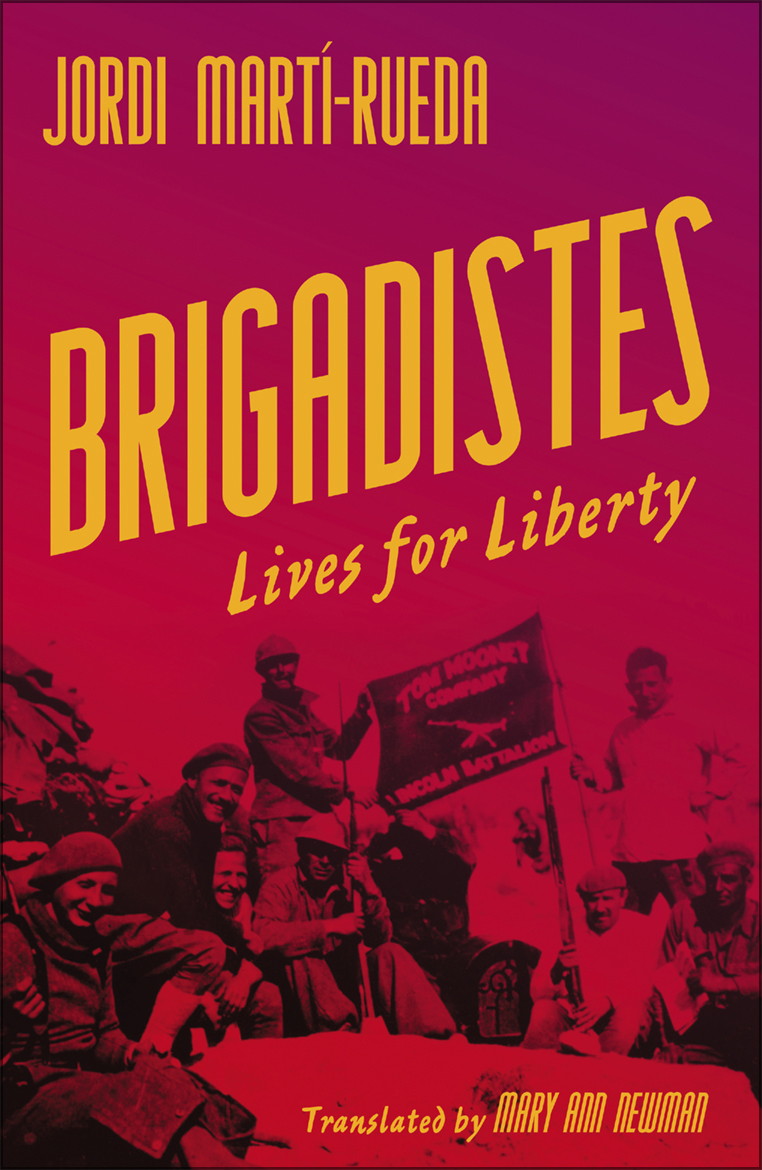 Brigadistes: Lives for Liberty, by Jordi Martí Rueda. Translated from the Catalan by Mary Ann Newman. Pluto Press, 2022. $18.95 (paperback with free ebook); $12.95 (ebook).
When the Catalan writer Jordi Martí Rueda first met some of the members of the Lincoln Brigade, he was smitten. It was back in 1996, when hundreds of brigadistas gathered for a commemorative event at the Autonomous University of Barcelona—an event that Martí, then a history student who was barely twenty years old, had helped organize with a couple of friends. His eyes still light up when he remembers those days.
From that moment on, Martí has been part of the small but powerful community of writers, researchers, activists, and educators in Spain who won’t let their fellow citizens forget about the volunteers who flocked to the country from all over the world to support the Second Spanish Republic when it was attacked by international fascism. Over the past couple of decades, Martí has dedicated a good part of his life to researching the brigadistas’ biographies and writing about them. In 2015, he published Cinc històries humanes de les Brigades Internacionals i la Guerra Civil (Five Human Stories of the IB and the Civil War); five years later, he added Brigadistes. Vides per la llibertat (Brigadistas: Lives for Liberty). His most recent book is Passarem (We Shall Pass, 2026). As a professional historian working for the Catalan government, moreover, Martí has been closely involved in the Alvah Bessie Program, which aims to locate and exhume the international antifascist volunteers who died during the war and were buried in Catalan soil. The goal of the program, which includes a DNA database, is to identify the remains, inform the descendants, and, if the family wishes, return the remains to them.
The second of Martí’s three books on the Brigades, Brigadistes, was published in 2022 by Pluto Press in Mary Ann Newman’s excellent English translation. In a short 142 pages, Martí shares touching vignettes, each accompanied by a photo, featuring some sixty of the more than 35,000 international volunteers. They include a good number of Americans: Jimmy Yates, Evelyn Hutchins, Milton Wolff, Salaria Kea, Oliver Law, Anne Taft, and Esther Silverstein, among others. Martí’s sampling does not seek to be representative of the IB population; if anything, English-speaking volunteers are overrepresented.
Because Martí has set himself the challenge of portraying each volunteer in fewer than 400 words, his texts cannot be complete biographies. Yet we can’t call them snapshots, either; they are more poignant and powerful than that. The description that perhaps best fits them is the way Martí himself describes the sketches of fellow fighters that the British artist and antifascist volunteer Felicia Browne left behind when she was killed while trying to help a wounded Italian comrade: “figures with the vitality of the swift line of an ephemeral draft.” Here, for example, is the final paragraph of the vignette dedicated to Esther Silverstein:
[At] Brunete, one of the most deadly battles of the war, … she assisted the Catalan surgeon Moisès Broggi in the operating room. She didn’t speak Catalan or Spanish, and he didn’t speak English, but this was no obstacle to their doing thirty operations in twenty hours without a break. What she would never forget, though, were the mothers in Lleida. She was there one afternoon when the children had been dismissed from school and had run to the market to buy candy. No one noticed the bombers until they were right over their heads and opening their hatches. When they flew away the only thing left were the broken bodies of the children scattered through the Dantesque geography of what had been the market, the shrieks of the mothers crying out for their children, and Esther there in the midst of it all, compelled by an unseen force to remain in place right where she was. “I will never forget Lleida as long as I live,” she would later say in a speech in California. “Children must be able to buy candy in the market on the square without bombs raining down upon their heads.”
Written as tributes, Martí’s books have helped introduce to a Catalan reading public some of the most remarkable individuals among the thousands who joined the war. For American readers, this extremely readable translation is a great opportunity to experience an outsider’s view of the Lincolns—but also to learn about some of the many volunteers from other countries. Helpfully, the book comes with many pages of notes and suggestions for further reading.






