
Manuel Periáñez-Ginestà (1940–2026)
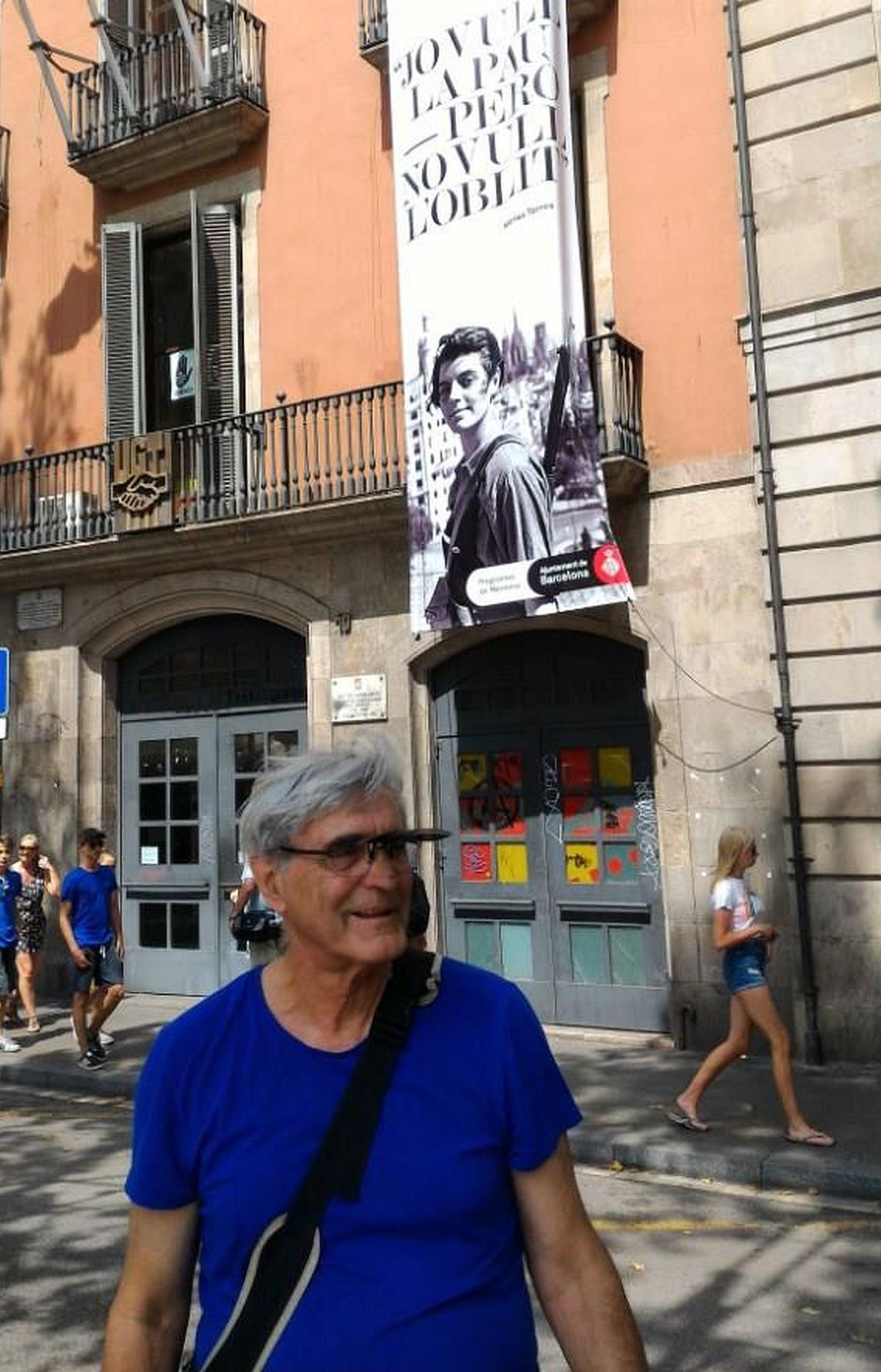
Manuel Periáñez in Barcelona, 2016, with his mother’s portrait in the background.
Manuel Periáñez, who died in Paris on February 9, was the proud son of Spanish Republicans. Both his parents had fought for the Republic and were forced into exile as a result of Franco’s victory. His father, Manuel Periáñez Martín, served as a major in the Republican army; his mother, Marina Ginestà i Coloma, grew up in Toulouse, in southern France, because her family had previously fled Spain for political reasons. In 1931, with the proclamation of the Spanish Republic, the family returned to Barcelona. During the war, she served as an interpreter for Mikhail Koltsov, the well-known Soviet correspondent. (Marina, whose portrait by Juan Guzmán would become an iconic photograph of the Spanish war, is profiled here.)
Manuel was born in December 1940 in the Dominican Republic, where his parents, who had met on the boat, were living as refugees. (The right-wing Dominican dictator Trujillo had admitted a large group of Spanish Republicans in order to “whiten” the country; in fact, the Spanish refugees would eventually play an important role in the fall of his regime.) The Periáñez family did not stay long, however, moving to Venezuela as soon as the opportunity arose. There, Manuel’s parents separated, and Marina married a Belgian diplomat. For the young Manuel, this marked the beginning of an entirely new life. In 1953, when his stepfather was appointed to the Belgian embassy in The Hague, Manuel became, in a sense, Dutch: He learned to speak the language fluently and went on to study architecture in Delft.
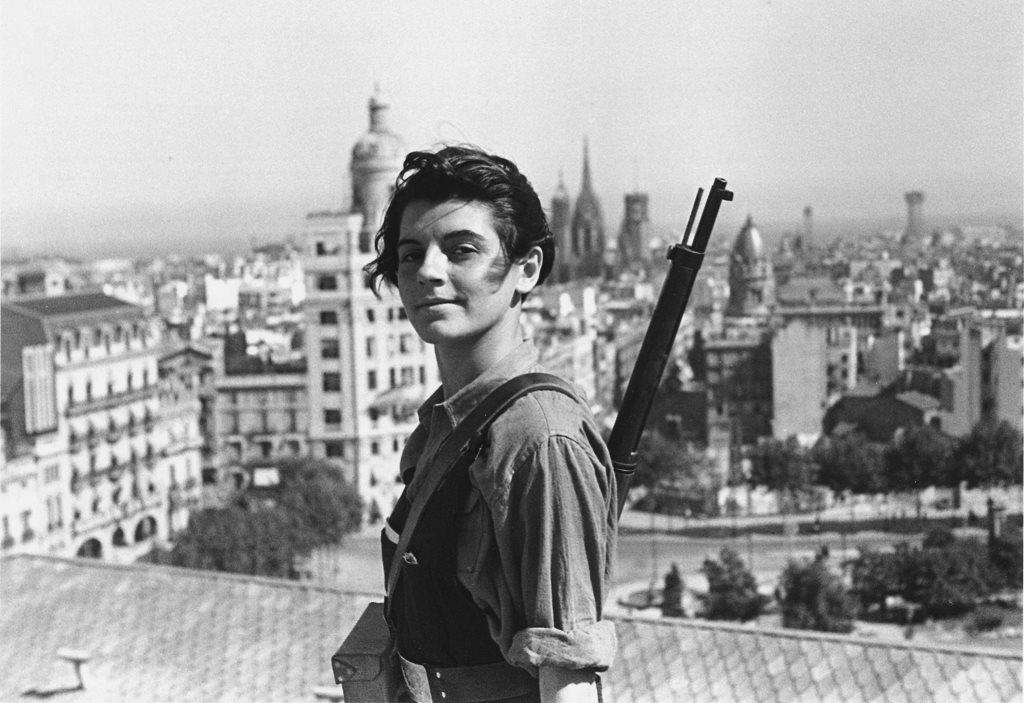 For a long time, Manuel knew very little about his parents’ revolutionary past. In diplomatic circles, his mother, Marina, could hardly boast that she had served as an interpreter between a confidant of Stalin and the renowned Spanish anarchist Durruti. Even many years later, when the famous photograph surfaced showing her at age 17 on the roof of the Hotel Colón in Barcelona with a rifle slung over her shoulder, she stubbornly maintained that the photographer had simply put the rifle in her hands—she had never fired a shot. Manuel later demonstrated that Marina had done far more than merely pose for a photograph.
During his student years in the Netherlands in the early 1960s, Manuel became a Trotskyist—much to his mother’s amusement—and befriended well-known Dutch Trotskyists such as Fritjof Tichelman, Sal Santen, Igor Cornelissen, and Maurice Ferares. The suicide of his partner in 1967 marked a turning point in his life. He lived for a time in Italy and eventually settled in Paris, where he worked as a sociologist and psychotherapist. In the final years of his life, he became increasingly fascinated with his parents’ revolutionary past. He ensured that the largely autobiographical books his mother had written in the 1970s were republished. He also contacted the photo agency that had distributed the now iconic image of his mother and contributed to several publications about her.
In 2016, Manuel was thrilled to see Guzmán’s portrait of Marina adorning the streets of Barcelona to mark the eightieth anniversary of the beginning of the Spanish war. In 2022, he published La Bande Mauve, Part 1, devoted to the complex history of his Spanish family. It was meant to be the first in a series that, unfortunately, he was unable to complete.
Yvonne Scholten is a Dutch writer and freelance journalist who has several biographies of Dutch volunteers in Spain and coordinated the online biographical dictionary of Dutch volunteers in Spain at www.spanjestrijders.nl. Translation by Sebastiaan Faber.






