
The Long Shadow of Anti-Communism: The Distorted Legacy of Juan Negrín
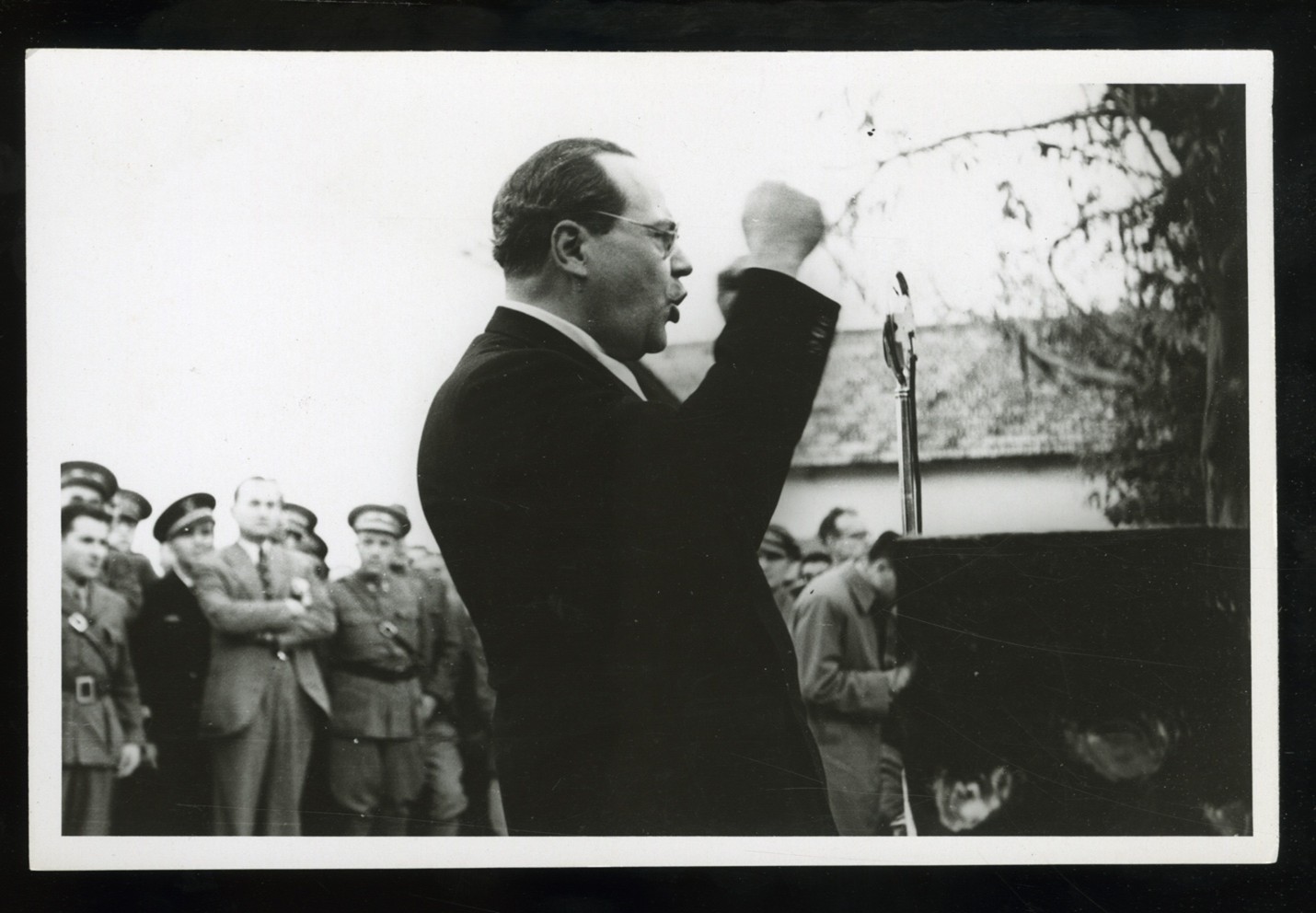
Negrín addresses the IB, October 1938. Archivo Negrín.
Few political leaders of modern Spain have been as maligned as Prime Minister Juan Negrín, who died in exile in 1956. But his personal papers, which have been only open to researchers since 2014, challenge long-standing portrayals of Negrín advanced by anti-Communist critics on both the left and right.
On 25 July 1938, Spanish Republican Prime Minister Juan Negrín authorized what would become the greatest military operation ever undertaken on Spanish soil: the Battle of the Ebro. It was the Republic’s most daring offensive, but also its most costly. Following General Vicente Rojo’s plan, Republican forces successfully took the west bank of the Ebro River. But they proved unable to hold it against the Francoist counteroffensive and over the following months suffered massive casualties. The operation was designed not only to strike a blow against nationalist forces and reunite the Republican zone that Franco had split in two; it was also a political signal—an attempt to demonstrate the Republic’s vitality to the western democracies in hopes of securing material assistance, increased aid, or at least diplomatic mediation.
But as Republican troops and International Brigades desperately defended the line with their backs to the Ebro, news arrived of Chamberlain’s deal with Hitler in Munich. It confirmed what Negrín and others had feared: Rather than confronting the expansionist Nazi regime, the western democracies would accommodate it instead. It was a death sentence for the young Republic. Within just six months, an internal coup toppled Negrín’s government, effectively bringing organized resistance to an end. Spain, now under Franco’s rule, remained ostensibly neutral while supplying Hitler with critical materials for the project of Nazi expansion, even as its population endured decades of hunger and repression.
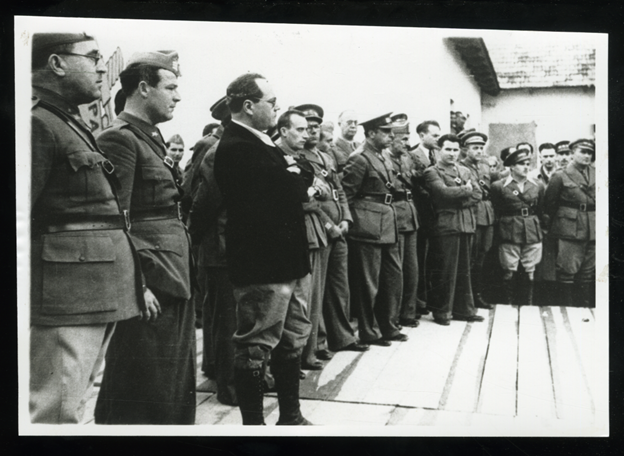
Negrín & generals at the despedida of the IB, Oct. 1938. Archivo Negrín
Negrín fled to Paris in March 1939, settling on the Avenue Henri Martin, where he lived with his companion, Feliciana López de Dom Pablo, until heart disease cut his life short in November 1956, less than three months before his 65th birthday. The documents Negrín smuggled out of Spain in 1939 lay for 75 years gathering dust in the basement of the Paris apartment, wrapped in civil war-era newspapers. After the death of Negrín’s son, Juan Negrín Jr., custody of the collection passed to Negrín’s granddaughter, Carmen Negrín Fetter. Negrín Jr. had long opposed making the papers public, fearing that their release would further compromise his father. Carmen, on the other hand, believed that the documents had their own story to tell and should be available to scholars. Under her direction, the collection was transferred to Spain, organized, and opened to researchers in 2013 at the Archivo Fundación Juan Negrín in Las Palmas de Gran Canaria. This achievement was only possible through the tireless efforts of Carmen, Sergio Millares, the late historian Gabriel Jackson, and a few other collaborators.
The collection includes effectively all the documents that crossed Negrín’s desk after May 1937, when he became prime minister. It offers a far clearer picture of his conduct during the war, particularly in its final decisive months. That evidence challenges long-standing portrayals of Negrín—advanced by anti-Communist critics on both the left and right—that he was a Communist dupe, a committed Stalinist, or a lazy opportunist who betrayed the Republic. Such interpretations gained wide acceptance during the Cold War, as the script for the Spanish war was rewritten to fit an increasingly rigid anti-Communist framework. In light of the documentary record, however, those interpretations are simply no longer tenable.
The Negrín that emerges from the archival record is a shrewd liberal statesman who put his immense energies to the task of sustaining the antifascist resistance while working persistently to overturn the so-called non-intervention of the western democracies—a policy that ultimately proved fatal to the Spanish Republic. His close collaboration with Soviet advisors and the Spanish Communist Party reflected not ideological affinity but rather a recognition of the hard realities of the war and the necessity for discipline, especially given that the Communists were undeniably the Republic’s most effective and organized party of war. Resistance grew increasingly unsustainable not because of Negrín’s policies, but because a pervasive anti-Communism—within Spain and beyond it—undermined cohesion, legitimacy, and the Republic’s capacity to continue the war.
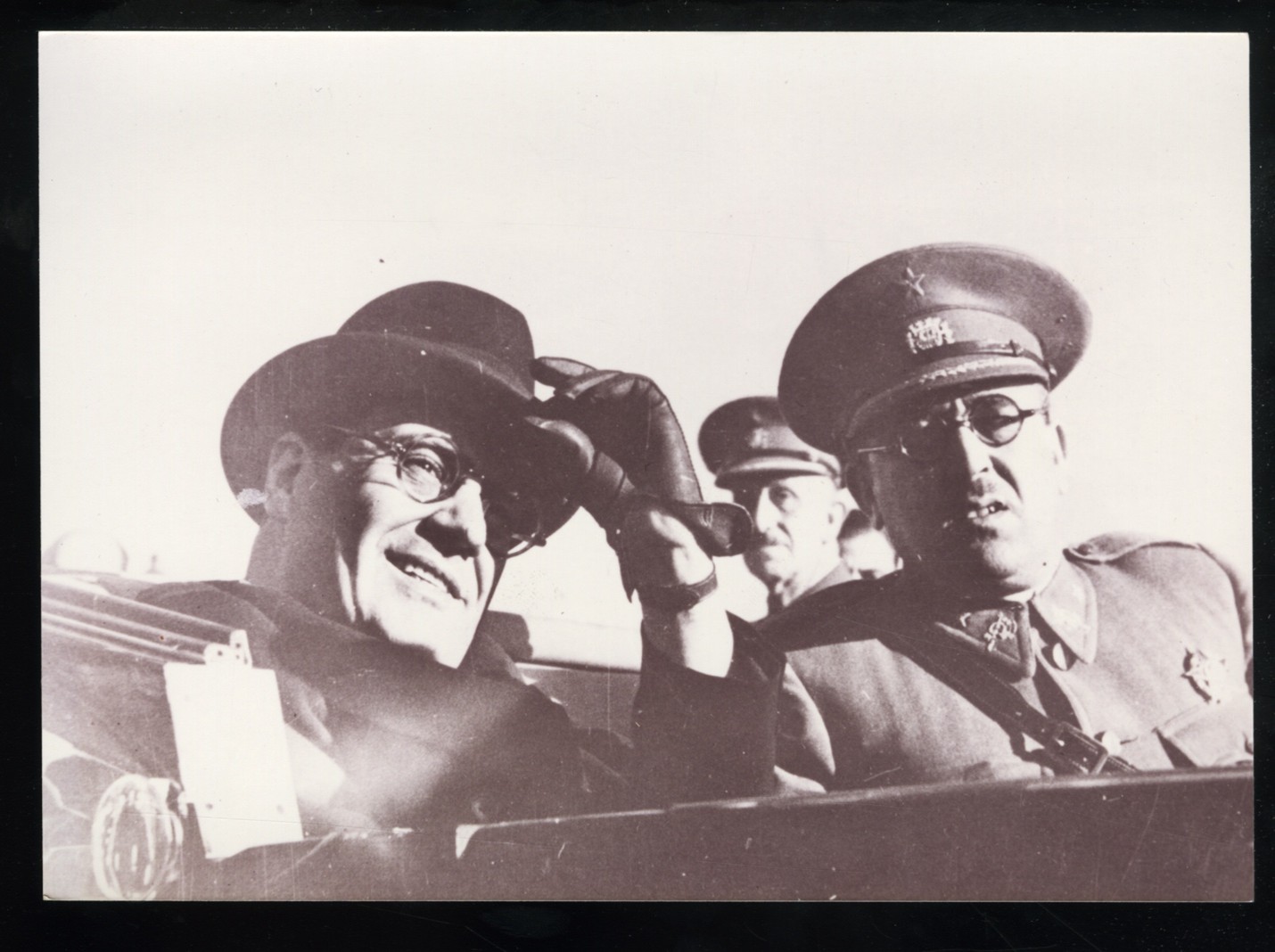
Negrín and General Rojo, c. 1938. Courtesy of the Archivo Fundación Juan Negrín.
The archive makes clear to what extent Negrín grasped the fascist threat to Europe. In the days leading up to the Munich pact, he repeatedly argued in diplomatic exchanges that Czechoslovakia and the Spanish Republic faced a common fate if fascist expansion went unchecked. The consequences, he warned, would reach far beyond both countries, extending to the rest of Europe. “The outcome of Spain’s war,” Negrín wrote to Franklin D. Roosevelt, “will decide what Europe will be and will set the course of future events around the world… Spain cannot struggle indefinitely against the economic and military power of Italy and Germany when it is blockaded by its enemies with the collaboration of neutrals and friends.”
While Chamberlain met Hitler in Munich, Negrín addressed the League of Nations in Geneva, where he challenged the claims of Communist domination in Republican Spain that had been used by the western democracies to justify continued inaction. In a dramatic gesture intended to expose the asymmetry of that posture, he announced the surprise unilateral withdrawal of all foreign forces from Republican territory. Dissolving the Comintern-organized International Brigades was a failed attempt to pressure Italy and Germany to withdraw their own forces in turn.
In the final months of 1938, Negrín stayed all death sentences, in accordance with the recommendations of the British Chetwode Commission, which had been dispatched to Spain to organize prisoner exchanges and curb executions. The archive shows that he took particular care to ensure that the politically controversial trial of the POUM (Partido Obrero de Unificación Marxista) conformed to the constitutional norms of western bourgeois democracy. He maintained restraint despite the thousands of letters—preserved in the archive—that flooded his office from military units demanding exemplary punishment of the POUM leadership.
Despite claims by POUM leaders, there was no “Moscow Trial in Barcelona.” This was no accident. The archive shows that Negrín intervened throughout the prosecution to prevent partisan interference in the judicial process, even directing the translation and publication of the trial proceedings abroad in different languages in order to rally support for the Republic. These measures sought to underscore the Republic’s independent, non-Communist character, contrasting its constitutional justice with both Franco’s ferocious military trials and revolutionary Soviet justice. In fact, in a meeting with the British chargé d’affaires during the trial, Negrín stated that he could and would eliminate the Communist Party within a week if France and Britain agreed to supply the Republic.
But the moment had passed. Negrín’s diplomacy failed to change British and French policy. As Nazi troops occupied the Sudetenland, he turned once more to the Soviets for aid—not because he was a Stalinist, but because he had no other choice. The archive preserves this correspondence. On 7 November, he wrote to Soviet Marshal Kliment Voroshilov, and four days later to Stalin himself, requesting additional military aid. By then, funds from the so-called “Moscow gold” that the Republic had transferred to the USSR had been exhausted. The Soviet finance ministry notified Negrín of this only days after he authorized the Ebro operation. We now know that, despite the Republic’s deteriorating situation, Stalin approved a $50 million credit for war matériel. Some aid made it across the Pyrenees into Republican Catalonia, giving the antifascists a fighting chance. Much more of it, however, was blocked by French authorities under British pressure—despite Negrín’s clandestine trip to Paris in January 1939 to demand its release.
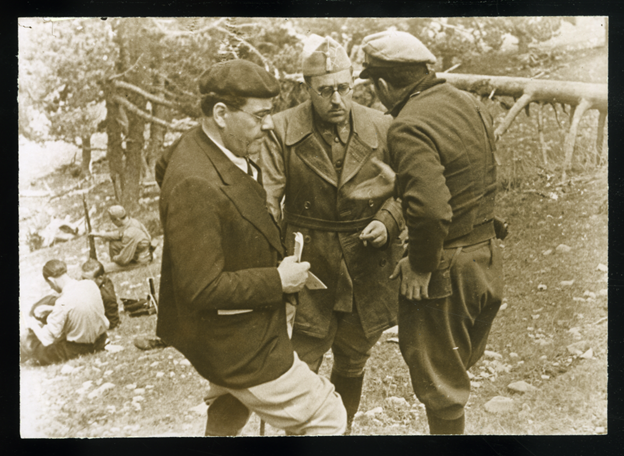
Negrín and General Vicente Rojo tour the front, c. 1938. Archivo Negrín.
The archive preserves a letter Negrín wrote to FDR that same week, imploring him to act on behalf of the beleaguered Republic. “Every minute that we delay taking action is a river of blood and pain,” he warned, “but also one more trench lost by the cause of justice.” A few weeks later, the U.S. Senate postponed debate on lifting the embargo on Republican Spain; FDR declined to intervene. On 22 January, Negrín had no choice but to order the evacuation of Barcelona, then the Republican capital, and Franco’s forces took the city within a week.
What emerges most clearly from the archive is the profound and corrosive effect that anti-Communism had on the Republic. It was fanatical anti-Communism that motivated Franco’s failed coup in July 1936, triggering the war. Once the war began, however, anti-Communism also furnished Britain and France with a rationale for denying assistance to the Republic, while also deepening political infighting within Spain, especially as the Communist Party grew in influence. The archive documents how repeated accusations of “bolshevization” undermined both military effectiveness and governmental legitimacy, a dynamic evident in the correspondence between General Rojo and Negrín. Most consequential is that, in the end, anti-Communism was the shared political language through which anarchists, liberals, and the conservative wing of the PSOE conspired to overthrow Negrín’s government and authorize surrender—ultimately delivering Republican fighters to Franco’s firing squads.
The POUM controversy drew international attention after the party’s leader, Andreu Nin, was abducted by Soviet operatives while in police custody and never seen again. Although Republican courts ensured due process for the remaining POUM leaders, the episode exposed deep political fault lines within the Republic. The archive shows that in December 1938, Negrín ordered an internal assessment of the positions of key political figures and parties on the outcome of the POUM’s trial. The report concluded that elements from the political center to the left were “working intensely to overthrow the government. They all invite the POUM to be the ‘binding agent center of anti-Communism’ (in reality, the ‘shock troops’).” It suggested that anti-Communists within the anarchist movement and the PSOE, Negrín’s own party, had coalesced around a project to remove him from office and form “another government of a marked anti-Communist complexion,” with the moderate Julián Besteiro as “the counterweight to Negrín.” In fact, within three months, Besteiro conspired with anarchists and socialist leaders to do just that, with catastrophic consequences for the Republic.
The central tragedy is that the anti-Communist coup that ousted Negrín effectively ended the Republic’s capacity to resist, bringing the war to an end just five months before the Nazi invasion of Poland transformed antifascism into a generalized European war. Although they never acknowledged it, those responsible must have grasped this in retrospect—especially after the Second World War ended with Europe in ruins, Nazism defeated, tens of millions dead, but Franco’s regime intact. Yet in the context of the emerging Cold War, those who had betrayed Negrín and the antifascist cause once again invoked anti-Communism to ease their consciences and rationalize the western democracies’ failure to aid the Republic. After all, if Negrín was indeed a Stalinist and the Republic a precursor to the Communist people’s republics of postwar Eastern Europe, was it not then correct to refuse it aid? Was non-intervention not then a perspicacious act of restraint? Was Spain not better off for having avoided Stalinism in favor of Franco’s brutal authoritarian conservatism?
This interpretive framework shaped the U.S. rapprochement with Franco, a shift grounded, once more, in the regime’s uncompromising anti-Communism. That rapprochement brought relief to a fragile impoverished state, bolstering the regime’s legitimacy and extending its longevity. But this is only part of the story. The post-hoc Cold War retelling of the Republic was not the work of the political right alone. Anti-Communism was equally entrenched on the left, where it was institutionalized through the CIA’s Congress for Cultural Freedom, whose Spanish-language section was headed by Julián Gorkin, a former POUM leader. In this context, George Orwell’s anti-Communist account of his time in Spain, Homage to Catalonia, was reissued in 1952 to enormous success despite having sold barely 1500 copies worldwide when it was first published in 1938.
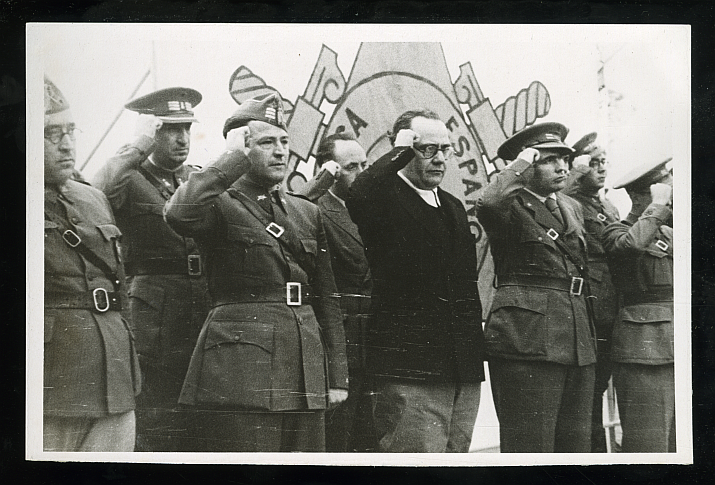
Negrín & generals salute the International Brigades, October 1938. Archivo Fundación Juan Negrín.
Riding the success of anti-Communist classics Animal Farm and Nineteen Eighty-Four, Orwell’s account of Communist domination—and its corrosive effects on truth—made the Spanish Republic intelligible to an increasingly anti-Communist political world. Yet, viewed through that Cold War lens, the Republic’s actual political culture becomes almost illegible. In place of the contemporaneous view of Negrín as the heroic leader of Spain’s antifascist resistance, Cold War narratives recast him as a loyal Stalinist, adopting the highly partisan and misleading framework of the POUM. In part through Gorkin, the CIA funded and oversaw the publication and dissemination of propagandistic anti-Soviet texts such as Jesús Hernández’s Yo Fui Ministro de Stalin.
By this telling, the USSR exported the politics of Moscow to Spain, eliminating its enemies through “purges,” crushing the revolution, and ultimately abandoning the Republic. Even Henry Kissinger, the Cold Warrior strategist par excellence, understood the war through this POUM–CIA nexus. In the wake of Franco’s death, he addressed the Spanish Civil War’s relevance in a 1976 report. Explicitly citing the writings of POUM leader Joaquim Maurín, Kissinger claimed that the Communists’ “meteoric rise” in Spain resulted from “their ruthless effort to try to exterminate or neutralize their rivals on the left…Their aim was to establish their hegemony, even at the cost of the war effort. In effect their activities were an extension to Spain of Stalin’s purges within the USSR and the Communist movement.” Indeed, the United States’ Cold War establishment found a ready-made explanatory framework in the POUM–Orwell narrative.
The Cold War has long since ended, and historical scholarship is finally beginning to disentangle its distorting effects on our understanding of Spain’s war. It is now possible to acknowledge that the USSR did far more to confront fascism in Spain than did the liberal democracies, whose governments cowered and appeased it. From a post-Cold War vantage, Stalin’s operation to aid Spain appears as bold, ambitious, and audacious as the Stalinist system that produced it. Despite its operational dysfunction, Soviet intervention in Spain stands as a significant achievement of the global Communist project in the struggle against fascism. It was neither a cynical weapons test nor a calculated bid for control in Western Europe; rather, it constituted the fraught first step toward the eventual triumph of the Soviet system over the Nazi war machine.
The archival materials also compel a reevaluation of Negrín himself—one shaped not by Cold War ideology, but by hard documentary evidence. In Spanish-language scholarship, the materials have inspired a new historiography, led by the works of Ángel Viñas and Enrique Moradiellos. In English-language work, the archive is beginning to make an impact, with important contributions by Paul Preston, Helen Graham, and Gabriel Jackson. Carmen Negrín herself has played a central role in promoting the archive to a Spanish public that has long been hostile to her grandfather.
Considering these shifts in the field, the day may yet come when the statue of Juan Negrín on Calle Triana in the old center of Las Palmas no longer needs to be routinely scrubbed of red paint. If it does, Negrín’s appeal to history as a moral tribunal—articulated in his January 1939 letter to Franklin D. Roosevelt and preserved in the archive—may at last be borne out: “History will be pitiless and unforgiving to those statesmen who close their eyes to the evidence, pitiless and unforgiving to those who, in their indecisiveness, jeopardize the principles of tolerance, coexistence, and freedom.”
Historian Jonathan Sherry is the author of Stalinism on Trial: Communism and Republican Justice in the Spanish Civil War (Liverpool University Press, 2025). He has held professorial and research posts in the United States, the United Kingdom, and Spain, and currently serves as Senior Editor and Contributing Writer at Eagle Intelligence Reports, a geopolitical and foreign-policy analysis outlet based in Bucharest, Romania.






