
The Art of War: Leon Bibel and Spain
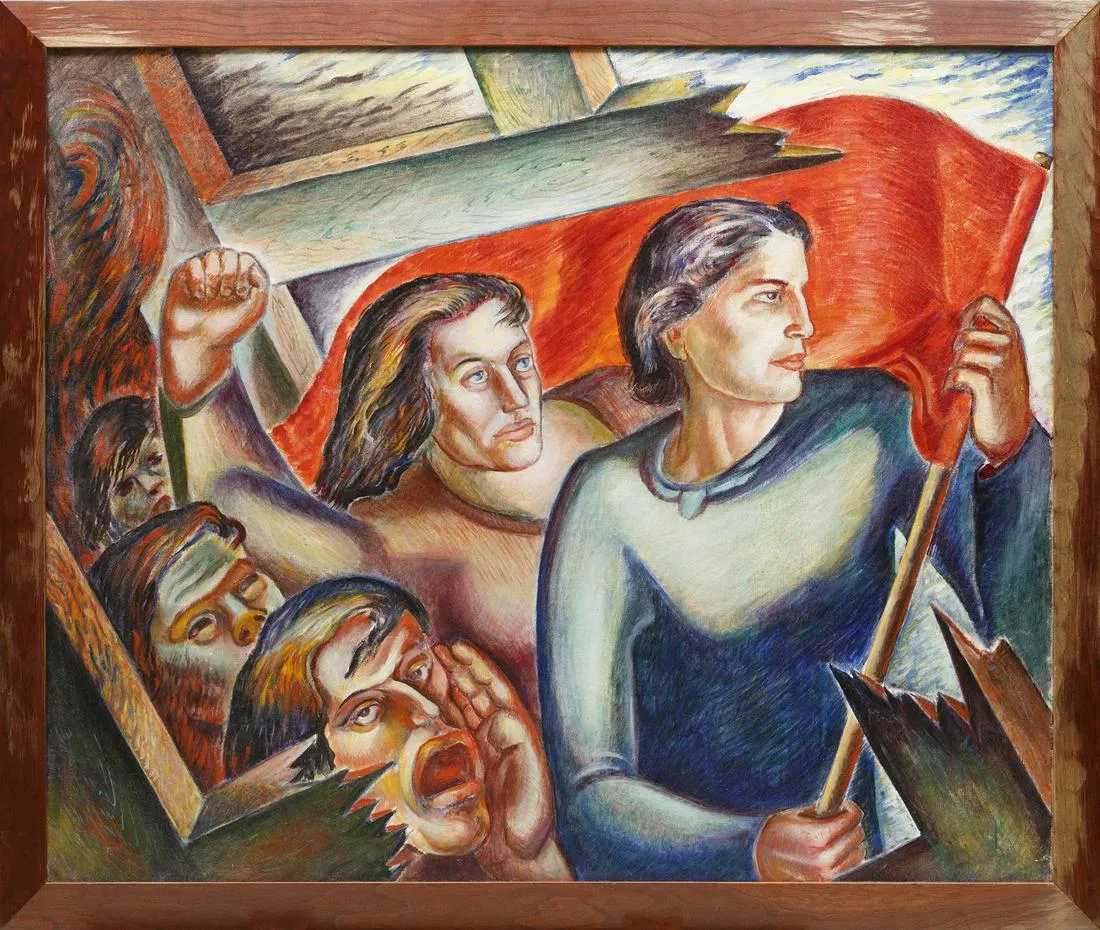
Leon Bibel. Flag Bearers (1936).
Leon Bibel, a New-York-based painter, printmaker, and teacher who worked with the WPA and was only discovered by the public years after his death in 1995, was primed from birth to identify with the Republican cause in the Spanish Civil War.
Born in the Jewish shtetl of Szczebrzeszyn in 1913 in what is now Poland, Leon Bibel’s earliest memories were dominated by the messy and conflict-ridden opening-up of Polish society after the First World War—especially for Jews who could suddenly vote and live for the first time as equals, at least theoretically. In 1927, he emigrated with his family to San Francisco, perhaps the most left-leaning city in the US at the time, “a little Russia, completely isolated and insulated,” as Kenneth Rexroth described it. The Bibels settled in the Western Addition, a multi-ethnic, predominantly working-class community of diasporic Blacks, Jews, Italians, Filipinos, and Japanese. In his early twenties, Leon witnessed “Bloody Thursday,” the violent nexus at the heart of the West Coast waterfront strike of 1934. The following year, he hopped on a train to New York to try and get on the Federal Art Project (FAP), which was part of the Works Progress Administration (WPA). Once there, he joined the radical Artists’ Union and eventually got work on the FAP as an art teacher in the Bronx.
Bibel’s new friends and neighbors were riveted by the Spanish elections of February 1936 and shocked by the military coup that unleashed the civil war. Like many New Yorkers, Bibel followed events on the Iberian Peninsula closely and agonized over the outcome. His initial artistic response to the war focused on the place of women in the conflict, a rarity for artists at the time. While photographs of women in the war proliferated, few American artists produced graphic artworks that focused on the role of women. Elizabeth Olds—whose New Women of Spain was published in New Masses in 1936—was a notable exception, as was Bibel. More women fought as combatants in the Spanish Civil War than in any previous conflict. They served on the front lines, played a crucial role as rearguard street fighters, and helped organize and lead local militias. A completely female battalion took part in the defense of Madrid. Bibel depicted this gender revolution in a number of works.
Aerial bombardment was the first awful innovation of the Spanish Civil War that presaged the horrors to come in the Second World War. As described by the American ambulance driver James Neugass, the effects were terrifying: “when [the bombing] comes near, you do not hear it with your ears. The sound reaches your eardrums through the ground and then through your body, as does a dentist’s drill or the sound of a surgeons’ saw cutting through one of your bones.” In a number of works, Bibel graphically explores the effects of this new form of aerial terrorism.
By 1938, Bibel’s focus had shifted from the experience of women and the horrors of aerial bombardment to the plight of those displaced by the conflict. An important body of his work explores the experience of refugees and exiles. These images –like all of his representations of the Spanish Civil War– emphasize how, even though wars might aim at big outcomes, and might come packaged in grandiloquent rhetoric, they happen to regular people. Bibel forces us to gaze upon ordinary women and men in the throes of war and displacement. Such was the fate of so many in Spain. Soon it would be the fate of many across Europe.
GENDER REVOLUTIONS
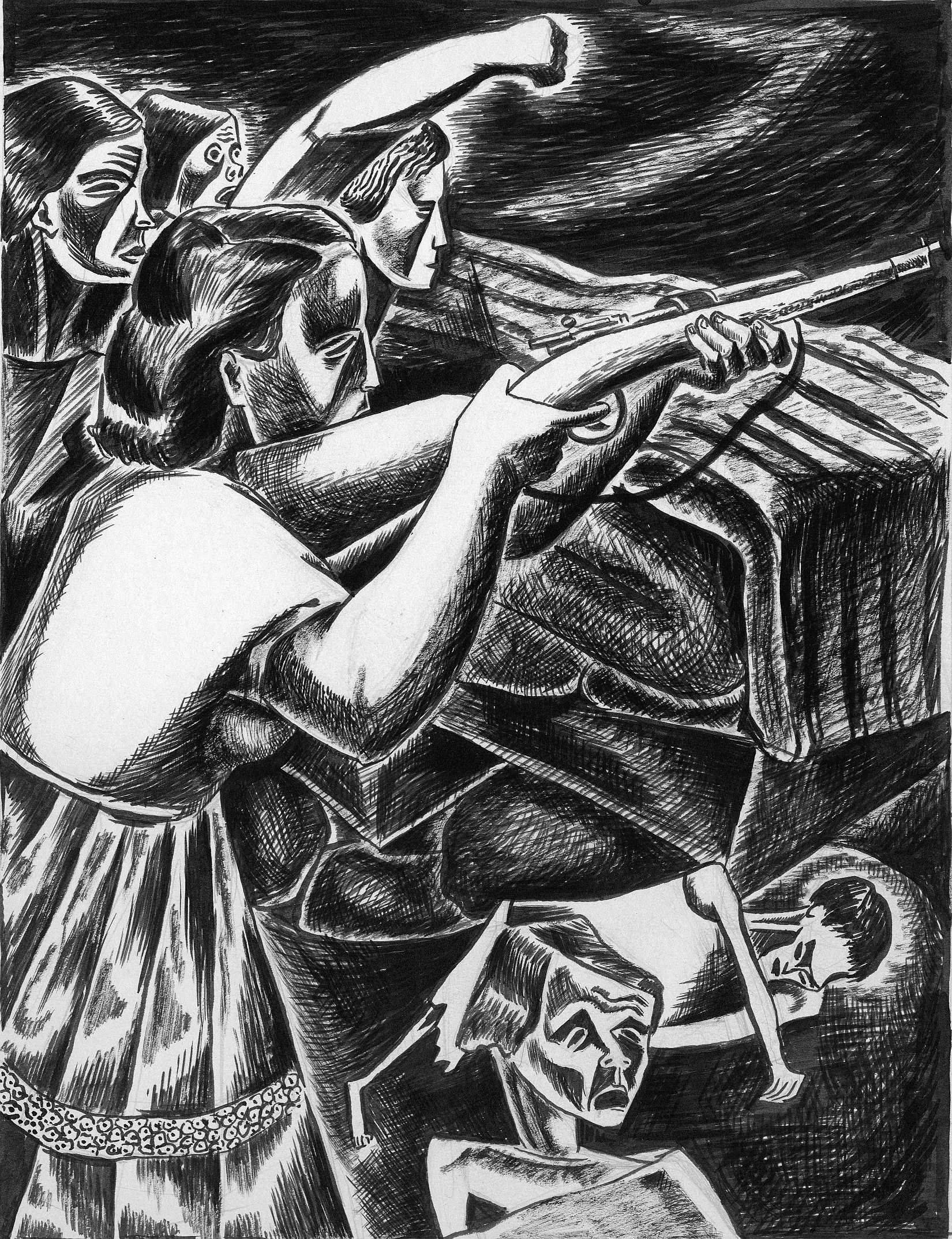
Leon Bibel, Women at the Front, 1936.
Women at the Front (1936)—an image based in part on the widely-circulated photograph Mujeres en el Asedio del Alcázar de Toledo (Women at the Siege of Toledo’s Alcázar)—in which women are defined by their determination and resolve rather than their frailty or domesticity.
Leon Bibel, Flag Bearers, 1936.
In Flag Bearers (1936), he continues the theme of strong women marching fearlessly into war. Here, the Republicans raise a fist and a red flag amid a shattered landscape. They are doomed perhaps, but not afraid.
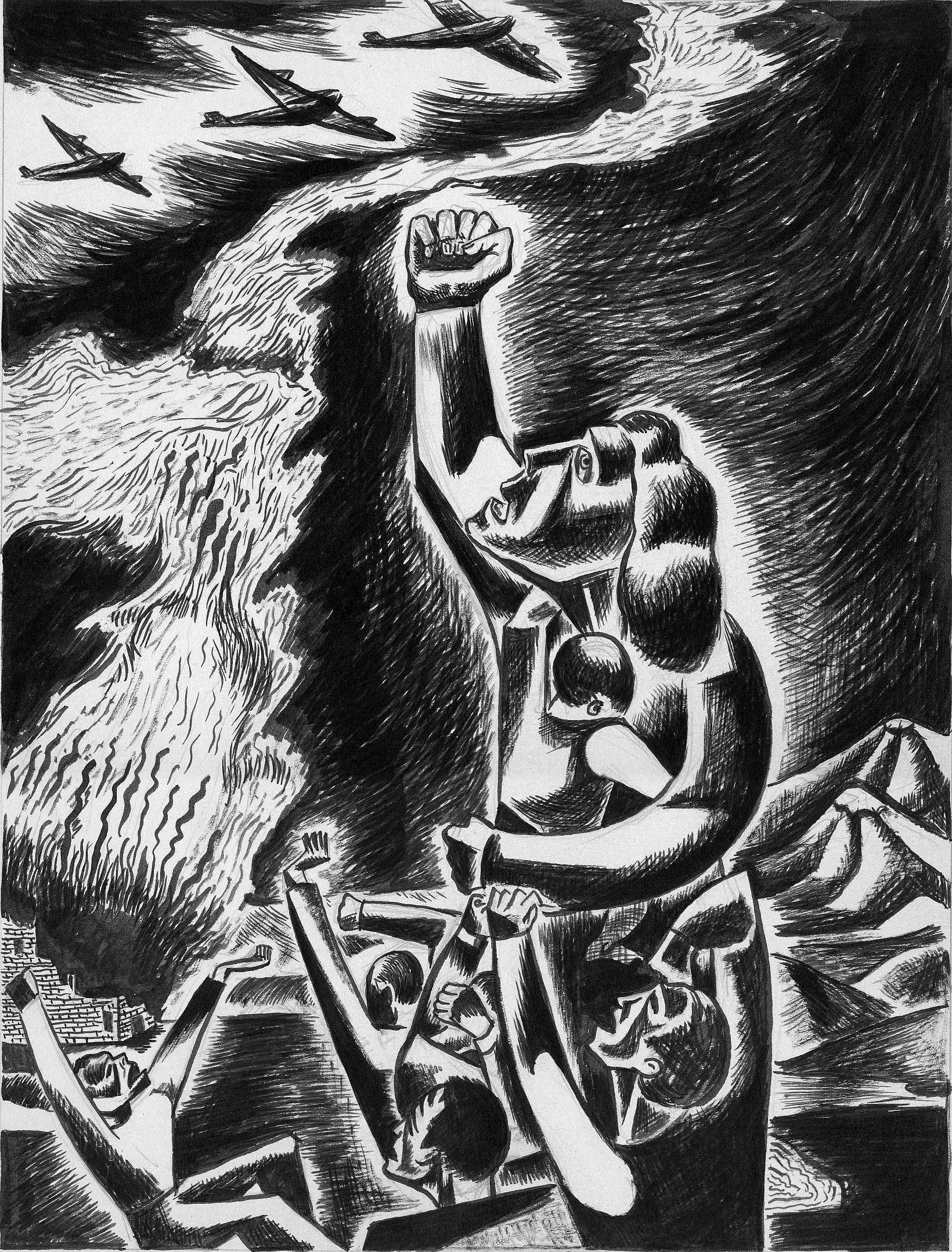
Leon Bibel, Mother Child and Bombers, 1936
Bibel’s Mother and Child and Bombers (1936) might seem like a more traditional depiction of Spanish womanhood but once again, Bibel brings defiance to the fore. Despite being tethered to her child, the mother stands high over her male counterparts. She is robust and purposeful, far more so than the men around her, some of whom don’t even seem to be able to stay on their feet, despite not having to care for an infant. The object of her anger is high overhead: planes are dropping bombs while buildings burn.
OTHER GUERNICAS
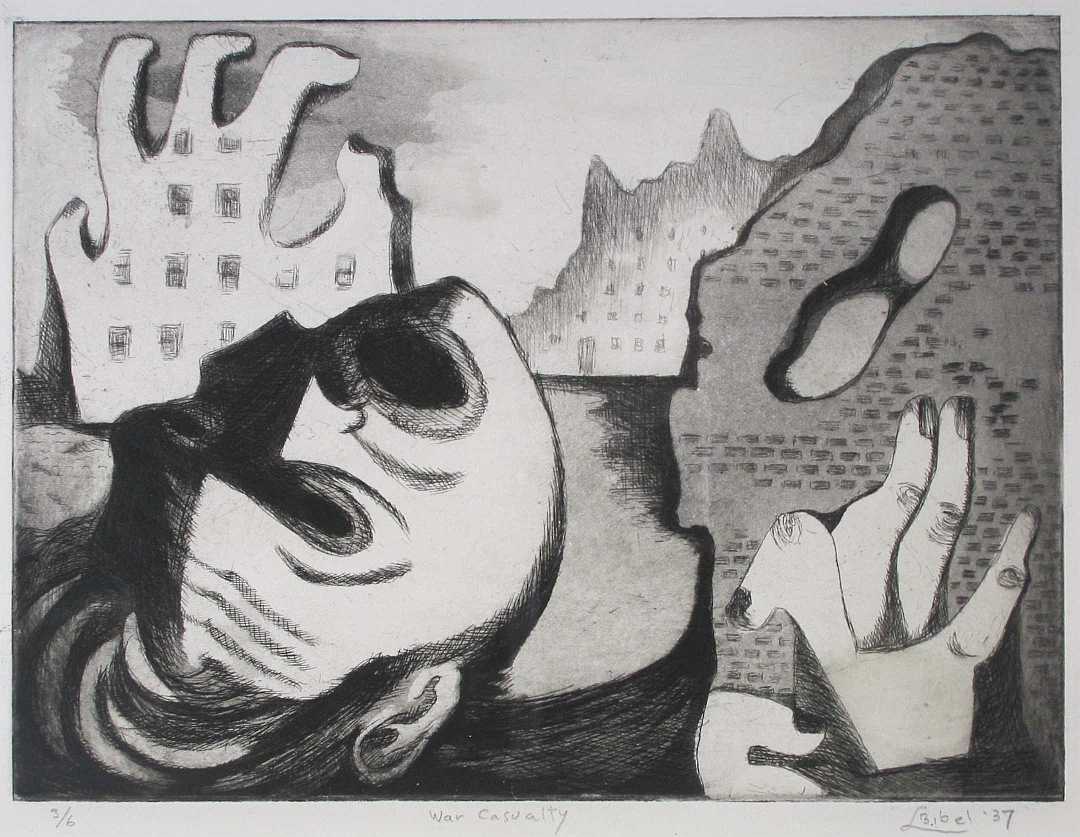
Leon Bibel, War Casualty, 1937.
In Bibel’s War Casualty (1937), a screaming face lies amid a bombarded landscape, a hand broken and twisted out of shape mirrored in the devastation visited upon the surrounding buildings.
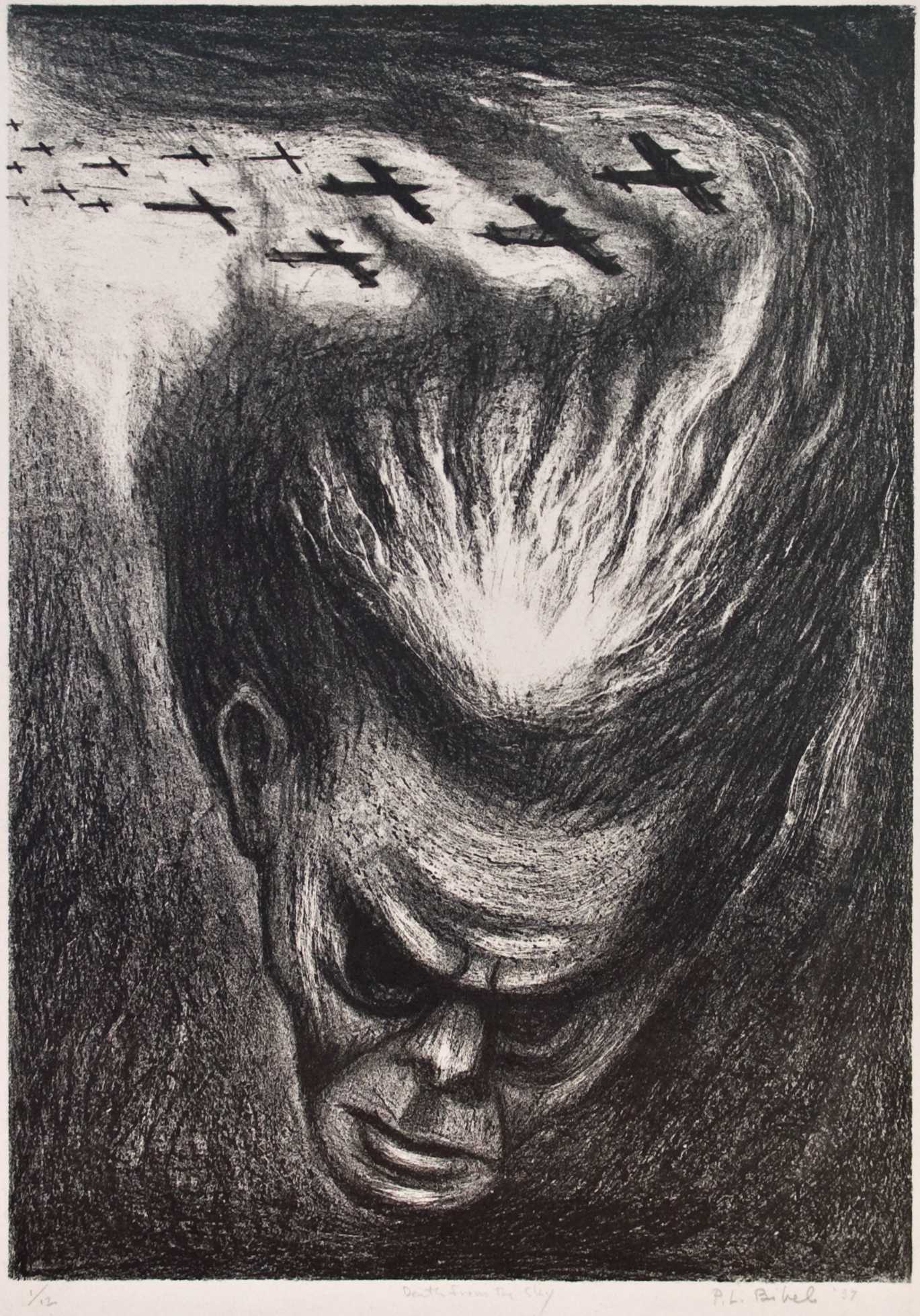
Death from the Sky (1937) depicts a bombing raid, planes trailing off into crosses above while the face of death rains down on those below.
THE PLIGHT OF REFUGEES
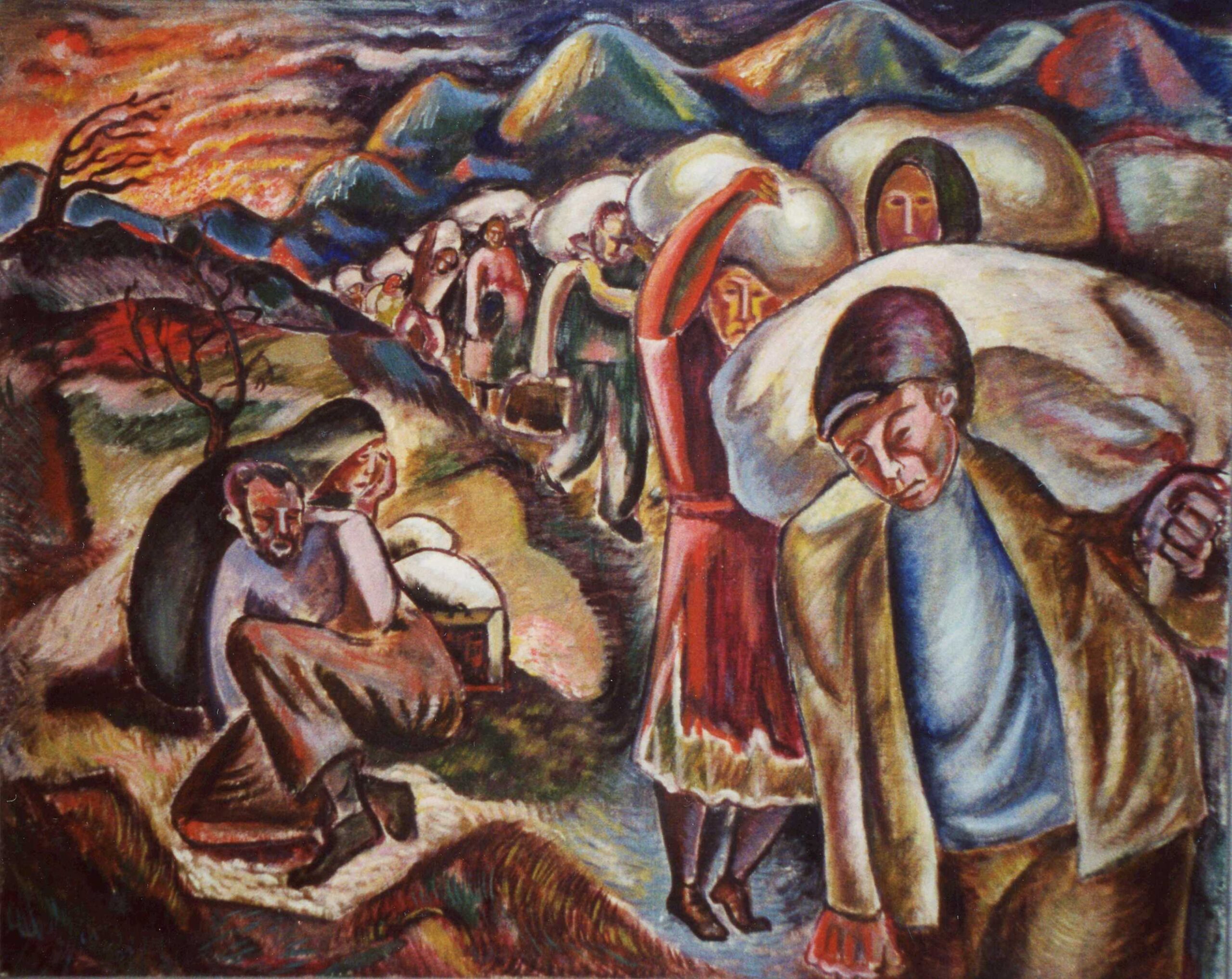
Leon Bibel, Escape Over the Pyrenees, 1938.
Escape over the Pyrenees (1938) depicts the sad plight of thousands forced to scale the mountain range, often the only way out of a country whose Mediterranean coastline was patrolled by Italian Fascists. A man and a woman are so exhausted they are unable to continue. Around the long trail of evacuees, with their belongings hoisted upon their backs, is a barren, forbidding landscape. Behind is the Spanish heartland, seemingly ablaze in fire and destruction.
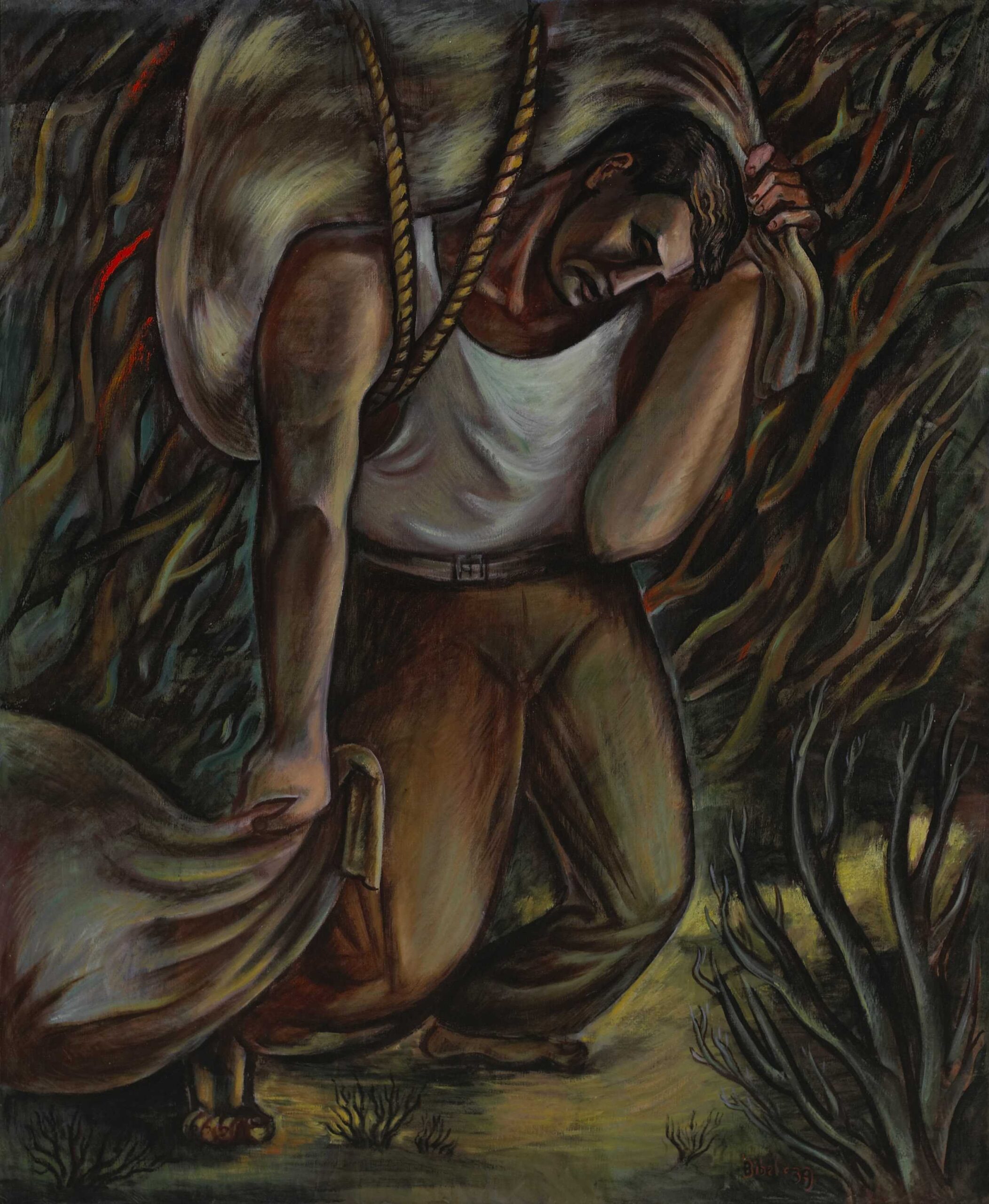
Exiled (1939), an oil-painting version of a lithograph from 1938—is cut from similar cloth. A man struggles and slumps forward beneath the weight of his burden. He seems about to keel over, his knees giving way under the effort of his journey. Around him is a wild thicket of branches, hemming him in. In front of him is a blasted tree stump, evidence of lifelessness and destruction.
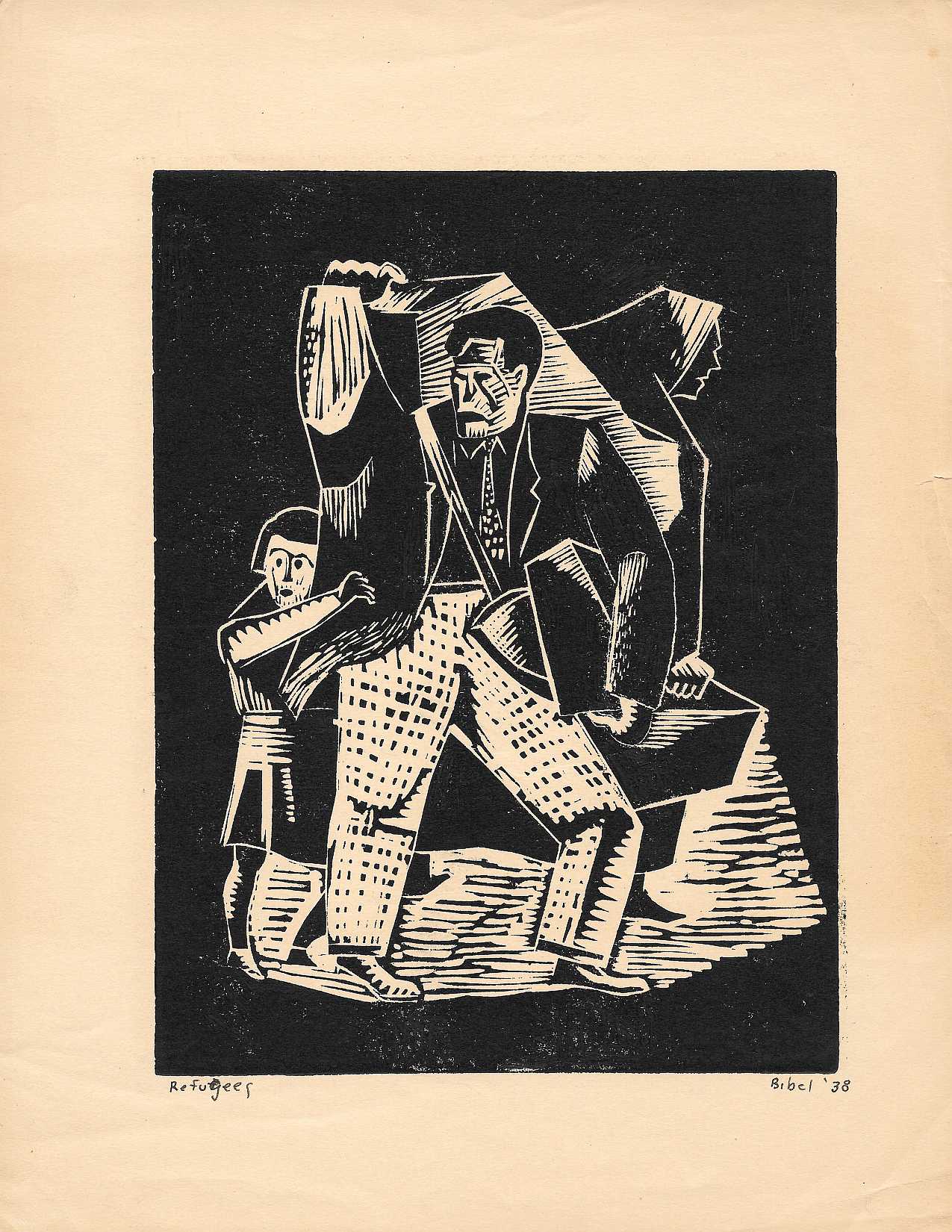
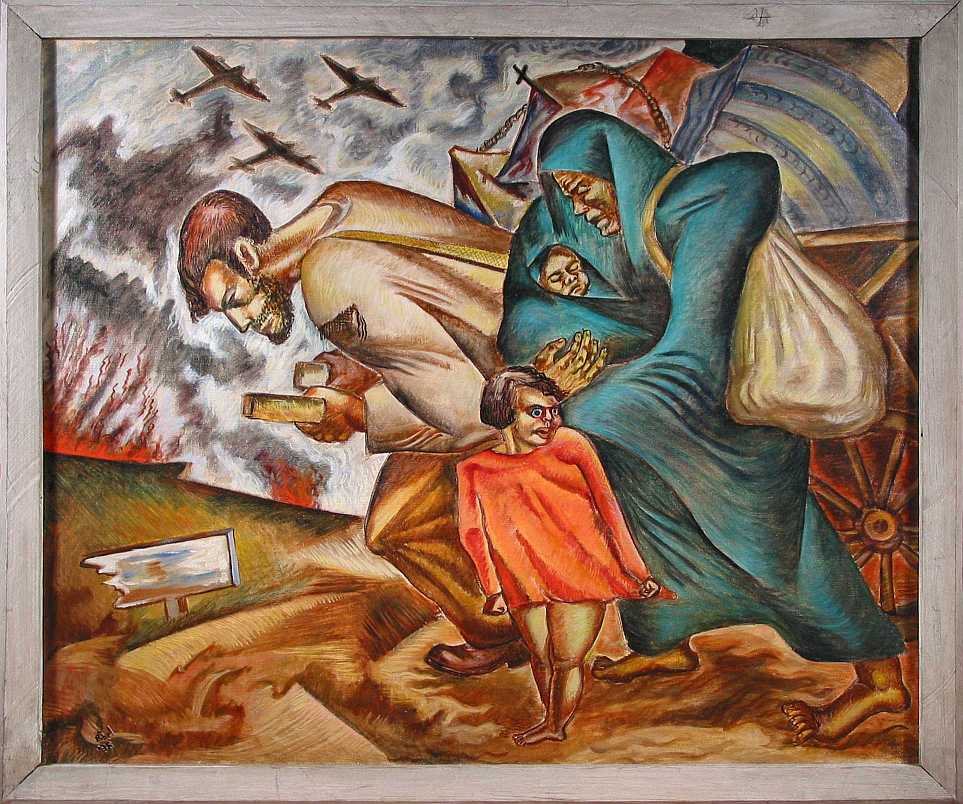
Leon Bibel, Refugees, 1938.
Bibel produced two images specifically named “refugees”. The first was a linocut featuring a family of three shouldering their belongings. The child—apprehensive and frightened—shelters behind her father, his face lined with worry. The mother faces forward as they move off but the father and daughter stare backwards, unable to shift their gaze, as if pursued by a great terror. The family reappears in an oil painting of the same name, only their peril has grown significantly worse. The image seems almost biblical, but the setting is contemporary. Bombers fly overhead ravaging the landscape. The family are sitting ducks, but they are resolute and as yet undefeated. They have nothing but their possessions and their faith. Neither though seem like it will help. Even the road sign is blank, their direction unknown and unknowable.
Richard Haw is a professor of Interdisciplinary Studies at John Jay College of Criminal Justice (CUNY). He is the author of Leon Bibel: Forgotten Artist of the New Deal (2025), along with The Brooklyn Bridge: A Cultural History (2005), Art of the Brooklyn Bridge: A Visual History (2008), and Engineering America: The Life and Times of John A. Roebling (2020).






