
Remembering Steve Nelson, American Radical
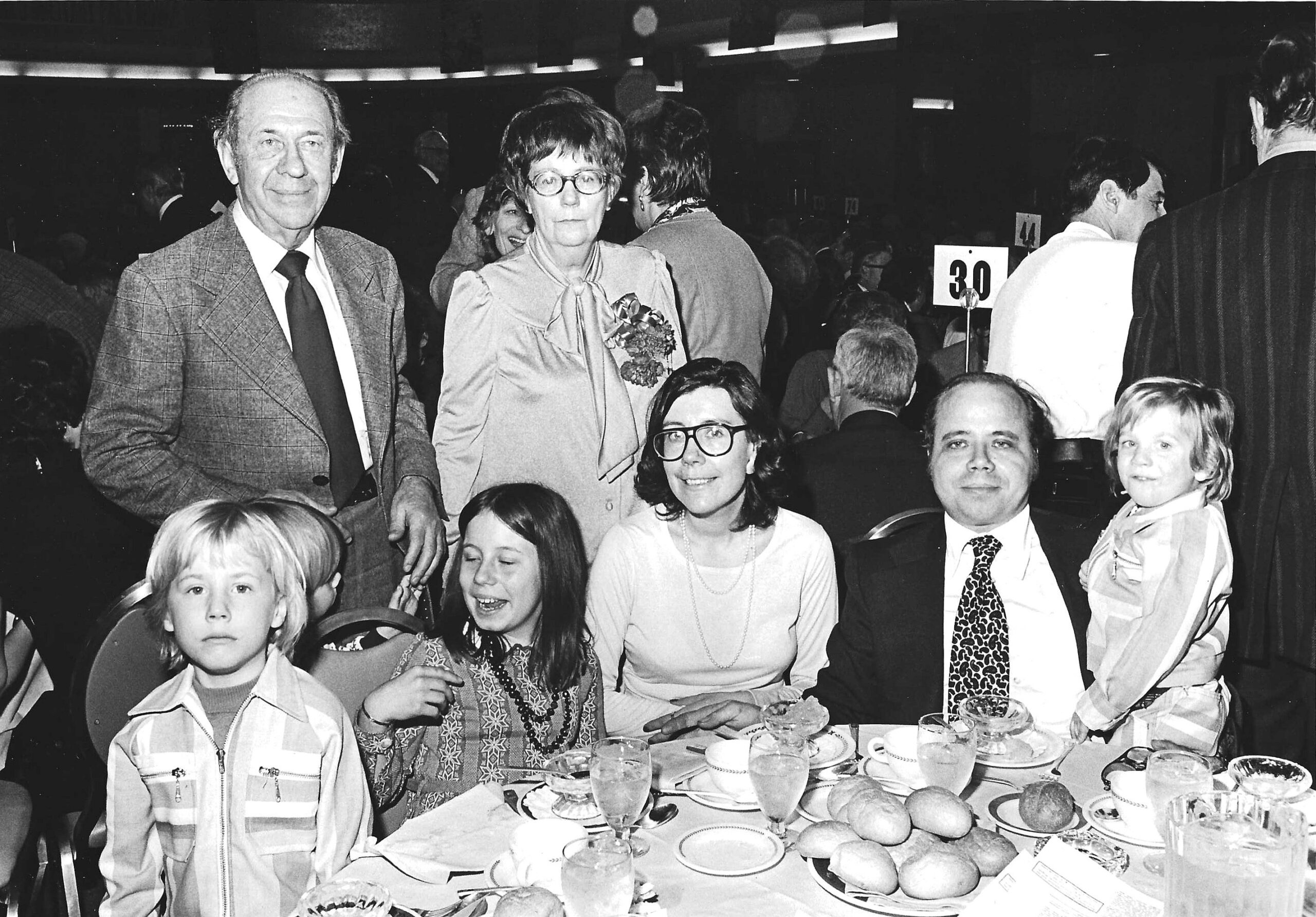
Steve and Margaret Nelson with their family during a 1975 VALB dinner in New York celebrating Steve’s birthday. Front row (l to r): Tom Nelson, Steve Yurek, Diana Yurek, Josie Yurek, Henry Yurek, Chet Nelson.
On the 70th anniversary of the Supreme Court case Pennsylvania v. Nelson, which wiped state sedition laws off the books, Steve Nelson’s grandson reminisces about the beloved commissar of the Abraham Lincoln Brigade.
I firmly believe that all grandparents should be considered legends in their grandchildren’s minds. As generational touchstones for family history, grandparents help us realize and accept that there is a circle of life. And on a hot summer day, they might also give us that second cone of chocolate-dipped ice cream our dad told us was off-limits.
My grandfather, Steve Nelson, who we knew as “Pa,” was the absolute archetype of a grandparent legend. Whenever my brother and I visited him, there was always a second helping of ice cream—chocolate-dipped at that. As I grew older, I also came to learn he was a legend in other senses of the word.
Born in Subocka, in Northern Croatia, in 1903, Pa had emigrated to the United States in 1922. A year later, he had joined the Communist Party, attended the Lenin school in Moscow, and subsequently undertook missions for the Communist International in China and India. In 1937, he volunteered to fight fascism in the Spanish Civil War. In Spain, Pa was shot twice (once in the cheek and once in the leg) and nearly killed on the Belchite front. Later in life, back in the United States, he was indicted, in an obvious violation of the First Amendment of the U.S. Constitution, under the Smith Act of 1940. This year marks the seventieth anniversary of the landmark U.S. Supreme Court decision, delivered by Chief Justice Warren, overturning Pa’s conviction—and wiping sedition laws off the books.
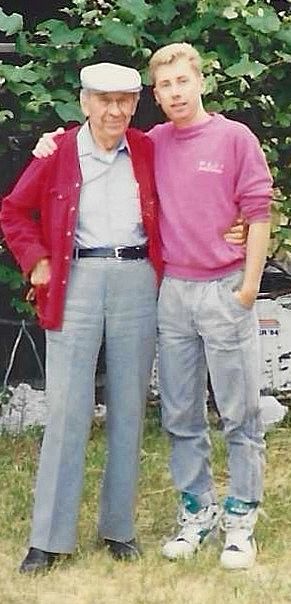
Tom Nelson (r) with Steve Nelson Cape Cod, Mass., c. 1988.
While he was jailed, he wrote several books, including one about his time in Spain (The Volunteers) and one about his trial (The 13th Juror). A later book, American Radical, deals with his time as an activist, labor rights leader, and member of the Communist Party of the United States. When Nikita Khrushchev revealed the horrors of Joseph Stalin’s rule of the USSR, he handed in his party card.
As he grew older, this charming man developed deep, meaningful relationships with each of his four grandchildren: Diana (my eldest cousin), myself, Chet (my brother), and his namesake Stevie (not just my cousin, but one of my best friends).
When I decided to become a writer, I focused on sports journalism. Pa could’ve told me that sports were trivial, an opium for the masses—something not worth anyone’s time. As someone who had been shot fighting fascism, stood up for labor, and knew he was part of something bigger than himself, he had every right to do so. Instead, he chose to tell me about his time in “The Hole” in that godforsaken prison in Pennsylvania.
“Tommy, when I was in ‘The Hole,'” I remember him telling me in my early 20s, “me and the fellas, we talked about sports. It’s important. It made us feel better. It allowed us to set aside our worries for a couple of moments and really be passionate about something. So, what you are doing is important.”
After Pa died in 1993, I told that story to my brother Chet, who is an actor. His response astounded me. It turned out that Steve had also endorsed Chet’s career choice. “The screen, the theater, the stage,” he’d said, “it all makes us feel better, Chetty. It’s important. People can set aside their worries and just enjoy the show.”
For all the love and support Pa provided me, my brother, and my cousins, we are eternally grateful. More importantly, we are forever in debt to every one of the brave men and women who took up arms to fight fascism—as some say, prematurely—ninety years ago.
Tom Nelson is an accomplished journalist and journalism educator who lives in Los Angeles.






