
How the Spanish Republic Saved Cultural Heritage for the Anti-Fascist Cause
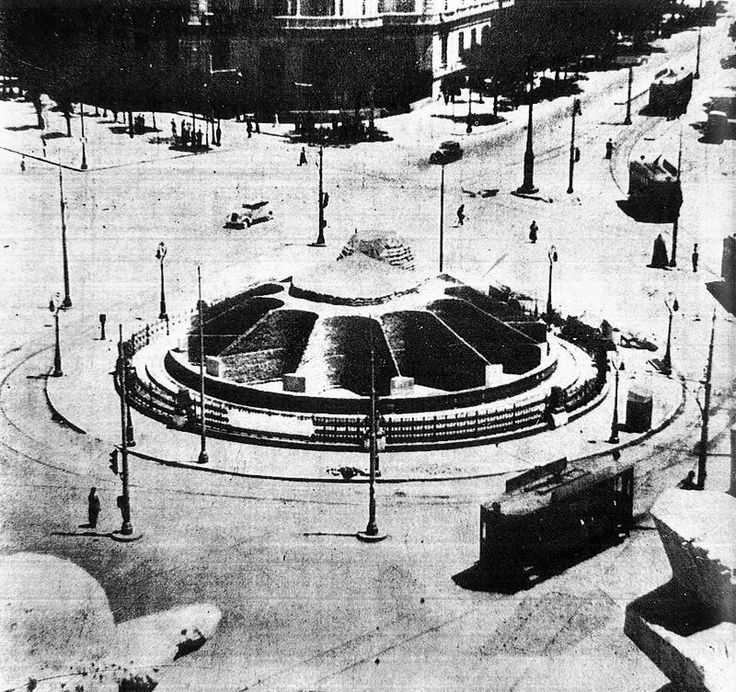
Fig. 20. Unkown author. Cibeles Fountain, Madrid, protected during the war, 1937–39.
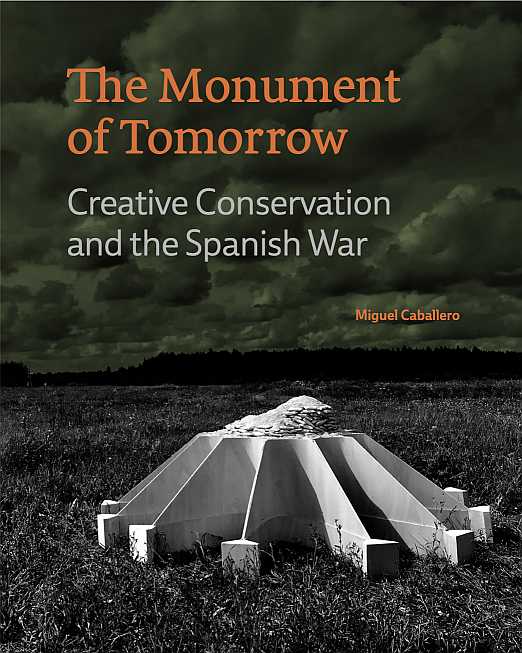
Can conservation be a revolutionary practice? In his new book, The Monument of Tomorrow, Miguel Caballero shows that it certainly can. The story it tells is also the story of the Madrid that the Abraham Lincoln Brigade encountered—and helped shape—during the war.
In 2012, when I first encountered the art installation Monumentos ciegos by Spanish artist Fernando Sánchez Castillo (Blind Monuments, 2006–ongoing), it threw me for a loop. The installation showed a collection of scale models of the protective structures that the Republican government commissioned during the war to safeguard Madrid’s monuments—including Catholic and monarchic statues.
“Wait a second,” I thought. “The Republic went out of its way to protect statues of kings and buildings honoring the Catholic Church?” That was certainly not the story I had grown up with in Spain. I knew the Franco regime had legitimized its dictatorship as a form of messianic salvation from an allegedly iconoclastic Second Republic. Even the parliamentary monarchy established in the 1970s and 1980s did not fully embrace the Second Republic as its precursor, in part because of this presumed iconoclasm. How, then, should we understand the wartime conservationism that Sánchez Castillo was documenting and exploring?
Before I knew it, I was hooked, intrigued by the possibility of studying evidence that ran counter to what I had learned in school, in the media, and in broader public discourse. And because I admire Sánchez Castillo’s work, I also wanted to see how academic research might contribute to his inquiry. My research quickly showed me that the Second Republic had, indeed, been iconoclastic. Radically so, in fact, but not in the way that I had imagined.
The 1930s, as we know, were years of intense political radicalization. When the Republic was proclaimed in 1931, people in many cities, including Madrid, took to the streets, defacing statues of kings and setting churches on fire. Liberals, socialists, anarchists, and communists alike drew on decades of iconoclastic thought and practice of what the anarchist revolutionary Mikhail Bakunin called “creative destruction.” It was impossible, they believed, to build an emancipatory world upon a material order shaped by a logic of oppression. An egalitarian society could not be built without destruction. This helps explain why, in the aftermath of the 1931 attacks on churches and statues, virtually no one was prosecuted.
 Paradoxically, also in 1931, leading conservation architects from across Europe met in Athens, where, for the first time, they agreed to think of conservation as a transnational duty. Today, this moment is broadly seen as a precursor of what we now call World Heritage. The Athens meeting was a foundational moment for the global consensus on transnational conservation of monuments and art at large.
Generally, the Second World War is considered the first major testing ground for this ideal. And it is an important story, for sure. Yet it is an incomplete one, told mostly through the genealogy of conservation technicians. Missing from it was a key chapter: the one that shows how, before World War II, conservation became politicized when it was embraced by liberals and leftists.
The first part of this chapter, which runs from 1931 to 1936, is one of rapidly changing strategies. As fascism was consolidated in Italy and Hitler declared himself Führer, calling for mass mobilization and destruction in the name of hyper-nationalism, anti-fascist forces across the world formed Popular Fronts. When Popular-Front representatives gathered to define their strategies at the antifascist conference “In Defense of Culture,” celebrated in Paris in 1935, they faced a theoretical challenge with profound implications: Would the liberal and leftist traditions of “creative destruction” become indistinguishable from the fascist cult of destruction that was already taking shape in Germany, Italy, and elsewhere? They agreed it probably would. For that reason, they embraced a new strategy: one of anti-fascist conservation, an idea embodied in the congress’ slogan about defending culture. In my book The Monument of Tomorrow, I explain how conservation came to be understood as an avant-garde weapon, as a revolutionary practice.
The Spanish War was, in fact, the first testing ground for this strategy. (I avoid referring to it as the Spanish Civil War, among other reasons, because it is impossible to understand these and other transnational processes if we reduce this war to a purely civil conflict.) The fascist destruction of Guernica, perpetrated by Hitler’s Condor Legion, is often taken as emblematic of the Spanish War as a laboratory for new techniques of destruction, especially carpet bombing. I focus on the other side of this account: The war should also be read as a laboratory for militant and experimental conservation, a crucial episode in the shift from political iconoclasm to transnational alliances that seek to conserve, not destruct.
When the Abraham Lincoln Brigade and other international volunteers arrived in Spain in the fall of 1936, they witnessed firsthand the evacuation of the Prado Museum. The Madrid they encountered was a capital city in the process of being de-capitalized, so to speak, as everything that constituted it as a capital was leaving. The government had fled to Valencia, together with the Prado collection; the gold reserves were being sent abroad to purchase weapons. No government, no crown jewel of the national treasures, no bullion. Just ordinary citizens who overnight had to become milicianos and international volunteers struggling to resist overwhelming odds. And resist they did. After the Battle of Madrid, in the fall of 1936, the city entered a period of relative stabilization, transformed into a fortified trench with Francoist forces in near siege. It was in this context, at the beginning of the summer of 1937, that the organized protection of monuments began.
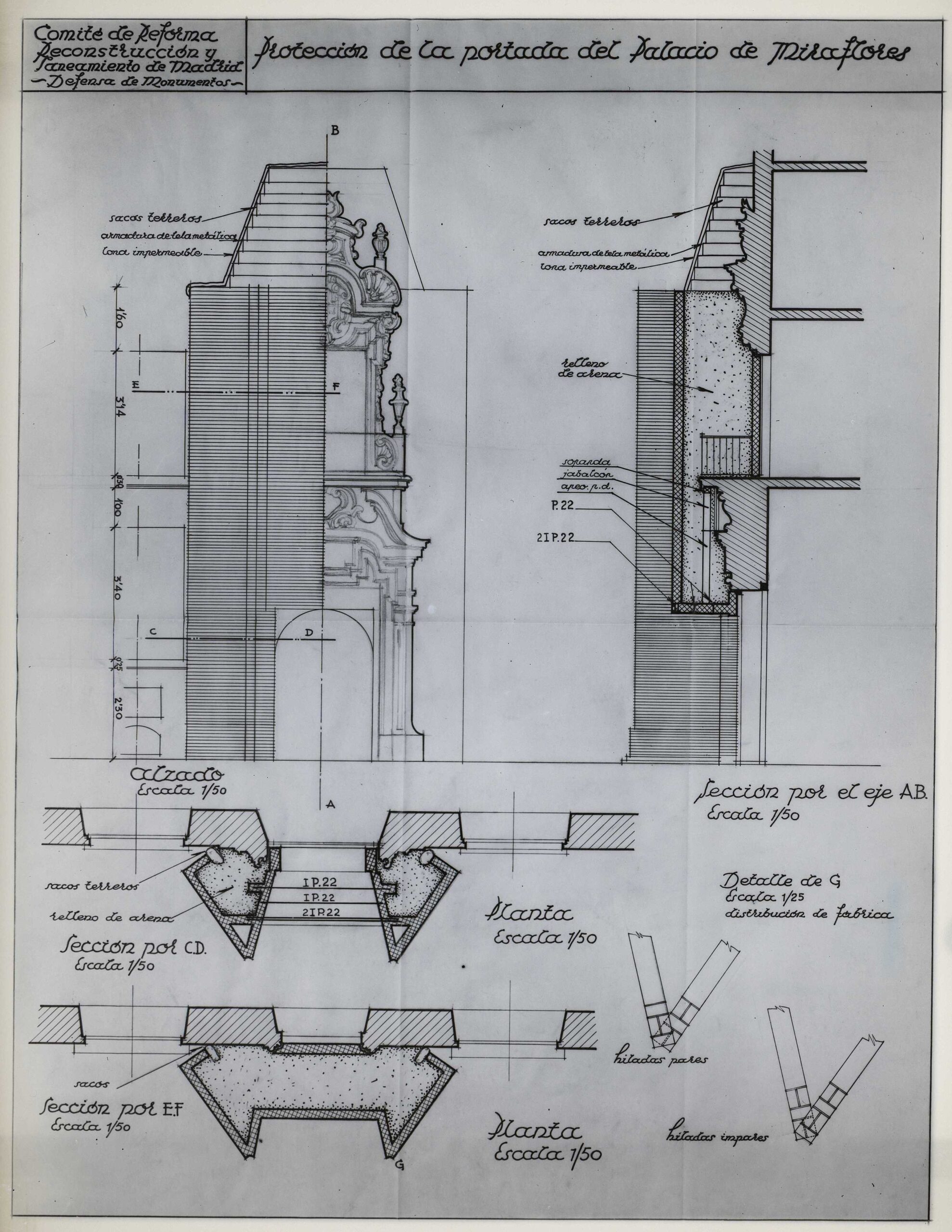
Committee for Reform, Reconstruction, and Sanitation. Plan for protecting the façade of the Miraflores Palace, 1937–39. Moreno Archive. Photographic Collection of the Institute of Cultural Heritage of Spain, Ministry of Culture, Spain.
This work of protection was radical in multiple senses. It entailed a process of secularization of art, with campaigns urging people to look at religious images not as expressions of faith but as works of art. Constructions belong to those who build them, implied another campaign poster, claiming working-class ownership of religious buildings. But if the workers were the proud owners of the buildings they erected, then it also made sense that they would want to conserve them. This, in turn, required training: Madrid’s elitist School of Architecture opened its doors to approximately two hundred workers with no prior university education to instruct them in techniques of wartime protection. This was not only radical in pedagogical terms but also in terms of experimentation—there were no established international protocols for protecting civilian populations or cultural heritage from air raids at the time—and aesthetics. As architects applied the principles of modernist, rationalist architecture to protective structures, the protections themselves became monumental, imagining what the architecture of a future Republican Madrid might become. That is what the title of my book, The Monument of Tomorrow, tries to capture: conservation was avant-garde because it was forward-thinking, oriented toward the future.
During the years it has taken me to finish this book, sensibilities have shifted. When I began the project, the context was shaped by debates over the defacement of Confederate monuments in the United States and other symbols of oppression around the world. When I presented my research, most of the questions I received at the time came from those discussions. Today, I find that audiences are more primed to read the project through the lens of antifascist strategy. At its core, that is indeed what the book is about.
At a moment when the ultranationalist Right is seizing power across the globe, some voices have argued that the primary lesson of the 1930s is to leave as soon as possible. I understand the reasons for that position, but I do not think it is the only lesson. This book explores another one: What does it mean to stay, or even to move toward the epicenter of anti-fascist struggle rather than away from it, as the Abraham Lincoln Brigade did? The book also asks how we might preserve what we have been building, how to protect our achievements under conditions of threat, while at the same time ensuring that this act of conservation can be reconciled with progressive politics.
Miguel Caballero (PhD, Princeton University) is an assistant professor of Spanish and Portuguese at Northwestern University.






