
Edward Robel (1916-1937): An Idahoan Defends the Spanish Republic
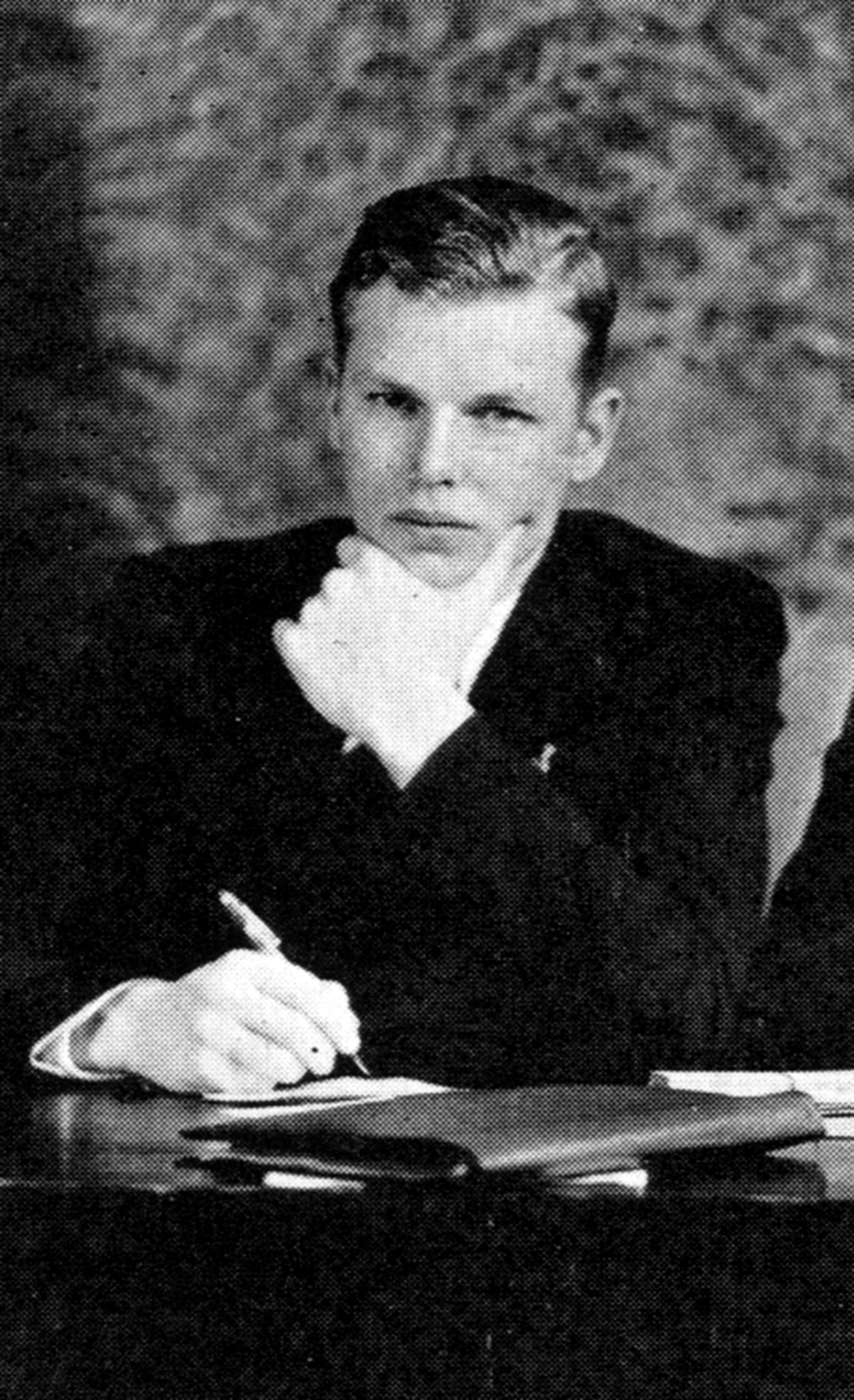
Edward Robel, Lewiston State Normal debate team, 1935. Lewis-Clark State College Archives.
The First World War II casualty from Lewiston, Idaho, did not die at Pearl Harbor, but in Spain.
In the spring of 1934, as the Great Depression deepened, student strikes were breaking out on campuses across the nation. Lewiston State Normal in Idaho was no exception. Students there formed a chapter of the Student League for Industrial Democracy (SLID) and elected Edwin Robel as its president and spokesman. Advocating an anti-war platform, the SLID pronounced as its goal the establishment of “a classless cooperative society in which men will have an equal opportunity to achieve the good things of life.” By the time Robel graduated, the SLID chapter was ready to merge with the National Student League, the Communist-led organization for college and high school students, to form the American Student Union (ASU), whose National Executive Committee would include George Watt and Paul MacEachron, who both volunteered for the International Brigades. So did Ed Robel.
Born in Kansas in March 1916 as the fifth of six children, Charles Edward Robel Jr. had moved to Lewiston with his family in 1923. One of his elementary school teachers, Miss Lillian McSorley, recalled that he was “the sort of a boy who would stand up for what he thought was right—a fine boy.” Entering Lewiston High School in the fall of 1930, he was drawn to debate and declamation as extracurricular activities, quickly networked with his new classmates, and consistently achieved “highest honors” status for his grades. The junior class selected him as their president for the upcoming 1931-1932 school term. The editors of the 1933 yearbook, Purple and Gold, unknowingly chose for him a prophetic senior motto from the writings of Roman orator Cato—“A young man who blushes is better than one who turns pale.”
High school graduation led Robel to Lewiston State Normal, where his notoriety on campus and in the community started, oddly enough, having nothing to do with debate. After playing no sports in high school, Robel turned out for the Pioneers football team. Coach George Greene was surprised by the 170-pounder’s performance in the frosh game of October 18. Calling Robel a “find,” Greene told a Lewiston Morning Tribune reporter that “I have a lot of faith in him. He’d fight a buzz saw and is plenty fast.”
After taking his degree at Lewiston State in 1935, Robel enrolled at Whitman College in Walla Walla, Washington, where he resumed his emphasis on debate for the next school year. The Depression left millions of college graduates without jobs. “I was disgusted with the daily job hunt and its fruitlessness,” he would tell his family. By early 1937, he was living in San Pedro, California, and still active with the ASU, now at the University of California in Los Angeles.
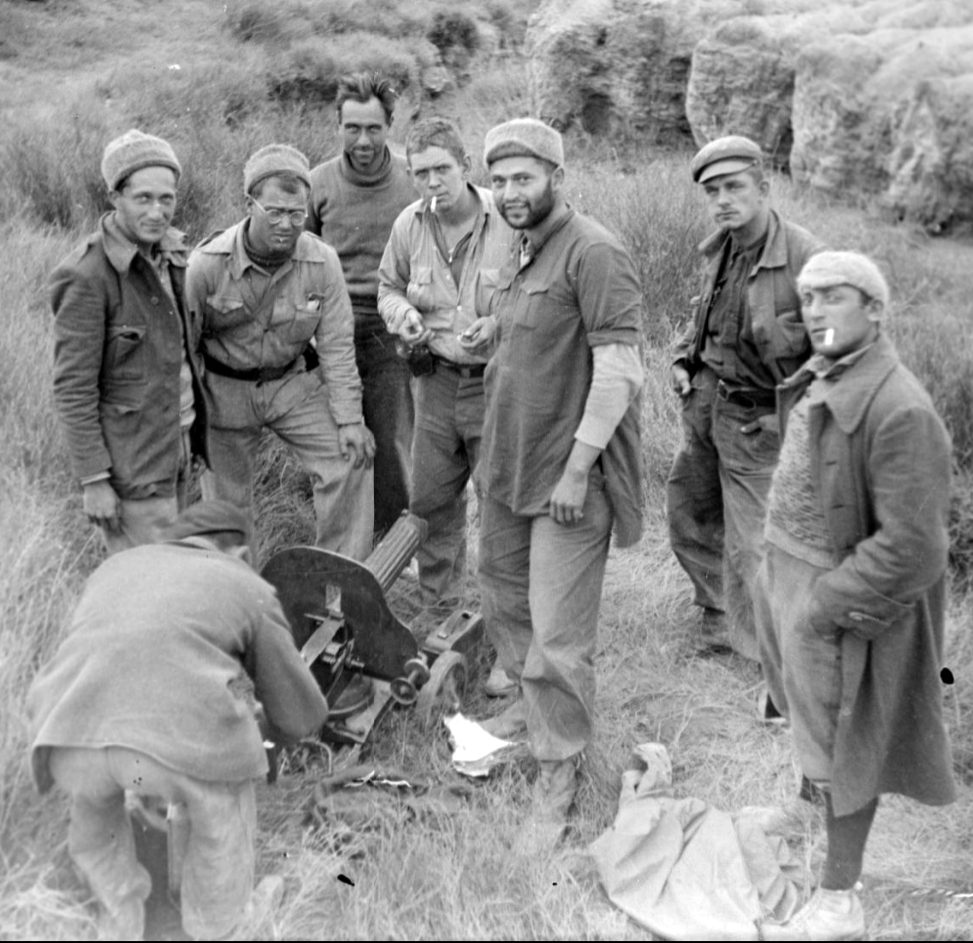
George Washington Battalion, machine gun crew, October 1937. Edward Robel is believed to be standing second from the right. Harry Randall Collection, Tamiment Library, Box: 2, Folder: 11-0699, Photo Unit #C009
After the Spanish Civil War broke out in July 1936, Robel wrote that the opportunity to fight fascism in Spain was “too good to be true.” On March 10, 1937, he received a passport and sailed for Spain on March 27 aboard the S. S. Paris. He misled his parents as to his new circumstances by having a friend in Southern California post his letters home. In one missive, he would explain to his father:
When I recalled that you and mother have actually been in tears over the thought of your boys having to go to war, I thought I would do less harm to both of you by simply keeping silent on the subject for a while.
Robel was one of 68 young men from the Pacific Northwest who would enlist with the XV International Brigade.
Upon finally learning of where his idealism had led her son, Robel’s mother began petitioning to have him returned home. She hounded Idaho’s U.S. Senator James Pinkney Pope for help. He would file a request for information through the State Department but could do little more, because, as he explained to the family, Ed “had entered the Spanish army of his own initiative and violated the neutrality laws of the United States.”
Though not without self-doubt, Robel had no intention of returning home. In one of his long letters to his family, he wrote:
This is not solely a struggle which concerns Spain. A victory for fascism in Spain would have dire consequences for the whole world. The fight is still not won. The world is still in danger. The whole point is that the job of stopping fascism has to be done here, irrespective of party or person. I consider myself no better than many who have fallen in this cause, for I know I have less talent than the majority here.
In another letter to his parents, he confessed to them: “All the way over, and even yet, I am arguing with my pacifist past and trying to convince myself I am in a war.”
In a war he was, indeed. His last letter to his parents arrived in early July. A month later, while reading the August 13 issue of the Oklahoma City socialist newspaper The American Guardian, they would learn that their son had been wounded in action. And on October 9 the feared news would finally arrive: Robel had been wounded in the stomach during an air attack on the road leading to the capital city and had died aboard an ambulance en route to a field hospital. He was buried in an unmarked grave alongside the road. He was 21.
The October 11 issue of the Lewiston Morning Tribune carried an editorial without byline:
You may not agree with the advanced economic and social views held by this young man from Lewiston. You may feel that his act was foolhardy, a daring and futile gesture of youth. You may hold these opinions, yet you also must admire and respect his unselfish devotion to an ideal which he was prepared to defend to the death. Edward Robel forgot himself in what he considered the common weal.
Five years after his death, on Armistice Day, 1942, the Lewiston Morning Tribune published a tribute to Robel, taking for granted the seamless continuity between the Spanish Civil War and the subsequent world war against fascism, calling young Edwin the “first casualty from Lewiston in World War II.”
Steven Branting, the institutional historian at Lewis-Clark State College in Lewiston, Idaho, is an award-winning author whose research has produced 10 books and more than 125 articles.






