
Book Review: Rafael Alberti’s Rome
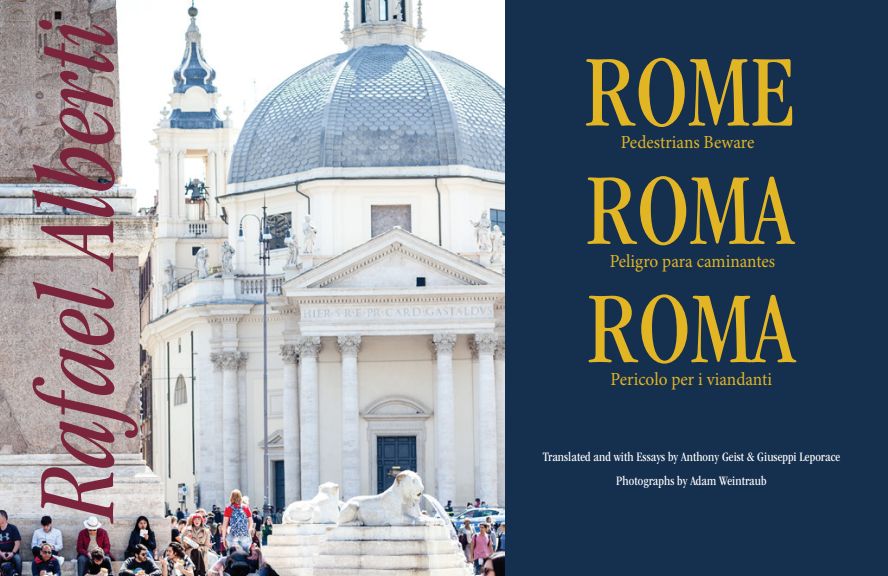 Rome: Pedestrians Beware, by Rafael Alberti, translated by Anthony Geist, with essays by Geist & Giuseppe Leporace and photographs by Adam Weintraub, Swan Isle Press, 2024, 200 pp., 101 color plates.
In 1968, as students were revolting in Berkeley, Paris, and Mexico, a 66-year-old Rafael Alberti wandered through the streets of Rome. Along with many of his poet peers. Alberti had gone into exile following the 1939 defeat of the Spanish Republic. While Jorge Guillén, Pedro Salinas, and Luis Cernuda ended up in North America, Alberti made his home in Argentina for close to 25 years. In 1963, when the political situation became increasingly difficult for an active member of the Spanish Communist Party, as Alberti was, he moved to Italy, where he lived until returning to Spain in 1977, two years after Franco’s death. He died at 96 in October 1999.
His Roma, peligro para caminantes is a lovely collection of poetic impressions of the city, in which feral cats share the stage with notable figures from Italian history and Roman mythology. Alberti’s work, like Picasso’s, went through several distinct stylistic phases. Just between the 1920s and the 1930s, for example, he transitioned from the surrealist-inflected avant-garde compositions to epic, combative war ballads. Roma, a remarkably diverse collection, puts the poet’s formal virtuosity on full display, from free verse to tightly composed sonnets in the style of—and dedicated to—Giuseppe Gioachino Belli.
Swan Isle’s stunningly beautiful edition includes Alberti’s original Spanish alongside translations into English and Italian by Anthony Geist and Giuseppe Leporace—who both contribute short, insightful essays, as well—along with some 100 thought-provoking images of Rome today by the Seattle-based photographer Adam L. Weintraub, who assumed the daunting challenge of translating Alberti’s poems into photographs five and a half decades later.
Sebastiaan Faber is a member of the ALBA board.






