
Book Review: Mike Wallace’s Gotham at War
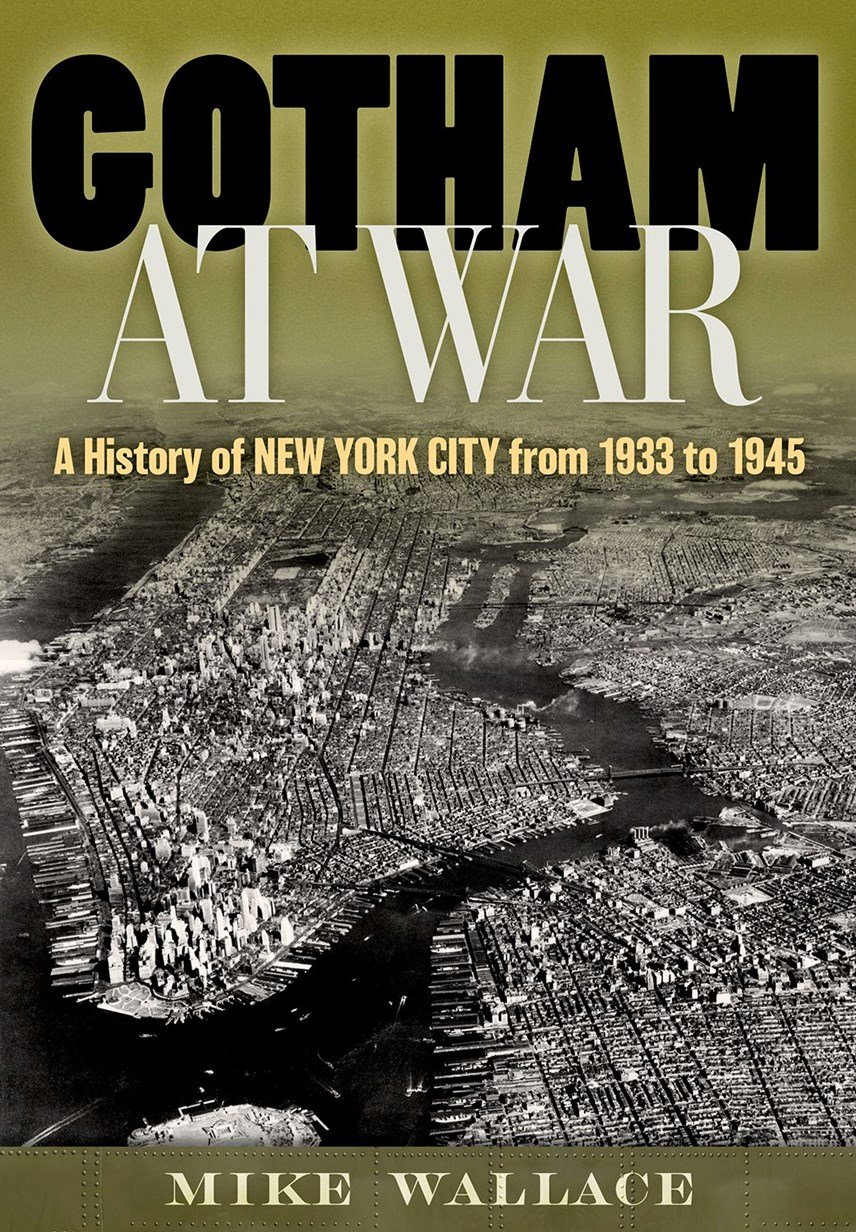 Gotham at War: A History of New York City from 1933 to 1945, by Mike Wallace. Oxford, 2025, 976 pp.
In the third and final volume of his awe-inspiring Gotham trilogy, Mike Wallace once more displays his extraordinary ability to synthesize political, cultural, labor, economic, and intellectual history. Many books in one, Gotham at War tells the story of Roosevelt-era New York City politics; New York ethnic communities; New Deal coalitions; labor movements and wartime economies; race relations and the rise of civil rights movements; the ascendance of liberalism and multiculturalism; the emergence of modern culture industries and new forms of popular culture; colossal midcentury gender role shifts; Wall Street slump and recovery; radicalism and the Left; a transforming urban infrastructure; the consolidation of American cultural authority and academic prestige; the rise of U.S. global dominance; and the new world order. Despite this vast range, Wallace’s brisk, vignette-like chapters unfold like an engrossing saga of the metropolis. While the story expands outwards—including to Rockefeller’s incursions into Latin America, Pearl Harbor, India, and Puerto Rico—it always remains anchored in New York and the people who make the city.
Beginning in 1933 with Jewish New Yorkers’ responses to the rise of fascism, Wallace also examines how fascism reshaped the identities and loyalties of the city’s many other racial and ethnic communities. The war between Ethiopia and Italy found its way into Bronx boxing rings as African American and Italian boxers traded blows. Japanese aggression in China sparked public demonstrations across Chinatown and instigated boycotts of Japanese silk stockings. The Catholic Church, a major political and social force with a vast network of social services, influenced Irish, Italian, Polish, Spanish, and Latin American communities, who collectively made up a quarter of the city’s population. Christian fears of godless Soviet Communism muted responses to German Nazism. The horrors of Jim Crow at home and of Jewish genocide abroad created new possibilities for U.S. Black and Jewish solidarity. The Spanish Civil War, the proverbial canary in the coal mine, became a rallying cause that cut across ethnic and religious divisions. As the conflicts in Europe intensified, new coalitions were forged. While antifascist left-wingers found common ground with elite Anglophiles and capitalists concerned about fascist threats to their finances, right-wing populists joined principled pacifists to advocate against U.S. intervention. No city group was left untouched.
Underlying these developments of ethnic relations and newfound coalitions was a profound shift in the understanding of race and racism. Wallace shows how biological notions of racial hierarchy, central to eugenics, nativism, and Nazi ideology, gave way to a new framework emphasizing cultural differences and relativism, largely driven by the anthropological work of Franz Boas at Columbia University. In the 1930s, New York City became the cradle of a distinctively American liberalism, wedded to a pluralist vision of democracy that stood in stark opposition to Nazi ideologies of racial supremacy. The Statue of Liberty, once primarily associated with republicanism, became a symbol of America’s multiethnic heritage.
At the same time, Wallace underscores the contradictions of this era. While the democratic rhetoric and aspirations of the war years, and the overlapping struggles against racism and fascism, helped lay the groundwork for the modern civil rights movement, for example, racial inequality remained deeply entrenched. Paul Robeson, celebrated nationwide for his performance of “Ballad for Americans,” was still barred from eating in a Midtown hotel dining room. Housing complexes like Stuyvesant Town were publicly subsidized even as they explicitly barred Black tenants. Japanese Americans were interned with minimal opposition, and non-citizens had to register as “aliens,” subject to deportation for “radical” beliefs. As early as 1940, hundreds of public college faculty and staff were subpoenaed and questioned about ties with the legal U.S. Communist Party, leading to “the largest political purge of college faculty in the history of the United States.” Among those fired was the first Black faculty member ever hired in a New York City college. The celebration of liberal cultural pluralism and the reality of discrimination and curtailed civil rights co-existed side by side.
Under these wartime pressures, New York’s economy was transformed, and the city emerged as a newly ascendant global cultural capital. As a major port city, New York faced the very real threat of attack, a story Wallace tells with the suspense of a thriller. Maritime defenses expanded dramatically, and the city, as the largest manufacturing center in the nation, went into high gear for wartime production and maritime transportation. Wall Street rallied. Women entered industrial labor in the mold of “Rosie the Riveter” and radically altered gender dynamics and household economies. The economic development unfolded alongside seismic cultural changes. New York City became the primary beneficiary of an unprecedented transfer of intellectual and cultural capital as Jewish refugee scholars, artists, and intellectuals arrived in large numbers, fleeing persecution and the devastation of the war. Universities collaborated more closely with industry and government research. Technological industries expanded. Radio and broadcasting transformed political communication and popular culture, and new forms of entertainment—from comic books to Latin jazz and bebop—flourished. Frank Sinatra, Dr. Seuss, Captain America, and the musical “Oklahoma!” all find their way into Wallace’s eclectic tale of New York’s emergence as a cultural center of the world.
His account also reminds us of alternate futures that were not to come. Debates raged over the continuation of New Deal governmental policies versus free market-driven economics. The repression of radicalism revealed the limits of U.S. liberalism. The horrors of the Holocaust, as they became known, precipitated a drastic political shift as U.S. Jews who had long and largely been opposed or indifferent to Zionism turned, within a few years, toward near-universal support, merging Jewish identity and Zionism in ways that make it now politically fraught to parse.
Although Wallace’s account ends in 1945, the book feels urgent and timely, and not only because New York has just elected a Democratic Socialist mayor who models himself after Fiorello LaGuardia. Social inequities and racial segregation continue to shape the city; its most prestigious college campuses are now gated and accessible only through policed checkpoints; academic freedom is under attack; antisemitism is on the rise; the question of Palestine looms large; and a New-York-born president with unchecked dictatorial tendencies embraces an America First rhetoric even as he embroils the nation in overseas wars that threaten the postwar global liberal order. Will effective coalitions emerge once again in Gotham and elsewhere to keep lit the lamp of liberty? Readers may well feel that the coda to Gotham at War is being written in our midst.
Cristina Pérez Jiménez is an associate professor in the English, World Languages and Literatures Department at Manhattan University. Her newest book Here to Stay: The Making of Latinx New York is forthcoming with Duke University Press.






