
Book Review: Masculinity & the Military in Spain & Chile
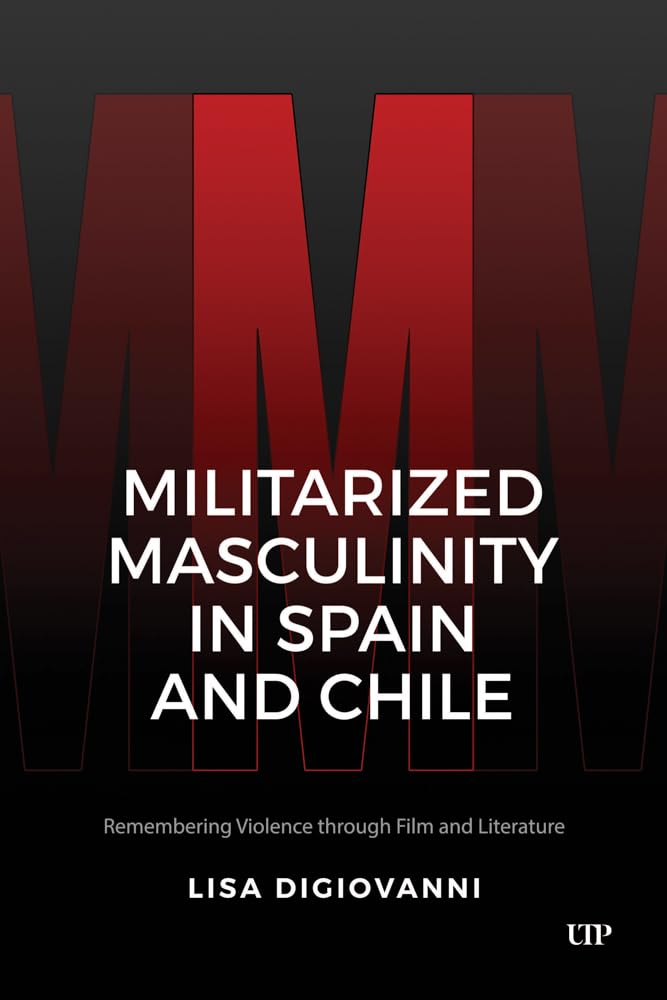
Militarized Masculinity in Spain and Chile: Remembering Violence through Film and Literature, by Lisa DiGiovanni, Toronto, 2025, 301 + xiii pp.
If there were any lingering doubts about the strong link between militarism and a particular idea of masculinity, a single press conference from the current US Secretary of Defense—who has been less hesitant to declare war on DEI and “gender ideology” than on Iran—will be enough to dispel them. These days, it seems, even adhering to international law and the Geneva Conventions makes one a sissy.
But the mutually reinforcing feedback loops between militarized violence and rigid conceptions of gender go much farther back than the Right’s current obsession with “wokism.” As Lisa DiGiovanni shows in her engrossing study of the Franco and Pinochet dictatorships, both regimes were obsessed with affirming a narrow conception of what it means to be a man (and what it means to be a woman). More importantly, that obsession directly shaped their language, their policies, their ideology, their portrayal of the “enemy,” and their repressive tactics, from the criminal code to torture techniques. It’s no coincidence, DiGiovanni writes, that in repressive, militarized regimes, the “infliction of severe physical and psychological suffering,” used as a form of social control, is often “intentionally tied to gender identity, sexual humiliation, and the destruction of reproductive organs.”
Although Francoism and Pinochetism only overlapped by two years (1973-75), DiGiovanni reminds us there were deep ideological links between them, especially when it came to notions of gender. To make this point, DiGiovanni resorts to a rich trove of novels, comics, feature films, and documentaries from both countries, ranging from the 1980s to 2022. Indeed, one of DiGiovanni’s central contentions is that film and literature, as complex, multivoiced representations of the world, allow us to “connect the dots between masculinity, militarism, and violence” and, with it, “comprehend the causes and consequences of dictatorial brutality.” Among the novelists studied are Nora Fernández, Antonio Muñoz Molina, and Roberto Bolaño; the filmmakers include Patricio Guzmán, Pilar Miró, Agustí Villaronga, and Lisette Orozco.
The value of DiGiovanni’s comparative approach not only lies in the ways that it illuminates dimensions of the most recent Spanish and Chilean experiences with military dictatorship. Her book also allows and encourages us to see the centrality of ideas about gender in other repressive regimes. This also means that overcoming the painful legacies of those regimes requires attention to gender. “To achieve meaningful social reconstruction and coexistence,” DiGiovanni writes about the current situation in Colombia, for example, it is not enough to teach former combatants about human rights. It’s just as important to “prioritize gender-sensitive re-education”: “Learning new forms of communication, rethinking stereotypes, and gaining depth of self-awareness are part of the equation”—in society at large, but also, especially, in the military itself. The aggressive resistance to precisely those kinds of programs in the current US administration and other far-right governments around the world, and their active attempts to censor books and films that lay bare the links between militarized violence and rigid conceptions of gender identity, are a testimony to the transformative power of those programs, books, and films.






