
New Podcast Episode: Family Secrets
A new episode of the podcast “Family Secrets of the Spanish Civil War” is now available. In the podcast, which premiered in October 2024, historians Patricia Schechter and Dan Czitrom discuss the impact of the Spanish war on their and others’ families. This episode features the children of Anna and Alvin Warren.
Below is a teaser. The episode can be accessed through YouTube, Spotify, Apple, and other providers.
Teaser:
Patricia: Welcome to the podcast, Family Secrets of the Spanish Civil War. I’m Patricia Schechter, coming to you from Portland, Oregon. My guests today are Fred, Constancia, and David Warren, siblings raised by Alvin and Anna Warren. They come from a family with very strong and interesting ties to left, labor and anti-fascist politics, including the Spanish Civil War. Thank you all for coming on the show today. Why don’t we go around and have each of you just introduce yourself and say a few words about you and your names…
Fred: My name is Frederick Douglass Warren. I’m here today at my home in Bellevue, Kentucky, on the south side of the Ohio River, across from Cincinnati. I’m retired from working in the printing industry. I’m named after the prominent abolitionist and formerly enslaved man, Frederick Douglass. A few summers ago, when I was leading a tour at the Harriet Beecher Stowe house in Cincinnati, I got to meet a great, great, great-some descendant of Frederick Douglass. He was really interested to learn my name and meet me, being named after his ancestor.
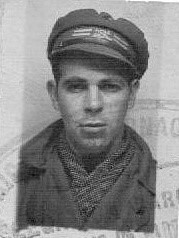
Alvin Warren (passport photograph).
Connie: I’m Constancia Warren. My parents were expecting to name their first child after Frederick Douglass. What they weren’t expecting and didn’t know until the last minute was that they were going to have twins. So, Fred got Frederick Douglass and my parents decided to give me a name that recalled the Spanish Civil War. The initial idea was Dolores for Dolores Ibárruri, La Pasionaria. But my mother looked up Dolores and she knew what it meant. It meant sorrow; dolores means pain in Spanish. And so they named me after Constancia de la Mora, who was a woman who came from a very well to do Spanish family, very close to the crown. During the Spanish Civil War, sge broke with her family and with her class [to support the Republic]. I believe she ran the foreign press office in Barcelona and wrote a wonderful memoir called In Place of Splendor.
My mother’s father, upon hearing the names of these two children, said: “You know, there were biblical heroes too!” And that’s how we got David [for King David].
David: Well, that tells the story of my name, which Connie just gave, which I only had gotten from hearsay. I am David Warren and I’m in Atlanta, Georgia. I’m a chef, and that’s what I do every day.
Connie: I neglected to say that I’m in Croton on Hudson, which is 35 miles north of New York City. Croton is an interesting village that has both an artistic and a left-wing history right and is not too far from where we grew up in Montrose.
Patricia: And Croton is not too far from where I grew up in Peekskill, New York, which is part of the fun of making the connection with you all.
Your father, Alvin Warren was born Alvin Cohen in 1913 in Brooklyn, New York into a Jewish immigrant family. He was drawn to labor and working-class politics from his youth, he attended a number of labor colleges. As a young man, he worked as a CIO organizer in lower Westchester County. There is an important family story about the name change from Cohen to Warren.
Connie: The name change comes from Alvin’s older brother Norman, from whom also he got some of his politics. Norman first introduced Alvin to left-wing politics and he had a consciousness further raised by his experiences riding the rails and hanging around with young people who might otherwise be described as ne’er do wells.
Norman’s wife Rose was an early woman executive in the textile industry. During the Great Depression, the employment agency which she was using sent her out on a job interview. When Rose got there, she was told there was no job. When she came back and told the agency, they said: “Yeah, well, there was a job, but you have the wrong last name.” They weren’t hiring Jews during the Depression.
Norman and Rose were the ones who initiated the name change to Warren. Daddy went along with it, and so did both of his sisters who then married and changed their names to their husband’s names.That whole generation did, in fact, change the name to Warren.
Patricia: I’ll just share back that my Italian relatives, my father’s mother’s people, came from Italy around the turn of the 20th century. Their last name is Scardaccione, from Southern Italy, and their name change really divided their family. My grandmother was the next to youngest of six, and her older brothers, who had great aspirations to be doctors and engineers and such, felt the name Scardaccione was too ethnic and they changed it to Stewart. It was New York City and they went “Dutch” so to speak! But it divided the family. When the when the patriarch and matriarch, Eduardo and Zita Rosa, passed away, my grandmother took on her older brothers to make sure that the family mausoleum on Staten Island was inscribed with the name Scardaccione.
I share my story only to underscore how the Warren family name change story is impressive for its sense of solidarity and sense of shared purpose.
Fred: It extends beyond just our immediate family, because my mother’s sister married a man who went to Spain and fought in the Spanish Civil War with the Abraham Lincoln brigade. And my father’s sister married similarly. So, in addition to our father, we had two uncles, one on each side of our family, who also fought in Spain, Maury Colow and Arthur Munday.
David: Maybe I should know this, but Connie where does your middle name “Joan” come from?
Connie: It’s actually a funny story. The story that I was told was that they had the name Constancia but they didn’t have a candidate for a middle name. They thought that since Fred had a middle name, “Douglass,” that I would feel left out if I didn’t have a middle name. Joan was, according to my memory, the labor room nurse! They put it down in order to put something down! It had no meaning and about 60 years ago, I dropped it legally.
Patricia: Thereby confusing researchers in the future! Just kidding! Actually, that’s a lovely story, too.






