
ARKIVO: The World of Strings (China)
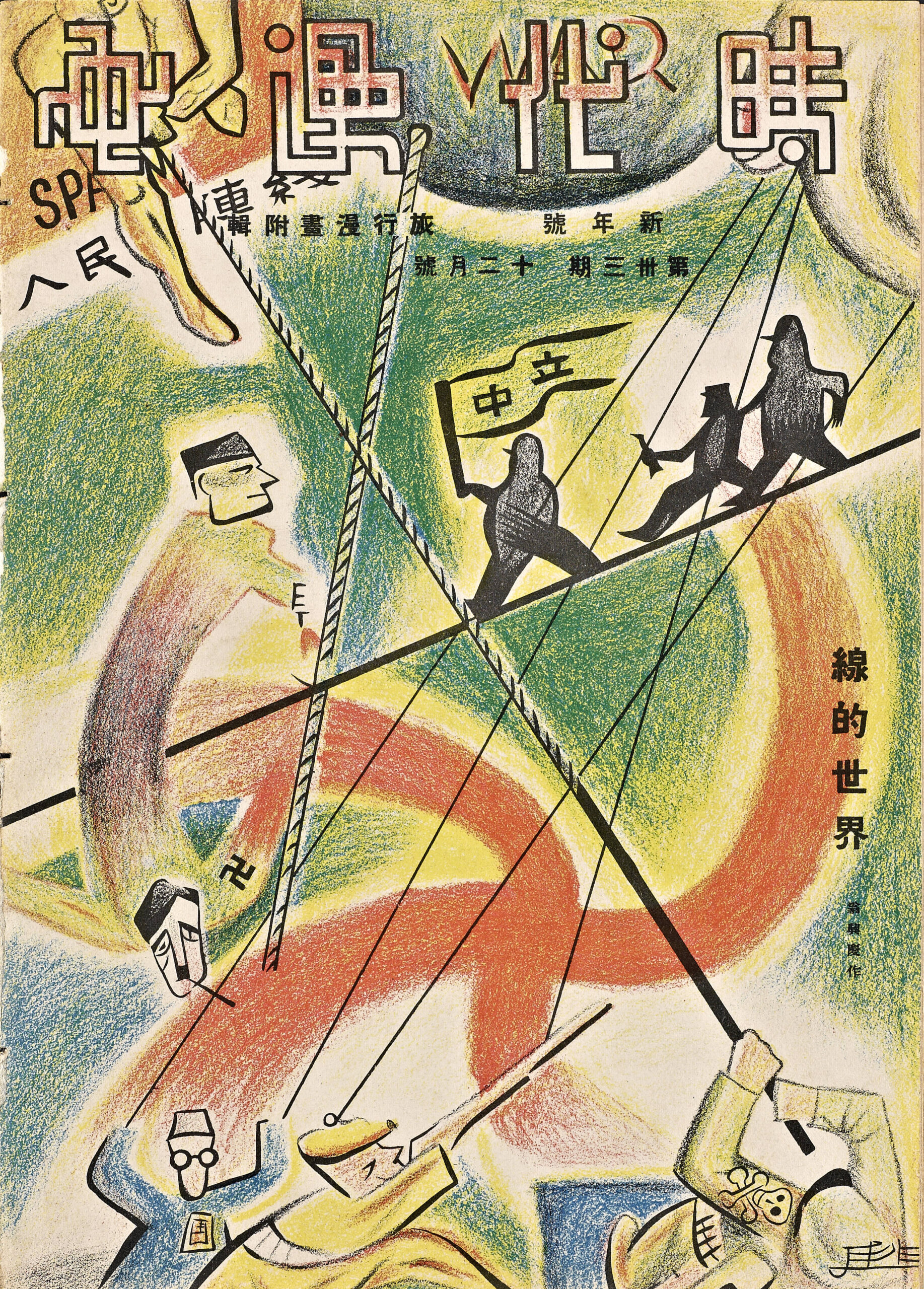
Weng Xingqing 翁興慶, “The World of Strings 線的世界”, Shidai Manhua 時代漫畫 no. 33 (December 1936), back cover.
In this occasional feature of The Volunteer, whose title is the Esperanto word for “archive,” we present, translate, and contextualize iconic foreign language documents related to the anti-fascist struggle in Spain. If you have a favorite document in a language other than English, let us know!
China, like most of the world, was entangled in multiple local and global crises when this image was published in December 1936, on the back cover of a Shanghai-based magazine titled Shidai Manhua 時代漫畫, or Modern Sketch. Although power in China was formally held by the Nationalist Party (Kuomintang, Guomindang, 國民黨,) headed by Chiang Kai-shek 蔣介石 (1887–1975), the Communist party (Gongchandang, 共產黨) vied for the minds and hearts of people—as well as for territories to control and taxes to collect. Other political parties and factions existed beside and within the Kuomintang and the Communist Party. In December 1936, as the Japanese threatened to invade, Chiang Kai-shek was kidnapped in the old capital city, Xi’an, to be forced into cooperation with the Communists. Numerous local rulers, former warlords, accepted the rule of Kuomintang to varying degrees, while parts of the former Qing empire aspired to independence. Cities like Shanghai were cosmopolitan, with a notable foreign presence and rich international culture, but alongside luxury and affluence there was widespread poverty and hunger. Electricity, telegraph, and automobiles coexisted with coolie labor in ports and ancient agricultural practices in the countryside. Although daily life was relatively peaceful, the news brought tidings of wars and strife from across the globe—including China’s own northeast, Manchuria, which in 1931 had been turned into a Japanese puppet state, Manchukuo, formally ruled by Puyi 溥儀 (1906–1967), the child-emperor of Qing empire (1644–1912). China would plunge into its own massive tragic war soon after the publication of the image reproduced here: July 1937 saw the outbreak of the Second Sino-Japanese War, the opening salvo of what would be World War II, ending only in September 1945.
December 1936, in other words, was not an easy, light-hearted time for China. Yet Shanghai found a space for various forms of entertainment serving different tastes and incomes. Shidai Manhua aimed to appeal to middle-class, educated urbanites. Although it wasn’t left leaning or not overtly political at its start, the magazine grew increasingly engaged in the public debates over domestic politics and the international situation. Its contributors wrote about the Italo-Ethiopian war; Japanese encroachment in China’s northeast and Nationalist government’s non-resistance policy; the rise of fascism in Europe and the worldwide spread of communism; the clash between those two ideologies; the passivity and neutrality of the League of Nations; and, of course, the Spanish Civil War.
This stunningly colorful and dynamic drawing, “The world of strings” (Xian de shijie 線的世界), was made by Weng Xingqing 翁興慶. The first image to strike the viewer is the red swastika-like twirl in the lower half of the composition. The black “strings” crisscrossing the surface also jump out, especially the thick black diagonal line that divides the drawing into halves and on which three human silhouettes march to the lower left. The first of them carries a flag with characters “zhongli 中立” (neutrality); the second one seems to carry something in his hand—possibly a dove of peace. The path of this faceless group is obstructed by two intersecting ropes, one going from top left to bottom right, from a human figure in a red bubble with caption “SPA[IN]” and “Renmin zhanxian 人民戰綫”, Popular Front, to another human figure with a skull and crossed bones emblem on his shoulder, placed on a blue rectangle. Yet another rope stretches from a blue bubble in the upper central part of the composition, inscribed “WAR”, to one of the red lines in the swastika.
Even if the “neutrality” procession manages to pass through those ropes on their finely balanced march, they still need to face the rotating figures of Hitler (recognizable by moustache, hairstyle, and a black swastika on his shoulder) and Mussolini (depicted with a familiar heavy chin and hat). Thinner strings connect a nondescript bubble in the upper right corner to two smaller figures in the bottom left and center: one, wearing glasses and a blue robe, is almost certainly Puyi, while the other appears to be just a soldier without individualized traits. Both are puppets controlled by the strings. What does this drawing show?
War looms large, fascism is on the march, battles erupt between irreconcilable enemies, and the peace faction attempts an almost impossible balancing act of maintaining neutrality amidst the whirlwind of world conflicts. The Spanish Civil War is prominent in the composition, not only in the significantly positioned figures in the upper left and lower right corners, but also in the clearly visible inscriptions in two languages. These would most likely be familiar to the readers of Shidai Manhua, given that the war and Popular Front were recurring subjects in Shanghai’s and other Chinese newspapers. The passive stance of the League of Nations regarding Japan’s invasion of Manchuria in 1931, the inaction of Western powers in Mussolini’s war against Abyssinia, and the insufficient help Republican forces received from the USSR and Western countries compared to Hitler’s support for Franco were perceived and depicted by Chinese manhua artists as interrelated tragic trends leading to the impending larger war. The neutrality of the Western powers and the inadequate diplomatic support for the victims of aggression such as China (in the eyes of its press) and for the defenders of the righteous cause such as the Republican fighters in Spain thus tied into a tightly woven narrative of impending doom for the whole planet, visualized in Chinese cartoons (manhua).
Image: Weng Xingqing 翁興慶, “The World of Strings 線的世界”, Shidai Manhua 時代漫畫 no. 33 (December 1936), back cover.






