
Strong Submissions: ALBA Awards Six Watt Essay Prizes in Three Categories
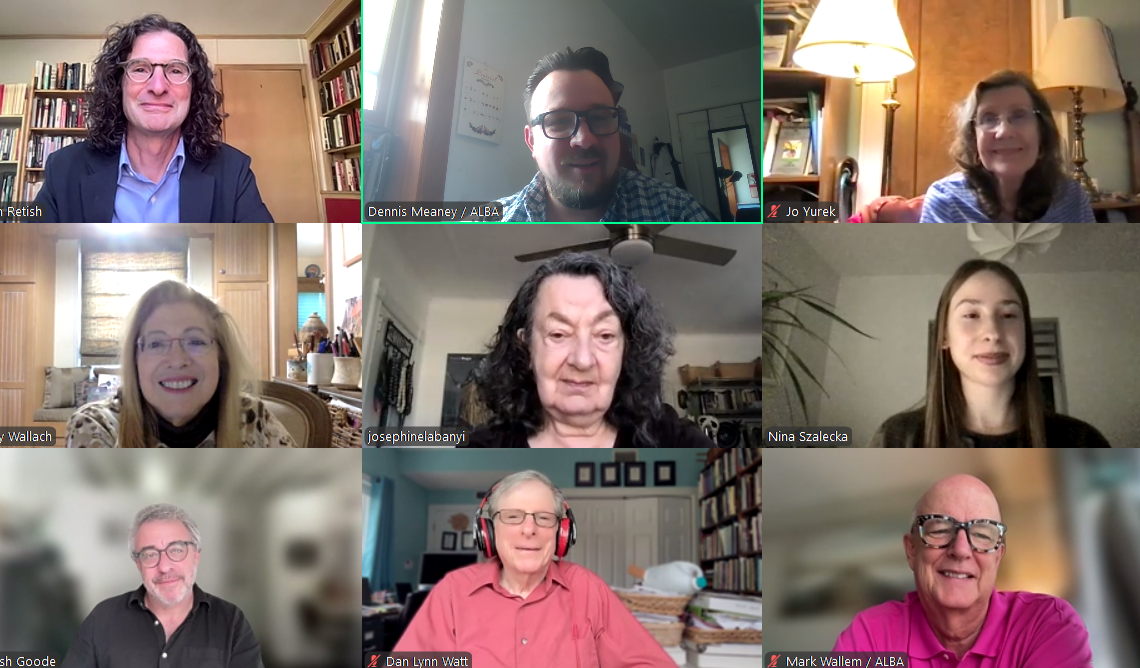
The Watt Jury with Nina Szalecka.
In another year of strong submissions from students across the United States and Europe, the jury of the Watt Essay prize was pleased to award prizes to six promising scholars.
This year, ALBA awards three students in the pre-collegiate category. Madison Vinsant penned a set of poems, “Letters Across the Trenches,” that one of the jurors called beautiful and profound. The collection imagines an exchange between a soldier and a nurse in the international brigade as they experience their first battles of the Spanish Civil War. Emilia Rodríguez created a moving diary of a young antifascist Basque woman living in the coastal town of Hondarribia. Writing in 1945, she looks back on the past nine years of her life, including the destruction of her town, starvation, the repression of Basque culture, and the lost hope that the Allied victory in Europe would bring freedom in Spain. Jahsean Meikle’s compelling essay “Racial Integration and Equality in the Lincoln Battalion,” finally, draws on memoirs and the Abraham Lincoln Brigade Archives to explore the lasting significance of racial integration in the United States after the Spanish Civil War.
In the fall, the jury had the opportunity to meet with the three young scholars who won this year’s Watt award in the undergraduate and graduate categories. Hridoy Kundu of the University of North Carolina-Chapel Hill discussed his essay on pirate radios and underground newspapers, a creative and well-researched piece that prompts us to reconsider the broadcast revolution of the 1930s. Nina Szalecka from the University of Leeds presented her work on Sylvia Pankhurst’s overlooked activism on the Spanish Civil War through her writings in contemporary newspapers like The New Times and Ethiopia News. Deeply researched and well-argued, her essay invites fellow scholars to rethink the life of Sylvia Pankhurst. (Leeds, the jury couldn’t help notice, has produced award-winning students for three of the last four years!)
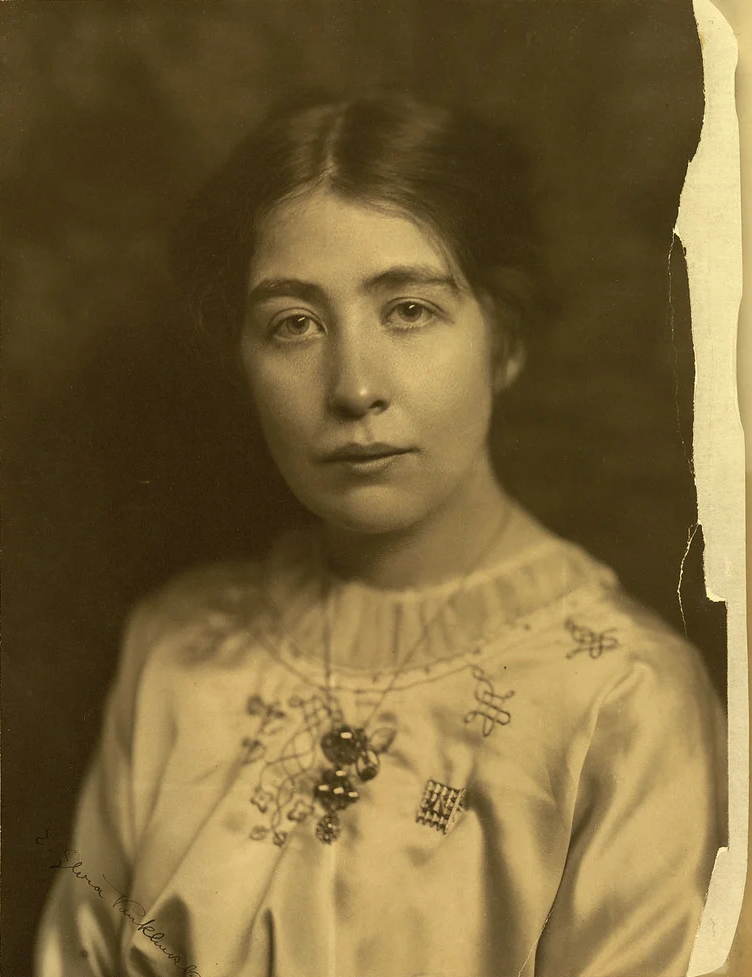
Sylvia Pankhurst in 1911. Public domain.
Our graduate award went to Luke Michael Bowe for “Tarna: The (Re)Construction of a Contested Space,” an excerpt from the first chapter of the dissertation that he recently completed at New York University. In this interdisciplinary study, Bowe draws on archival records as well as film and literature to examine the impact of the Franco regime in the region in Asturias in northwestern Spain. The chapter that he submitted for the award focuses on the village of Tarna, which was nearly destroyed in fall 1937, and which, after the war, Franco adopted and promised to reconstruct. Although the Franco regime tried to reconstruct the village into a Francoist social space, Bowe shows that its fitful efforts fell into a bureaucratic mess. The Francoist state never fully remade the village. Bowe’s crisp writing not only draws the reader into the cultural life of the village but also makes an important scholarly contribution to how social space was imagined and re-imagined in Francoist Spain.
The Watt award honors the memory of Abraham Lincoln Brigade veteran George Watt (1914-1994), a social worker, writer, and lifelong activist central to the creation of ALBA. The jury for the 2025 George Watt Memorial Essay was comprised of Angela Giral (Columbia University), Joshua Goode (Claremont Graduate University), Jo Labanyi (New York University), Aaron Retish (Wayne State University), Josephine Yurek (New York City Public Schools), Nancy Wallach (New York City Public Schools), and our newest member—Daniel Watt, George’s son.
Aaron Retish, the chair of ALBA’s Board of Governors, teaches at Wayne State University.






