
Letter to the Editor of the NY Times
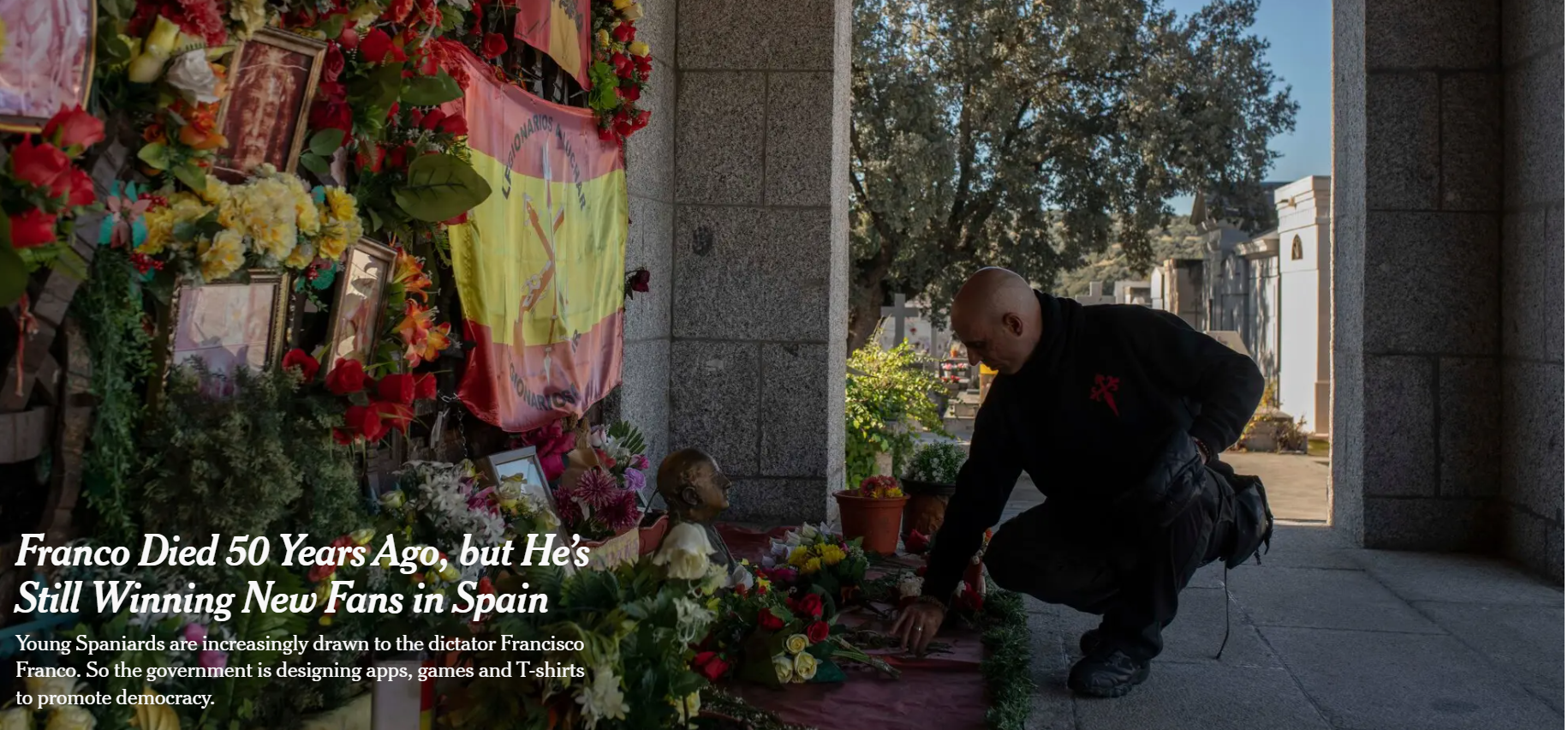 On the fiftieth anniversary of Franco’s death, the New York Times published an article by Jason Horowitz about the “nostalgia” for Francisco Franco being expressed by a growing number of younger Spaniards, most of whom have no direct experience of the dictator. As is common these days in the Times’ coverage of any number of issues, the article normalized this idealization of dictatorship and fascism, making it seem like one legitimate stance among others. Emilio Silva Barrera and James Fernández sent a letter to the Editors, which was not printed.
To the Editors:
Just like the misguided Spaniards featured in his article—those who today feel nostalgia for Franco—Jason Horowitz seems to fall victim to the Generalissimo’s most impressive sleight of hand: accepting at face value the dictator’s own revisionist version of himself and of Spanish history.
Horowitz outrageously calls the defenders of the Second Republic “Communist-backed forces,” an expression that makes about as much sense as referring to General Eisenhower’s forces in Europe as “communist-backed” because of their alliance and coordination with the USSR.
Horowitz refers to Franco “pleasing his supporters by improving infrastructure and the economy” without mentioning that much of that infrastructure had been bombed to smithereens by the combined Air Forces of Franco, Hitler, and Mussolini, and that many of the improvements were carried out with prison labor. Nor does Horowitz point out that the Spanish economy actually enjoyed little improvement until the 1950s, when Franco was forced to abandon his disastrous autarchic plans and to refashion himself as a Cold Warrior in an attempt to curry favor with the US.
In the end, Horowitz’s article exemplifies Franco’s ultimate success, in that it—like contemporary Spain—gives so much play and so much voice to positions that would be considered beyond the pale in other countries that also endured “efficient” dictatorships, where, in the good old days, the trains ran on time and the camps were models of stream-lined management.
Emilio Silva, Journalist, Co-founder of the Asociación para la Recuperación de la Memoria Histórica
James D. Fernández, Professor of Spanish Literature, New York University






